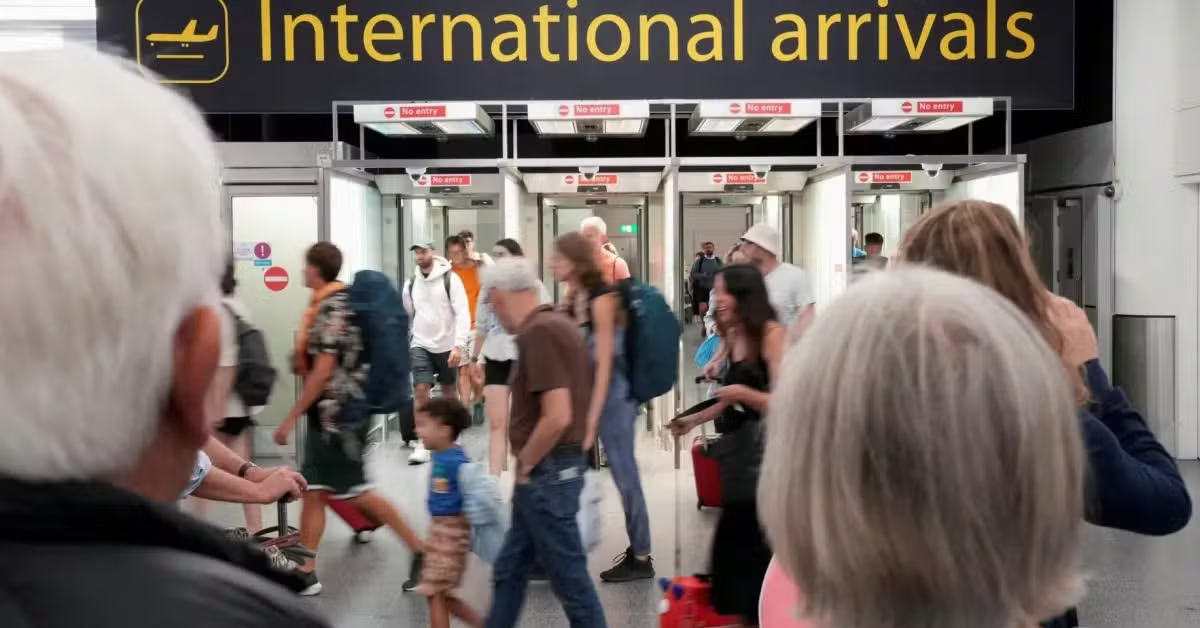
UK net migration falls to 77,000, lowest level since 1997 excluding pandemic
How UK migration figures compare to France, Spain and the rest of Europe
inews.co.uk· 6h
UK net migration falls to lowest level in 30 years
channel4.com· 23h
UK net migration at lowest level since 1997 as asylum claims also fall
bbc.com· 31h
Royaume-Uni: l'immigration légale nette au plus bas depuis 1997, hors période du Covid-19
rfi.fr· 32h
Royaume-Uni : l’immigration nette enregistre sa plus forte baisse depuis 1997, hors période du Covid-19
lemonde.fr· 32h
Net Migration to U.K. Falls to Lowest Level Since 1997, Excluding Pandemic
nytimes.com· 33h
Net migration to UK falls to lowest level since 1997 excluding pandemic
theguardian.com· 34h
Net migration falls to lowest level in 30 years
thetimes.com· 34h
Net migration drops by more than 90% since Suella Braverman was Home Secretary
mirror.co.uk· 34h
UK net migration more than halves to 77,000
ft.com· 35h
UK net migration falls to almost three-decade low, excluding pandemic slump
reuters.com· 35h
UK net migration fell to 77,000 in the year to the end of June 2026, down from 204,000 a year earlier and the lowest since 1997 excluding the pandemic, official figures published on 26 November 2026 show. The Office for National Statistics says the fall was driven mainly by a drop in long-term migration from people born outside the EU, reflecting tighter rules for workers, students and asylum seekers.
Net migration has fallen about 90% since its peak of 944,000 in 2022-23 under the Conservatives, and the 77,000 figure is the first time it has been in the tens of thousands since David Cameron's pledge to reach that level 16 years earlier. In 1997, the previous low, annual net migration was 48,000.
The biggest factors in the fall were drops of 45,000 in people coming to work, 33,000 in students arriving from outside Europe and 19,000 in asylum claims. Home Office visa data shows grants to international students fell by 38%, or 39,200, between January and June 2026 compared with the same period in 2025.
Asylum claims also fell, with 73,000 people arriving seeking asylum in the year to June, down from 93,000 the previous year. The Home Office said the asylum backlog, down 49% to 41,000 as of September, fell due to faster decisions and a drop in new claimants arriving via illegal entry routes, largely small boats across the English Channel. Fifty-two hotels used for asylum seekers have been emptied, with the hotel population down 64% to 13,000.
The figures cover only legal immigration and exclude irregular arrivals.
Official figures published on 26 November 2026 put UK net migration at 77,000 in the year to the end of June 2026, down from 204,000 a year earlier and the lowest since 1997 excluding the pandemic.
The Office for National Statistics says the fall was driven mainly by a drop in long-term migration from people born outside the EU, reflecting tighter rules for workers, students and asylum seekers.
Net migration has fallen about 90% since its peak of nearly a million people in 2023, according to Office for National Statistics data.
Some 73,000 people claimed asylum in Britain in the year to June 2026, down more than a fifth on the previous year but above levels seen between 2004 and 2021.
Interior minister Shabana Mahmood said the government has regained control of the immigration system but that further changes are needed, saying, 'We won't stop here.'
Shabana Mahmood said, 'Our reforms are restoring control and building a fairer immigration system that rewards contribution.'
Reform UK said the figures are 'no cause for celebration', arguing that years of high migration have strained public services and housing.
British Future director Sunder Katwala said the drop would surprise much of the public, many of whom still believed immigration was rising.
Sunder Katwala said, 'The government needs to ask what a sustainable level of immigration is, and how will they achieve it.'
Net migration peaked at 944,000 in 2022-23 under the Conservatives, when Suella Braverman was Home Secretary, before falling to 204,000 in the year to June 2025.
Immigration from outside the EU fell by more than 100,000 in the year to June 2026 while emigration remained stable.
Some 661,000 people left the UK to live abroad in the year to June 2026, of whom 292,000 were non-EU+ nationals and 124,000 were from the EU.
Home Office data shows 230,000 work visas, including dependants, were issued in the year to September 2026, down 63% from 2023.
Home Secretary Shabana Mahmood said the government has 'restored control' of the borders and has brought net migration down 92% from its peak by raising skills and salary thresholds.
Shabana Mahmood said the Conservatives lost control of the borders, letting net migration reach close to a million a year after promising to cut it to the tens of thousands.
Shabana Mahmood said her government is bearing down on illegal migration, with small boat crossings down, asylum hotels closing and removals under way, though more remains to be done.
Liberal Democrat spokesman Paul Kohler said Britain needs to regain control of its immigration system after the chaos of Brexit.
Paul Kohler said that sixteen years after David Cameron's 'tens of thousands' pledge, six prime ministers and ten home secretaries have overseen wild swings in numbers, with net migration now set to fall below zero.
The 77,000 figure for the year to June 2026 is down from a previous estimate of 171,000 for 2025.
Annual UK net migration in 1997, the previous low, was 48,000.
Home Office visa data from January to June 2026 shows grants to international students fell by 38%, or 39,200, compared with the same period in 2025.
Grants to skilled workers, including health and care staff and their dependants, fell by 38%, or 26,300, over the same period.
The Office for National Statistics figures show 738,000 people settled in the UK and 661,000 left between July 2025 and June 2026.
People from India, China and Nigeria topped arrivals to the UK over the year to June 2026.
European nationals left a negative balance of 45,000 over the year, continuing the pattern of more EU citizens leaving than arriving since Brexit.
Reform UK leader Zia Yusuf said the figures are no source of satisfaction and that the only way to improve Britons' quality of life is to send back everyone who entered the country illegally.
The published figures cover only legal immigration and exclude irregular arrivals.
Shabana Mahmood said on social media, 'This didn't happen by accident. It happened because this government took action.'
The 77,000 figure is the first time net migration has been in the tens of thousands since David Cameron's pledge to reach that level 16 years earlier.
The biggest factors in the fall were drops of 45,000 in people coming to work, 19,000 in asylum claims and 33,000 in students arriving from outside Europe.
Some 73,000 people arrived seeking asylum in the year to June, down from 93,000 the previous year.
The number of people waiting for an asylum decision stood at 41,000 as of September, down 49% on the year.
The Home Office said the asylum backlog fell due to faster decisions and a drop in new claimants arriving via illegal entry routes, largely small boats across the English Channel.
The Home Office was accommodating 93,000 people in September, down 16% on the year.
Fifty-two hotels used for asylum seekers have been emptied, while about 140 remain in use, with the hotel population down 64% to 13,000.
Home Secretary Shabana Mahmood said the figures showed Labour had 'delivered' where the Conservatives failed.
Shadow home secretary Chris Philp said the falls were the result of restrictions introduced by the Conservatives before the 2024 general election.
Chris Philp called for an 'annual legally binding inward migration cap, set by Parliament, at far lower levels'.
Dr Ben Brindle of Oxford University's Migration Observatory said the UK is entering an unusual period where immigration has come down and may fall further, while emigration stays relatively high.
Dr Ben Brindle said high emigration of non-citizens could push net migration down further next year but the dip is unlikely to last forever.
Zia Yusuf said, 'This population explosion is why British people struggle to get a GP appointment, can't get housing and our prisons are overwhelmed.'
Paul Kohler said, 'Britain faces serious demographic and economic challenges, and urgently needs a proper immigration plan to support our economy and public services.'
A Green Party spokesperson said, 'Creating a harsh environment for migrants and people seeking asylum is not a measure of success.'

