
Peptide backers push domestic manufacturing with party aboard WWII Liberty ship
Summary
- A trio of Gen Z venture capitalists threw a black-tie peptide party aboard the SS Jeremiah O'Brien, a World War II Liberty ship, with about 150 guests.
- Guests received four peptide samples: a topical cream with GHK-Cu, a popular skincare ingredient, and three dissolvable sublingual strips from peptide startup Afterglow; no injections were given.
- The venue was a deliberate reference to American industrial prowess and to why the pharmaceutical supply chain should be centered in the United States.
- The US Department of Health and Human Services has issued an interim policy allowing certain unapproved peptides for compounding.
- FDA career scientists have not endorsed the interim policy, though it may seem to the average person that they have.
- It is unclear how well sublingual peptide strips work.
Reactions
- Victoria Song, author of the Optimizer newsletter, called the timing of the black-tie peptide party aboard the SS Jeremiah O'Brien pointed.
- Victoria Song said sourcing is one of the biggest question marks with gray-market peptides.
- Victoria Song called the Health and Human Services interim policy on unapproved peptides for compounding controversial.
- Victoria Song said it is unclear how well sublingual peptide strips work.
Timeline newest first
Sources newest first
- Meet the people who want peptides to be made in America
theverge.com· 2d
Victoria Song's Optimizer column for The Verge visits a black-tie peptide party that a trio of Gen Z venture capitalists threw aboard the World War II Liberty ship SS Jeremiah O'Brien, a venue she calls a deliberate nod to American industrial prowess and domestic pharmaceutical manufacturing. She reports HHS's interim policy allowing certain unapproved peptides for compounding, notes FDA career scientists haven't endorsed it, and questions how well sublingual peptide strips work.
Background newest first
 We Know Where Our Food and Clothes Are Made. Why Not Our Prescriptions?
propublica.org· 5d
ProPublica's investigation of FDA oversight of foreign generic drugmakers found the agency allowed imports from banned factories — exempting at least 150 drugs over a dozen years — while inspectors reported mold, dirty labs, contaminated vials, and destroyed testing records. It follows Hannah Goetz, who died at 21 after taking generic tacrolimus, some tested samples of which had lower amounts of the key ingredient, and offers an Rx Inspector tool to look up a drug's manufacturing facilities.
 We Investigated the Factories Making America’s Prescription Drugs
youtube.com· 5d
A ProPublica video reports on a year-long investigation by Debbie Cenziper and Megan Rose into foreign-made generic drugs — 90% of what Americans take — finding lab-tested tacrolimus pills with too little active ingredient, factory record manipulation, and FDA secret deals exempting banned plants during drug shortages. The piece ties this to Hannah Goetz, who died at 21 after rejection despite two versions of the drug, and offers its Rx Inspector tool for looking up a pill's factory.
 The 'Miracle Drug' and the Peptide Craze Breaking the FDA - Public Citizen
citizen.org· 21w
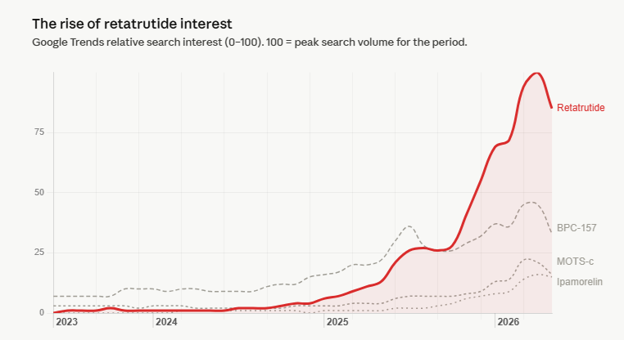
Public Citizen reports that the unapproved weight-loss drug retatrutide has become an online craze, with influencers including Braden Peters touting it despite impure supplies, growing hospitalizations, and an FDA that under Robert F. Kennedy Jr. has largely declined to act. The group calls enforcement ineffective and urges tougher sanctions.
 Hospitalizations, Enforcement Gaps, Influencers Tied to Unapproved Retatrutide Products - Public Citizen
A Public Citizen press release announces a report on a sprawling unregulated market for retatrutide, an Eli Lilly weight loss drug not FDA-approved for use outside clinical trials. The report says at least 14 hospitalizations are linked to the drug, that companies and influencer affiliates like Braden Peters openly promote self-injection, and that many firms warned by the FDA still sell it despite little sign of tougher sanctions.
Retatrutide-Report.pdf
A Public Citizen report argues that a craze for retatrutide, an unapproved Eli Lilly weight-loss drug that targets three glucose-regulating receptors, has overwhelmed FDA safeguards, with more than 100 companies openly selling it, influencers like Braden Peters, known as "Clavicular," touting it to millions of followers, and at least 14 reported hospitalizations. The group says that under HHS Secretary Robert F. Kennedy Jr., who has called himself a big fan of peptides and pledged to ease regulations on them, the FDA's 14 warning letters have gone largely unenforced, and it recommends the agency move to tougher sanctions.
 I bought peptides with crypto. How my purchase helped fuel a $100 million gray-market, ‘looksmaxxing’ economy | Fortune
fortune.com· 23w
Fortune's Ben Weiss buys unregulated peptides with crypto from a Chinese seller named Louise to trace the booming gray-market "looksmaxxing" economy, in which young men inject peptides to become more attractive. Chainalysis pegs vendors' first-quarter 2026 crypto intake at $32 million, up 700% year over year, projects over $100 million in 2026 volume, and reports some fentanyl-precursor makers pivoted to peptides. Health Secretary Robert F. Kennedy, Jr. told Joe Rogan he is a big fan of peptides.
https://www.preprints.org/frontend/manuscript/ae34a89ce81cb490bff0445a6ef28159/download_pub
preprints.org· 31w
A Preprints.org preprint posted 7 April 2026 by Christopher L. Mendias and Tariq M. Awan reviews approved and gray market peptide therapies for musculoskeletal injuries and athletic performance, finding that unapproved peptides like BPC-157 and CJC-1295 — promoted heavily on social media — carry potentially substantial safety risks with little human safety data. The authors recommend evidence-based alternatives such as physiotherapy, GLP-1 receptor agonists, and phentermine, and urge sports medicine clinicians to educate patients on the science, placebo effects, and risks of unapproved peptides.
 Influencers tout injectable peptides as key to youth and beauty. Scientists say they're 'a giant scam' | CBC Radio
cbc.ca· 31w
A CBC News article reports that influencers tout unregulated injectable peptides as the key to youth, beauty and muscle building, though the products are unapproved by Health Canada, unstudied in large human trials and often sold through a grey market. Scientists like Stuart Phillips call them "just a giant scam," Tim Caulfield dubs the marketing "science-ploitation," and Robert F. Kennedy Jr. seeks to ease FDA compounding rules.
