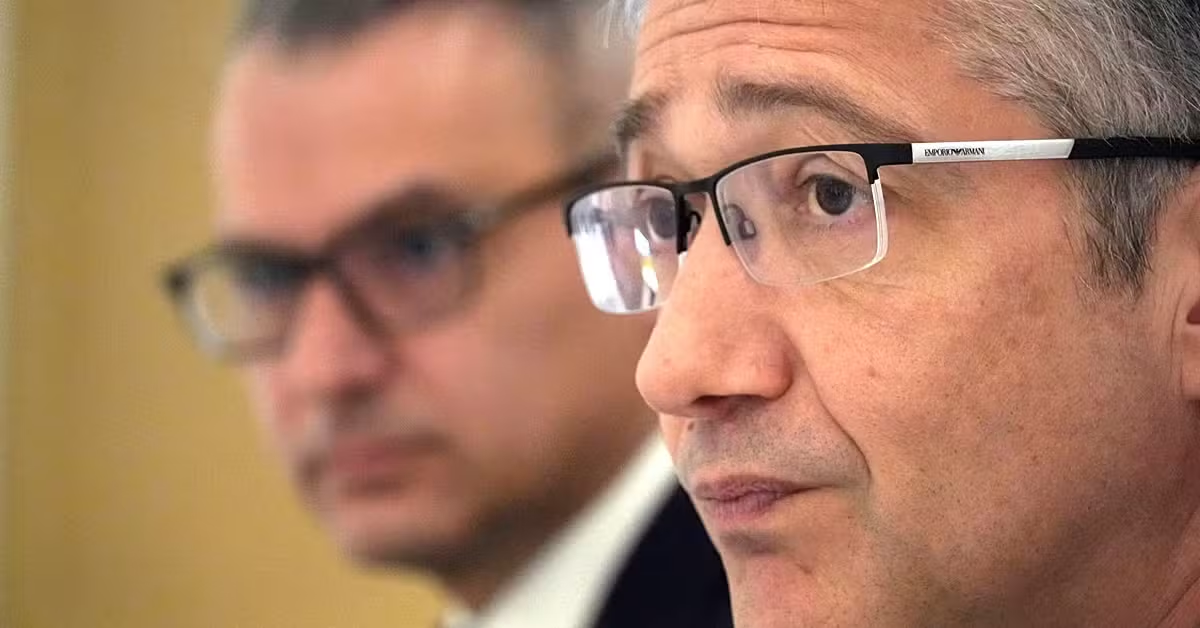
EU leaders recommend Hernández de Cos as ECB president, appointment due in December
Pablo Hernández de Cos, Spain's consensus technocrat to head ECB
euronews.com· 5h
European Central Bank set to appoint its first Spanish leader | CNN Business
cnn.com· 17h
Spanish economist to become new European Central Bank chief
aljazeera.com· 18h
Pablo Hernández de Cos: the ‘consensus-builder’ taking over the ECB
ft.com· 18h
Leaders choose Spain's former central bank head as next European Central Bank president
apnews.com· 18h
L'Espagnol Pablo Hernandez de Cos va être nommé président de la Banque centrale européenne
rfi.fr· 19h
A la tête de la BCE, un trio fraîchement nommé pour protéger l’Europe de l’inflation… et peut-être la France d’une attaque sur les marchés
lemonde.fr· 19h
ECB turns to crisis veteran De Cos as new strains loom
reuters.com· 19h
Présidence de la BCE : l'Espagnol Pablo Hernandez de Cos succédera à Christine Lagarde
france24.com· 19h
Christine Lagarde va être remplacée par l’Espagnol Pablo Hernandez de Cos à la tête de la BCE
liberation.fr· 19h
Spain’s Pablo Hernández de Cos set to lead European Central Bank
cnbc.com· 20h
Instant View: Spain's De Cos set to be nominated by EU leaders as next ECB chief
Eurozone leaders back Spain’s Hernández de Cos for ECB presidency
Spain's De Cos set to be nominated by EU countries as next head of ECB
EZB: Spanier Pablo Hernández de Cos soll Nachfolger von Christine Lagarde werden
spiegel.de· 20h
De Cos Is Poised to Take ECB Presidency in Era After Lagarde
bloomberg.com· 20h
Pablo Hernández de Cos to be next ECB President
Pablo Hernández De Cos To Succeed Lagarde As ECB President: FT
huffpost.com· 4d
Pablo Hernández de Cos, a 55-year-old Spanish economist and former governor of the Bank of Spain, is set to succeed Christine Lagarde as European Central Bank president after eurozone leaders agreed to recommend him for the job.
The race began in late October 2026, when Lagarde announced she would leave early, on 7 February 2027, setting off a contest among the 21 eurozone countries to choose a successor by the end of the year. By 23 November, Hernández de Cos had the backing of a majority of eurozone countries.
At the EU summit in Brussels on 26 November, he secured more support than former Dutch central bank governor Klaas Knot, and the Netherlands, which had officially put Knot forward, ended up backing him. European Council President Antonio Costa announced that member states had also agreed to recommend Laurence Boone and Markus Brunnermeier for the executive board.
The deal capped months of closed-door negotiations over the six-person board in Frankfurt am Main. If confirmed, Hernández de Cos would be the first Spaniard to lead the bank since its creation in 1998.
The European Council is expected to make the appointments in December after consulting the European Parliament and the Governing Council, neither of which has veto power. The nomination drew little market reaction, with the euro up 0.12% at $1.0988 and German 10-year yields up 5 basis points at 3.268%.
Pablo Hernández de Cos, a Spanish economist and former governor of the Bank of Spain, had received the backing of a majority of eurozone countries to succeed Christine Lagarde as European Central Bank president, according to a report.
Christine Lagarde is expected to step down as European Central Bank president in February 2027.
European leaders meeting in Brussels were poised to nominate the 55-year-old Spaniard Pablo Hernández de Cos as European Central Bank president on 26 November 2026.
The Dutch government aligned itself with the consensus of European peers on the nomination.
Christine Lagarde is expected to end her term early and leave the European Central Bank on 7 February 2027.
The Dutch government was reported to have signaled support for Hernández de Cos at the EU summit in Brussels, likely standing down its own candidate, Klaas Knot.
EU ambassadors were scheduled to meet at 1400 GMT on 26 November 2026 to launch a written procedure in which capitals sign off on names for three top European Central Bank jobs becoming vacant within six months.
The selection of Hernández de Cos capped months of closed-door negotiations over seats on the European Central Bank's six-person board.
Laurence Boone and Markus Brunnermeier were expected to be named to the European Central Bank's market operations and chief economist posts.
Hernández de Cos secured more support than former Dutch central bank governor Klaas Knot among eurozone countries at the Brussels summit on 26 November 2026.
EU ambassadors agreed on the text of the recommendations for all three European Central Bank candidates on 26 November 2026.
The European Council was expected to make the appointments in December 2026 after consulting the European Parliament and the European Central Bank's Governing Council.
If formally appointed, Hernández de Cos would become the first Spaniard to lead the European Central Bank since its creation in 1998.
Christine Lagarde had not endorsed any candidate as of 26 November 2026.
Jefferies economist Modupe Adegbembo said Hernández de Cos is considered slightly more dovish than Klaas Knot but that a change in leadership alone was unlikely to alter the European Central Bank's approach to interest rates.
MUFG economist Henry Cook described Hernández de Cos as a pragmatic centrist and expects him to broadly maintain Christine Lagarde's approach.
Spanish Prime Minister Pedro Sánchez and opposition leader Alberto Núñez Feijóo both backed Hernández de Cos's candidacy, which marked Spain's first bid for the European Central Bank presidency.
The set nomination of Hernández de Cos drew little reaction in European assets, with the euro up 0.12% at $1.0988 and German 10-year yields up 5 basis points at 3.268%.
ING global head of macro Carsten Brzeski called Hernández de Cos an excellent, well-qualified candidate, noting he would be the first European Central Bank president to have previously worked as ECB staff.
Oddo BHF chief economist Bruno Cavalier said Hernández de Cos is a well-regarded and experienced central banker who is capable of forging consensus within the Governing Council and generally sits near the centre of the hawk-dove spectrum, much like Lagarde.
Monex Europe's Nick Rees said the nomination is not hugely impactful for the euro in the short term and expects the European Central Bank to lean a little more dovish down the line, which could weigh on the euro.
Saltmarsh Economics' Marchel Alexandrovich said Hernández de Cos is likely to offer a continuation of many of Lagarde's policies at least initially, and forecast further European Central Bank interest rate hikes in 2027.
AFS Group's Arne Petimezas said that with the hawkish-leaning Knot dropping out, the dovish-leaning Hernández de Cos was the only contender and his nomination was all but assured.
RBC Capital Markets' Peter Schaffrik said the market consensus is clearly that Hernández de Cos is dovish and will give the European Central Bank a dovish bent, though he questioned whether his dovish record as Bank of Spain head will hold going forward.
In Touch Capital Markets' Piotr Matys said the European Central Bank's Governing Council could adopt a more cautious approach to further rate rises under Hernández de Cos, who has a reputation for being strongly data-driven and cautious with tightening.
Hernández de Cos's appointment as European Central Bank president still requires formal approval after consultation with the European Parliament and the European Central Bank's Governing Council, neither of which has veto power.
Union Investment's Christian Kopf said Hernández de Cos was the candidate with the 'strongest technical understanding of monetary policy and central banking' and that appointing a career technocrat would send a strong signal that Europe will not waver in its commitment to price stability.
Christian Kopf said the trio of Hernández de Cos as president, Germany's Markus Brunnermeier as chief economist and France's Laurence Boone as head of market operations is a 'carefully crafted package deal' balancing representation from northern and southern European countries.
OMFIF's John Orchard called Hernández de Cos a central banker's central banker who has managed to earn respect from typically hawkish northern observers.
European officials announced on 26 November 2026 that Pablo Hernández de Cos will succeed Christine Lagarde as president of the European Central Bank.
Hernández de Cos had received decisive support from Paris and Berlin, and the Netherlands, which had officially put forward Klaas Knot's candidacy, ended up backing him.
Christine Lagarde announced in late October 2026 that she would leave the European Central Bank early, effective 7 February 2027, setting off a race among the 21 eurozone countries to choose a successor by the end of 2026.
Spanish Prime Minister Pedro Sánchez hailed 'a Spain that leads Europe' in a post on X.
ING economist Carsten Brzeski said, 'De Cos has worked through the ranks, going from staff to policymaking, which is proof he has both the skills and the charm for the job.'
Carsten Brzeski said, 'Some people try to label him as dovish but I don't see that', adding that his track record makes him a moderate.
Societe Generale economist Anatoli Annenkov said the new president does not need a voice as formidable as Mario Draghi's in 2012, because the institution has matured and the individual risks Draghi took no longer need to be taken.
Laurence Boone was set to take charge of the European Central Bank's market operations from 4 January 2027, succeeding Isabel Schnabel, and Markus Brunnermeier to become chief economist from 1 June 2027, succeeding Philip Lane.
The three nominees, if confirmed by the European Parliament, would make up half of the European Central Bank's six-member executive board based in Frankfurt am Main.
Pictet Wealth Management's Frederik Ducrozet called the choice unadventurous, saying, 'It's a bit always the same circle.'
Agreement on all three European Central Bank posts was reached at the Brussels summit, according to an EU diplomat speaking on condition of anonymity for the Irish Presidency.
French President Emmanuel Macron confirmed the result in a post on X.
European Council President Antonio Costa announced that eurozone member states had agreed to recommend Pablo Hernández de Cos as the next European Central Bank president, with Laurence Boone and Markus Brunnermeier recommended for the executive board.
French President Emmanuel Macron wrote on X that he welcomed 'a balanced trio of individuals serving the stability and prosperity of the euro area, with Pablo Hernández de Cos as President and Laurence Boone and Markus Brunnermeier on the Executive Board.'

