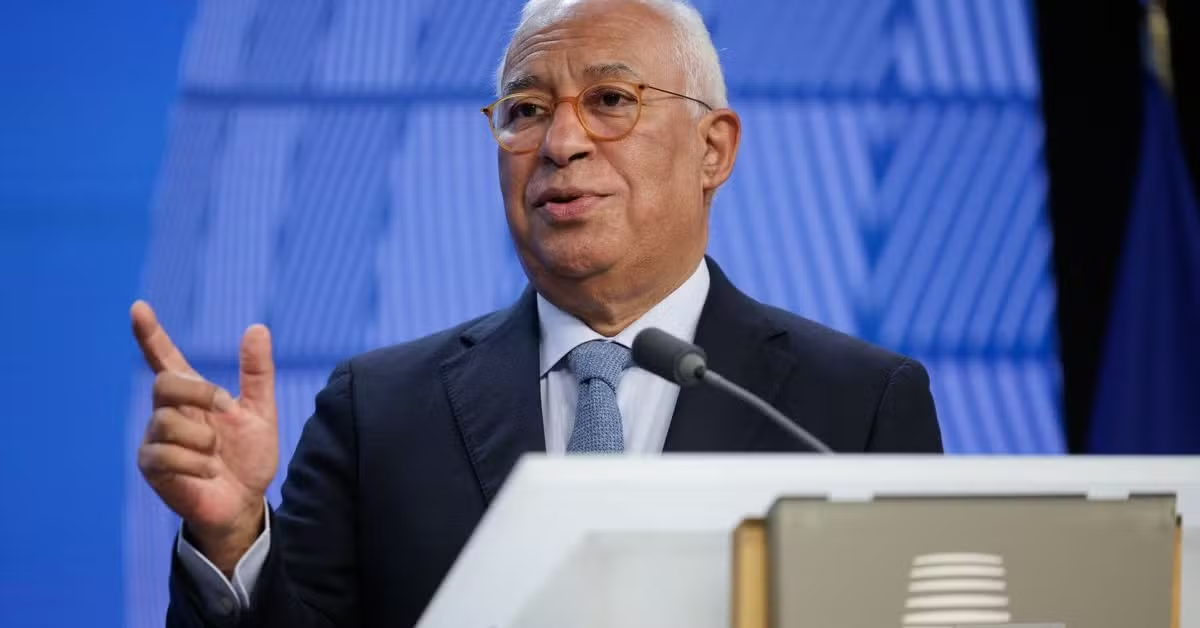
Costa proposes 204 billion euro EU budget cuts and digital tax, France rejects plan
António Costa kürzt, Friedrich Merz kritisiert dennoch den EU-Budget-Vorschlag
spiegel.de· 13h
Antonio Costa Proposes €1.78T EU Budget for 2028-2034, Preserves €100B for Ukraine
kyivpost.com· 19h
EU leaders' chair proposes new cuts to EU 2028-2034 budget draft, suggests digital tax
reuters.com· 20h
EU budget proposal keeps Ukraine funding unchanged as cost of Russia's war rises
kyivindependent.com· 22h
Latest EU budget proposal is 'very disappointing', French presidency says
Budget de l’UE : Antonio Costa, le président du Conseil européen, propose 204 milliards d’euros d’économies et une taxe numérique
lemonde.fr· 22h
European Council President Antonio Costa circulated a revised draft of the EU's 2028-2034 long-term budget to member states on 21 November 2026, cutting 204 billion euros, or 10 percent, from the European Commission's original proposal of 2,000 billion euros to about 1.78 trillion. He said he aimed to keep national contributions manageable and hoped to conclude negotiations among the 27 member states by the end of the year. EU leaders will discuss the plan at a special summit in Brussels on 26-27 November and aim to reach an agreement in December.
The cuts fall mainly on the European Competitiveness Fund, defence and external spending, leaving agriculture and cohesion relatively protected, though they cut deeply into cohesion funds for economically weaker regions. Support for Ukraine is left fully intact through a dedicated off-ceiling Ukraine Reserve of up to 100 billion euros in current prices, which sits above standard expenditure ceilings.
To boost the EU's own revenues, Costa proposed a tax of 3 percent of annual net turnover on large digital companies with more than 50 million euros in EU digital turnover and more than 750 million euros globally, a levy that would fall mostly on US-based giants such as Google and Amazon. The new revenue sources together, including levies on crypto assets, tobacco, uncollected electronic waste and mobile frequencies, would bring in just over 60 billion euros a year, accommodating France's long push for new EU revenues without higher national contributions. They also partially meet demands from net contributors such as Germany and the Netherlands, who had wanted the Commission's draft cut by several hundred billion euros. Costa additionally proposed slowing repayment of the capital of the more than 600 billion euros the EU will have jointly borrowed by the end of 2026 for its post-pandemic recovery fund.
France has rejected the plan.
European Council President Antonio Costa proposed on 21 November 2026 a revised draft of the EU's 2028-2034 budget, cut by 204 billion euros from the European Commission's initial proposal of 2,000 billion euros.
Costa proposed a new tax equal to 3 percent of annual revenue on large digital-sector companies to boost the EU's own revenues, alongside studying the taxation of crypto-assets and financing the budget through auctions of telecom frequencies.
Costa said he sought to spread the cuts fairly between traditional policy areas such as agriculture and cohesion and new priorities such as business competitiveness and research, and to give pledges to the frugal northern states led by Germany and the Netherlands without weakening the EU's capacity to intervene.
Costa said he hoped to conclude negotiations on the future EU budget among the 27 member states by the end of the year.
At a press conference, Costa said of the digital tax, 'This tax is in no way directed against any company or state.'
Costa said he would submit the compromise proposal to the leaders of the 27 member states at a summit in Brussels on the Thursday and Friday of that week.
Siegfried Muresan said in a statement, 'President Costa's proposal is simply unacceptable,' adding, 'Europe needs ambition and the means to face its growing challenges.'
The French presidency said the proposal as it stands 'does not constitute a basis for an agreement', called the new negotiating box 'very disappointing', and said 'the tally falls short, particularly on the CAP, the common agricultural policy, and notably on guaranteeing income support for farmers.'
Costa circulated the revised negotiating proposal for the 2028-2034 long-term budget to the EU member states on 21 November 2026.
Costa's proposed cuts would reduce the seven-year budget by 40 billion euros to 1.582 trillion euros compared with the proposal presented by the Irish EU presidency in October, and by 180.6 billion euros compared with the original European Commission proposal.
The cuts fall mainly on the European Competitiveness Fund, defence and external spending, while money for agriculture and cohesion is relatively protected compared with the Irish compromise proposal.
The proposed digital tax would take 3 percent of annual net turnover from online advertising, digital intermediation services and user-generated data for companies with more than 50 million euros in EU digital turnover and more than 750 million euros in global turnover.
The digital tax would fall mostly on US-based digital giants such as Google, Microsoft, Meta, Apple and Amazon, according to reports.
Costa proposed slowing the repayment of the capital of the more than 600 billion euros the EU will have jointly borrowed by the end of 2026 for its post-pandemic recovery fund, with interest and capital repayment starting in 2028 and running to 2058 as planned.
EU leaders will discuss the proposals at a special summit in Brussels on 26-27 November 2026 and aim to reach an agreement on the budget in December 2026.
Siegfried Muresan said, 'This proposal is unacceptable to Parliament and cannot form the basis for our consent. The EU budget is an investment budget. Cuts, more cuts and a side of cuts are not an investment strategy.'
German Chancellor Friedrich Merz said, 'A just and fair burden-sharing arrangement can only be achieved through corrections on the revenue side.'
Merz said the proposal is a first step but its volume is still too high.
The revised long-term budget proposed by Costa totals about 1.78 trillion euros in current prices, a reduction of 204 billion euros, or 10 percent, from the Commission's original proposal, aimed at keeping national contributions manageable.
The proposal leaves financial support for Ukraine fully intact at the level the European Commission initially proposed.
It establishes a dedicated off-ceiling Ukraine Reserve of up to 100 billion euros in current prices, equivalent to 88.9 billion euros in constant 2025 prices, which sits above the standard expenditure ceilings so it does not force cuts to cohesion or agricultural programs.
Support through the Ukraine Reserve would be delivered through budgetary guarantees, non-loan grant financing and macro-financial credit assistance, with additional interest-rate subsidies for Ukraine's borrowing costs and supplementary allocations through external action instruments including humanitarian assistance.
Costa said his proposal is 10 percent lower than the European Commission's initial proposal, a reduction of 204 billion euros in current prices, in order to keep national contributions at a reasonable level.
Costa's new revenue sources, including a levy on crypto assets, emissions trading revenues, the carbon border adjustment mechanism, a tobacco levy, a levy on uncollected electronic waste and mobile frequency allocations, would together contribute just over 60 billion euros a year, with the digital tax accounting for just over 5 billion euros annually.
The new own resources particularly accommodate France's wishes, as Paris has long pushed for new EU revenues to fund additional European investments without raising national contributions.
The proposal partially meets demands from Friedrich Merz and other net contributors such as the Netherlands, Austria, Denmark, Sweden and Finland, who want the Commission's draft cut by several hundred billion euros, and it cuts deeply into cohesion funds for economically weaker regions.
The next long-term budget would total around 1.781 trillion euros in current prices, with national contributions measured against economic output barely rising under Costa's calculation.
German Chancellor Friedrich Merz said the compromise proposal is still not capable of gaining approval and that an EU budget growing by more than 40 percent does not fit these times.
Merz said he is ready to work on a realistic and affordable EU budget and that reaching agreement by the end of the year is in everyone's interest.
Merz threatened a blockade if new aid for Ukraine is not borne by all 27 member states.

