
Vorläufige Daten: Globale Temperatur liegt offenbar sechs Tage nacheinander auf oder über der Zwei-Grad-Marke
Preliminary data from Copernicus, the EU's Earth observation programme, show that for the first time since measurements began the world has seen six consecutive days with the global average temperature at least two degrees above the pre-industrial mean, as the Guardian reports and Spiegel relays. The Paris Agreement's limits refer to long-term averages, so short-term exceedances do not count as the limits being crossed. According to the data, the series began on 18 November, and 23 November marked the highest deviation of any day since measurements began at 2.24 degrees, beating the 2.05-degree record set in 2023. Copernicus climate chief Samantha Burgess calls it an extraordinary global temperature anomaly and a striking sign of how much the climate has warmed, while Spiegel calls the 31st World Climate Conference in Antalya, which ended without an overarching resolution, a diplomatic disaster.

El planeta cruza otra línea roja: una semana seguida por encima de los dos grados de calentamiento
For the first time, Earth has registered warming of more than 2 °C above preindustrial temperatures for a week in a row. The Copernicus Climate Change Service confirms the 2 °C barrier was reached on 10 days in November 2026, seven of them consecutive, with the largest difference in the global average temperature recorded so far on 23 November at 2.25 °C above the preindustrial period. Exceeding 2 °C on single days has happened before, in November 2023 and February 2024, but never on so many consecutive days or with so large an anomaly, and a real breach of the Paris Agreement goals would require prolonged years, not days. Samantha Burgess of the European Centre for Medium-Range Weather Forecasts calls it a clear preview of where the climate is heading, saying the underlying warming from greenhouse gas emissions will persist unless emissions fall. The run comes as the COP31 summit in Antalya, Turkey ended two days late without closing an agreement, because some countries would not accept even mentioning the responsibility of fossil fuels for climate change. Copernicus expects 2026 to be the second full calendar year above the 1.5-degree mark and very likely the second warmest year on record.

World breaches 2C temperature limit six days in a row for first time
The world has recorded six consecutive days with average temperatures 2C above preindustrial levels for the first time, a streak that follows the collapse of the Cop31 UN climate talks in Antalya without a deal. The Paris Agreement's limits of well below 2C, with efforts for 1.5C, are measured as long-term averages, so six straight days above 2C do not mean they have been breached. Monday's daily global temperature reached 2.24C above preindustrial levels, the highest ever recorded according to the Guardian, and the Copernicus Climate Change Service says ever-growing greenhouse gas concentrations remain the main driver, with a historic El Nino forecast to begin in 2026 adding to the trend. More days above 2C are likely as the El Nino builds to its peak over roughly the next month, and 2027 is expected to be the hottest year on record.

‘There’s a lot more heat coming’: world has six consecutive days 2C above preindustrial levels for first time
The Guardian reports that for the first time the world has experienced six consecutive days of temperatures 2C above preindustrial levels, peaking at a record 2.4C, driven by human-caused global heating and an unusually large El Niño nearing its peak. Scientists caution the streak is too brief to signify that the upper range of the Paris agreement's 1.5C target has been breached, but say it is an early indication of what is to come unless fossil fuel emissions are rapidly eliminated. The Met Office's Richard Betts warns that drought-weakened tropical ecosystems will help push next year's CO2 rise to about 3.5 parts per million, nearly twice the pace compatible with limiting warming to 1.5C, while Copernicus's Samantha Burgess says 'There's a lot more heat coming down the pipeline.'
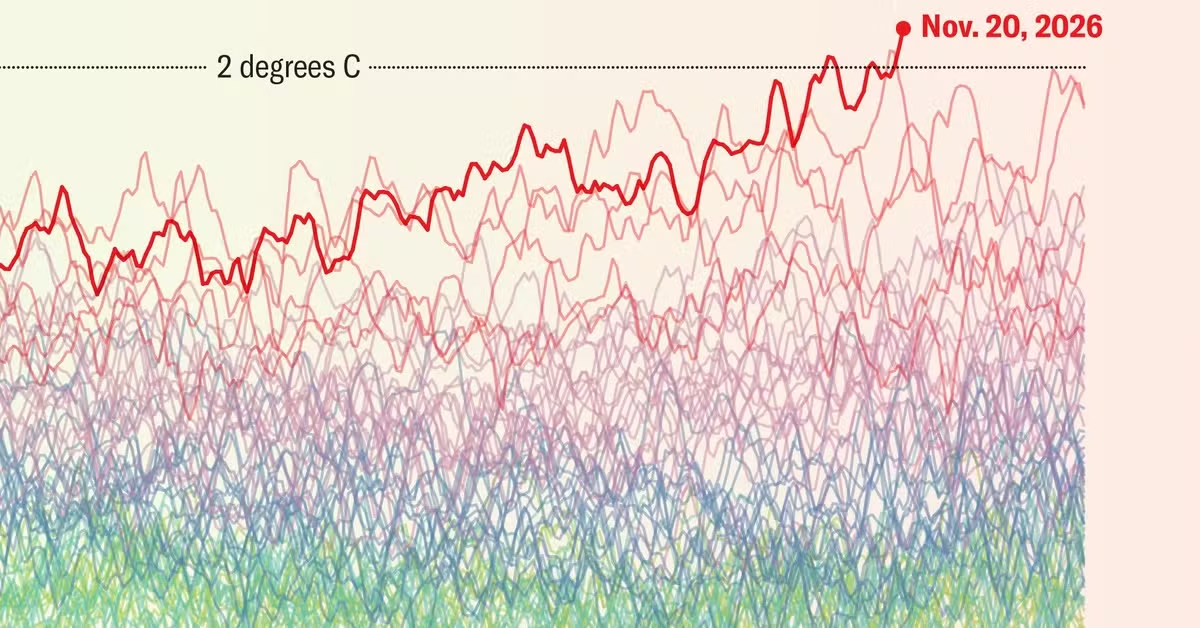
Earth just saw the most anomalously hot day ever on record
A Scientific American news article reports that preliminary data from the Copernicus Climate Change Service shows Friday, November 20, 2026 was the most anomalously hot day ever measured on Earth, at 2.12 degrees Celsius above the preindustrial average. The record stems from long-term, human-driven climate change combined with a powerful El Niño, which Scientific American describes as likely the strongest in the past 1,000 years. It came as international negotiations at the COP 31 climate summit fell apart with no global agreement on reining in warming. With that El Niño still gaining strength, the article forecasts the record-hot day could soon be surpassed.

