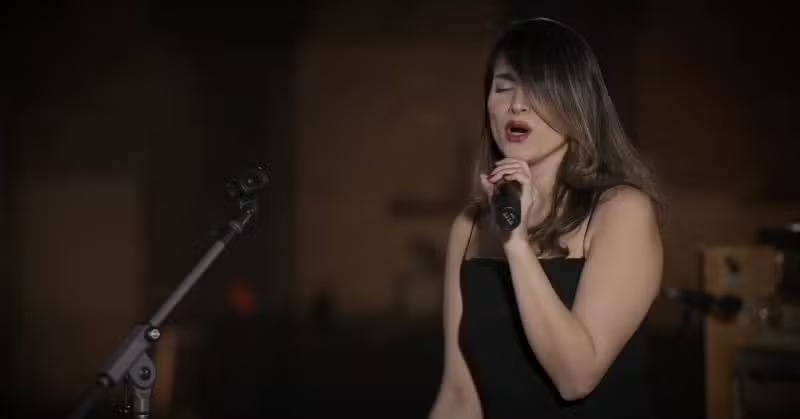
Iran flogs singer Parastoo Ahmadi and four associates over concert without hijab
Iran flogs female singer and four members of concert team over her performance without hijab | CNN
cnn.com· 5h
Iran lashes singer dozens of times over concert: reports
channelnewsasia.com· 5h
Iran flogs singer Parastoo Ahmadi for performing without headscarf
aljazeera.com· 6h
Iran: Sängerin Parastu Ahmadi wegen Verstoßes gegen Kopftuchpflicht ausgepeitscht
spiegel.de· 7h
Iranian singer subjected to 74 lashes for performing without her hijab | CBC News
cbc.ca· 7h
Parastoo Ahmadi: Bekannte iranische Sängerin nach Konzert 74 Mal ausgepeitscht
zeit.de· 7h
Pour s’être produite sans voile et pour un public, une chanteuse iranienne subit 74 coups de fouet
huffingtonpost.fr· 7h
Iran carries out flogging of singer who performed without hijab
euronews.com· 8h
Iran carries out flogging of singer and her team, Iranian website says
reuters.com· 8h
Iranian authorities flog singer who performed without hijab, lawyers say
bbc.com· 8h
Iranian authorities have flogged singer Parastoo Ahmadi and four male associates, giving each 74 lashes in the city of Qom, according to her defence team.
The punishment stems from a concert in December 2024, when Ahmadi, 29, performed without the mandatory hijab and wore a sleeveless dress in a show livestreamed on her YouTube channel.
In June 2026, a criminal court in Qom convicted Ahmadi and eight others of offending public decency through publishing obscene and indecent material, charges they denied. It sentenced each of them to 74 lashes, a two-year ban on audiovisual activities and a two-year ban on leaving the country.
At the end of September 2026, an appeals court in Qom rejected the defendants' appeal and confirmed the sentence.
On Monday 23 November, lawyer Mostafa Nili said the Qom prosecutor's office enforcement team flogged Ahmadi in the early hours at the third branch of the Criminal Sentence Enforcement Office, and the sentences against her four team members were carried out the same day. He identified the men as Soheil Faghih-Nasiri, Amin Taheri, Amirali Pirnia and Mohsen Lashkari.
Iranian authorities flogged singer Parastoo Ahmadi, three musicians and a producer, giving each 74 lashes in the city of Qom, according to her defence team.
Parastoo Ahmadi, 29, performed without the mandatory hijab and wore a sleeveless dress during a concert livestreamed on her YouTube channel in December 2024.
In June 2026, a criminal court in Qom convicted Parastoo Ahmadi and eight others of offending public decency through publishing obscene and indecent material, which they denied.
The Qom court sentenced Ahmadi and the eight others to 74 lashes, a two-year ban on audiovisual activities and a two-year ban on leaving the country.
At the end of September 2026, an appeals court in Qom rejected the defendants' appeal and confirmed the sentence.
On Monday 23 November, Ahmadi and four male co-defendants were flogged at the third branch of the Criminal Sentence Enforcement Office in Qom, her lawyer said.
Defence lawyer Mostafa Nili identified the four men flogged alongside Ahmadi as Soheil Faghih-Nasiri, Amin Taheri, Amirali Pirnia and Mohsen Lashkari.
A lawyer for Parastoo Ahmadi and her co-defendants said the defence team did everything in its power to have the verdict overturned, or to secure a reduction or suspension, but it did not work out.
The same lawyer said the lawyers also tried to get enforcement of the sentence postponed, but the enforcement branch insisted on carrying it out immediately.
Iranian artists and human rights activists condemned the sentences, warning that flogging is cruel, inhuman and degrading punishment that violates the international prohibition on torture.
Lawyer Mostafa Nili said the Qom prosecutor's office enforcement team carried out the flogging of Parastoo Ahmadi in the early hours of Monday, and the sentences against her four team members were carried out the same day.
Amnesty International called in June for the sentences against Parastoo Ahmadi's concert team to be quashed.
Amnesty International called flogging a cruel, inhuman and degrading punishment that violated the absolute prohibition on torture and other ill-treatment.
Amnesty International called on Tehran to abolish compulsory veiling and corporal punishment and to end the criminalisation of freedom of expression.
The Norway-based human rights organization Iran Human Rights said in a statement that the lashing is a cruel and degrading punishment that violates the prohibition of torture and other forms of mistreatment.
Iran Human Rights also said that making music and the choice of clothing must not be answered with corporal punishment.
The Norway-based human rights group Hengaw said the case followed the release of a video on YouTube in December 2024 showing Parastoo Ahmadi performing without the mandatory hijab alongside male musicians in Qom, south of Tehran.
Iran Human Rights said the flogging can leave deep wounds, tissue damage and permanent scars, with nerve damage and long-term psychological strain also possible.

