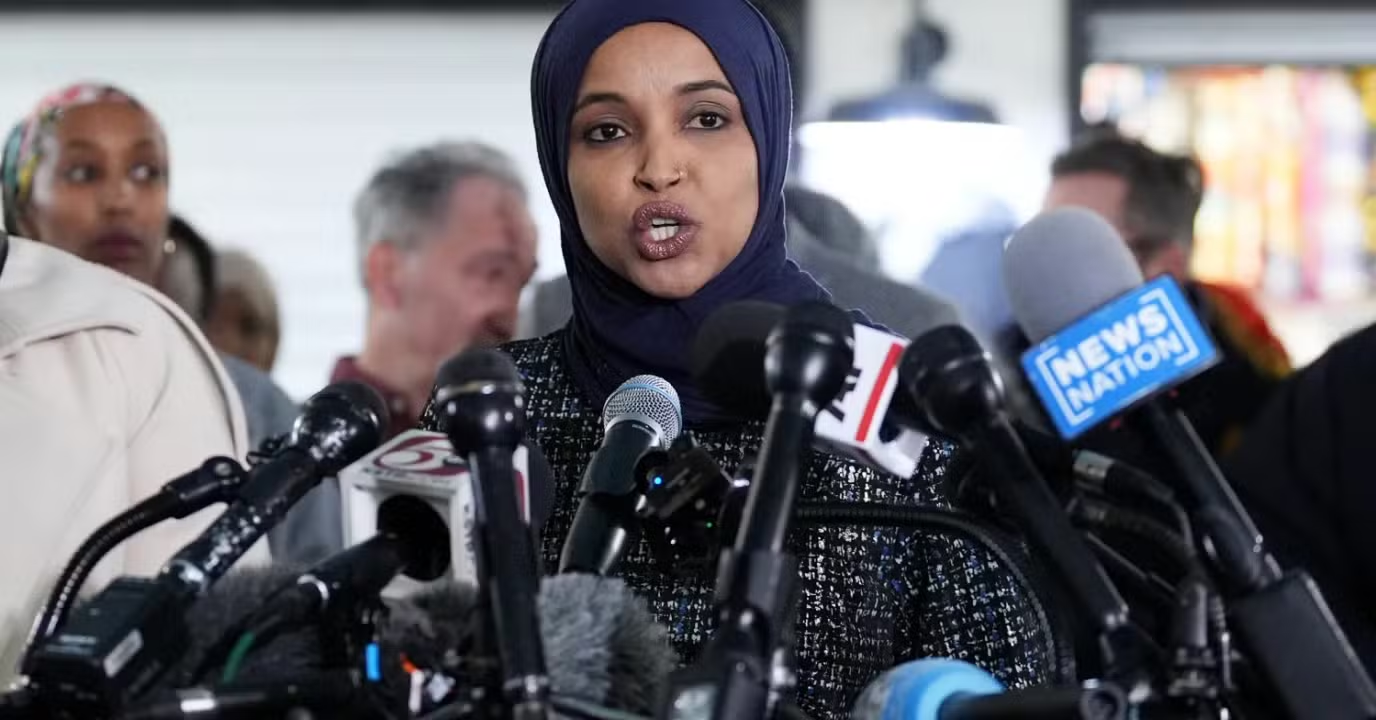
US Attorney Pirro files errata correcting account of search of Ilhan Omar's home
Trump team is super sorry for racist raid of Ilhan Omar’s home
dailykos.com· 38h
DOJ Forced to Apologize for Lying About Detail in Ilhan Omar Case
newrepublic.com· 43h
Trump Shares Warning to Ilhan Omar as Admin Apologises in Case - Newsweek
newsweek.com· 44h
Feds allege Ilhan Omar’s alleged crimes went on for decades
newsnationnow.com· 46h
Trump’s DOJ Issues Humiliating Apology Over Dem Raid Blunder
thedailybeast.com· 2d
Trump’s DOJ Issues Humiliating Apology Over Ilhan Omar Raid Blunder
yahoo.com· 2d
Justice Dept. Apologizes for Making False Statement to Judge in Omar Case
nytimes.com· 2d
US House counsel denies backing controversial raid on Ilhan Omar’s home
aljazeera.com· 2d
Judge initially blocked DOJ from searching Ilhan Omar’s home, court docs show | CNN Politics
cnn.com· 2d
'Frustrated' judge clashed with Trump DOJ in secret fight ahead of Omar raid: report
rawstory.com· 2d
Judge Unseals Records Related To Ilhan Omar Case
huffpost.com· 3d
DOJ says House’s top lawyer ‘refused to be involved’ ahead of Omar search
politico.com· 3d
Ilhan Omar Investigation Covers Most of Her Life, Unsealed Records Show
wsj.com· 3d
Judge demanded safeguards before search of Rep. Omar’s home, records show
washingtonpost.com· 3d
Heavily redacted documents detailing raid on Omar’s house unsealed
thehill.com· 3d
Unsealed records reveal federal investigation of Ilhan Omar spans her entire life
startribune.com· 3d
Judge turns Trump’s words against DOJ in fight over raid on MAGA foe’s home: reports
Federal agents searched Rep. Ilhan Omar's Washington, D.C. home on October 12, 2026, carrying boxes out of the residence and seizing her phone, laptop, notebooks and passport. The search, tied to an investigation into whether Omar or her father misstated her birth date on immigration paperwork to secure citizenship, came less than a month before the midterm elections and after Vice President JD Vance vowed to investigate her.
On November 23, a federal court in Washington unsealed nearly 170 pages of heavily redacted records after a coalition of news organizations petitioned for them, hours after prosecutors made a last-minute attempt to block the release. The records show Magistrate Judge Matthew Sharbaugh repeatedly resisted the plan, rejecting prosecutors' argument that Speech or Debate Clause protections did not apply to a member's private home and signing the warrant only after prosecutors agreed to let Omar identify privileged material before agents searched her belongings. The 67-page affidavit remains sealed, and the records do not identify which laws investigators are examining.
The released filings also detail a dispute over House counsel Matthew Berry, whom prosecutors cited as saying Speech or Debate protections do not extend to a member's private residence. Hours after Berry accused the Justice Department of making a categorically false statement to a judge, the department apologized in a court filing, conceding he took no position on the scope of those protections. On November 25, U.S. Attorney Jeanine Pirro filed an errata stating that the account of Berry's comments requires correction. Chief Judge James Boasberg is still considering whether more of the record should be made public.
Chief U.S. District Judge James Boasberg held a hearing on whether to unseal records tied to the October search of Rep. Ilhan Omar's Washington home, turning President Donald Trump's own public remarks against the Justice Department.
Boasberg noted that Trump, Vice President JD Vance, and Homeland Security Secretary Markwayne Mullin had publicly discussed the focus of the investigation into Omar's immigration status, and a Justice Department attorney said she had no control over what they said.
Boasberg partially granted a motion by news outlets including The Washington Post to make records of the investigation public, with release set for the following Monday unless the administration appealed.
Boasberg refused to release the affidavit given to Magistrate Judge Matthew Sharbaugh, saying it reveals important facts about the scope of the investigation and witnesses whose identities should not be disclosed.
The Justice Department argued the search warrant had not been fully carried out, and Boasberg countered that the administration appeared to be conflating the October raid with the ongoing review of whether Speech or Debate protections apply to the seized materials.
Boasberg replied to the Justice Department attorney, 'Seems to be a common refrain.'
Justice Department lawyers said the department would not oppose the release of the affidavit at a later point.
Homeland Security Investigations agents searched Rep. Ilhan Omar's Washington, D.C. home on October 12, 2026, carrying boxes from the residence.
Heavily redacted court records unsealed on November 23, 2026 show the Justice Department's investigation of Omar spans her entire life, seeking evidence of suspected offenses going back as far as 1980.
The unsealed documents show federal agencies sought the search warrant on October 2, 2026, and it was granted one week later.
Before the warrant was executed, a Justice Department attorney notified House General Counsel Matthew B. Berry that the search would be carried out at a member of Congress's private residence, and Berry refused to be involved because he believed Speech or Debate Clause protections do not extend to a member's private residence.
Federal prosecutors in Washington, D.C. are leading the investigation into Omar's immigration history and finances.
The released records do not identify which laws investigators are examining, and the 67-page search warrant affidavit remains sealed at the government's request.
The Justice Department asked the court to keep sealed a separate set of records concerning Omar's effort to recover property taken in the search, arguing that details of how the warrant was executed, what was seized, and anything she said during it are highly sensitive.
The released documents show investigators sought thumb drives, external hard drives, computers and other electronics, and a person with knowledge of the investigation said agents seized Omar's cell phone, laptop, notebooks and passport.
Some of Omar's family members, including her sister, have been subpoenaed.
The Justice Department asked the court to order the news organizations to explain in writing why they are legally entitled to the records on Omar's property-recovery effort.
The unsealed filings state that the United States believes Ilhan Omar has committed unspecified crimes over decades, beginning long before she was ever in Congress.
Omar, who has not been charged with a crime, casts the investigation as a politically motivated stunt by the Trump administration.
A federal court unsealed nearly 170 pages of heavily redacted records on the October 12, 2026 search of Ilhan Omar's Washington, D.C. home after federal prosecutors made a last-minute attempt to block the release.
Prosecutors described the case as a 'preindictment investigation'.
Federal authorities are investigating whether Omar, a Somali native, or her relatives provided false information on their immigration paperwork.
A coalition of 14 news organizations, including The Associated Press, CNN and The Washington Post, petitioned the court for access to the records.
The records detail a dispute between federal prosecutors and U.S. Magistrate Judge Matthew Sharbaugh over the procedures agents would have to follow to keep the search from violating the Speech or Debate Clause.
In an October 7, 2026 brief, prosecutors argued the investigation had no potential overlap with Omar's congressional work.
Sharbaugh authorized the search on October 9, 2026, three days before Homeland Security Investigations agents executed it, and Omar's phone was seized.
Federal prosecutors argued that releasing the records could jeopardize the investigation before authorities finish reviewing the seized materials and determine whether to bring charges.
Unsealed court documents show U.S. Magistrate Judge Matthew J. Sharbaugh repeatedly expressed reservations about the Justice Department's plan to search Ilhan Omar's Washington, D.C. residence, saying the agency had not adequately considered protections shielding Congress's work from executive intrusion.
Before signing the warrant for the October 12 search, Sharbaugh demanded that prosecutors design safeguards to ensure Omar's rights as a member of Congress were protected.
The records tie the search to a federal investigation into whether Omar or her father misstated her birth date on immigration paperwork to secure citizenship.
In an October 15, 2026 opinion, Sharbaugh faulted the government for having 'essentially just wave[d] its hand' at the risk of seizing legislative materials.
Prosecutors said their efforts to comply with a restriction requiring agents to notify the House general counsel before the search were met with disinterest.
In his October 15 opinion, Sharbaugh wrote that 'a member's legislative work is not neatly cabined in the four walls of their Congressional office' and that 'no matter how small the potential volume of legislative materials at issue, the constitutional protections remain.'
In an October 16 brief, Associate Deputy Attorney General Alessandra P. Serano wrote that the United States believes Omar committed unspecified crimes 'beginning long before she was ever in Congress' and that nothing in the case has anything to do with her professional life.
A 169-page document containing multiple court records justifying the search of Ilhan Omar's home was released on the evening of November 23, 2026, on the order of a federal judge in Washington.
More than a dozen news organizations and a conservative activist group argued the records should be made public.
The unsealed records show Magistrate Judge Matthew Sharbaugh pressed Justice Department prosecutors to explain their theories of probable cause and how they would conduct the raid without violating protections over Ilhan Omar's legislative records.
Over a dozen news organizations formally asked U.S. Attorney Jeanine Pirro to unseal the warrant, affidavit and other underlying records, and she refused, arguing it would be premature to reveal details about the probe without formal charges.
Omar said the raid lasted four to five hours and that agents asked her to sign a document waiving her Speech and Debate rights.
A person who reviewed the warrant was reported to have said prosecutors were scrutinizing Omar for immigration crimes, including making false statements on immigration paperwork and a single charge of conspiracy.
The Justice Department initially said only that the raid was part of an ongoing investigation.
Chief District Judge James Boasberg told prosecutors during a November 17 hearing that he expects the affidavit will eventually be made public with redactions.
Homeland Security Secretary Markwayne Mullin said on an October 16 podcast that agents were investigating potential immigration fraud.
White House border czar Tom Homan said Omar could be deported if she had lied on her naturalization forms.
President Donald Trump suggested Omar could 'go to jail or be deported' after Tom Homan's remark.
In a post on X on October 12, Omar wrote, 'For ten years, Trump has targeted me with baseless lies and smear campaigns. This is just the latest escalation in his campaign of political intimidation. I will not be silenced.'
Omar said of the waiver request, 'That was obnoxious. I couldn't understand why they would think that I would sign such a thing.'
Omar said at least two dozen agents were at her home during the raid and seized her personal cellphone, her daughter's cellphone, a camera, notebooks and a Somali phrasebook.
Justice Department lawyers argued that Speech or Debate Clause protection applied only to official congressional offices and certain devices, and Magistrate Judge Sharbaugh rejected that argument.
Unsealed records show Sharbaugh signed the warrant only after prosecutors agreed to let Omar identify privileged material before agents searched her belongings.
The search came after Vice President JD Vance vowed to investigate Omar, less than a month before the midterm elections.
The Justice Department later tried to keep the warrant sealed until after Election Day.
Unsealed filings show Magistrate Judge Matthew Sharbaugh initially refused to allow the Justice Department to search Ilhan Omar's Washington, D.C. home without precautions and forced the department to revise its plan over seven days in early October.
Prosecutors argued Omar was unlikely to have taken her legislative work home because people rarely keep printed work product and her Capitol Hill office was close by, so special Speech or Debate precautions were not needed.
The Justice Department disclosed an October 11, 2026 exchange, one day before the search, in which House counsel Matthew Berry told acting Deputy Attorney General Trent McCotter that the House counsel's office does not represent a member under investigation personally and was not the appropriate party to oversee the search.
The Republican-led House had not actually backed the search of Omar's home without Speech or Debate precautions, and prosecutors added that the Justice Department did not specifically tell the House the search was of her home.
Chief Judge James Boasberg is still considering whether more of the court record around the search should be made public.
In the unsealed records, Sharbaugh wrote in October that the government can still pursue criminal investigations against members of Congress and execute search warrants, but must fairly balance legislative interests by letting the targeted member identify protected material before the search, subject to potential further review by the courts.
Matthew Berry acknowledged his office replied to a Justice Department email on the eve of the raid saying it would not be present during the operation itself, and pointed to the court ruling requiring Omar's representatives to be given a chance to assert the constitutional privilege over seized items.
Court documents show Magistrate Judge Sharbaugh rejected prosecutors' assertions that the Speech or Debate Clause did not apply to Omar's home, writing, 'this court sees differently.'
Berry said the Justice Department's claim that his refusal meant he agreed Speech or Debate Clause protections do not extend to a member's private residence is 'categorically false'.
In a letter to the Justice Department after the raid, Omar's lawyers wrote, 'This search was neither justified nor lawful,' and said investigators did not provide them with a copy of the warrant in advance and seized her phone and passport.
Timothy Heaphy, a former federal prosecutor who served as lead counsel for the House committee that investigated the January 6, 2021 attacks on the Capitol, called a federal raid on a sitting member of Congress's home 'extremely unusual' and said it would be highly doubtful the House Office of General Counsel would not want to be involved.
Democratic lawmakers widely condemned the raid as a dangerous intrusion by President Donald Trump that violated constitutional separation of powers.
Hours after Matthew Berry accused the Justice Department of making a 'categorically false' statement to a judge, the department acknowledged its error in a court filing, saying it 'apologizes for this inadvertent misunderstanding' and conceding the House general counsel took no position on the scope of Speech or Debate Clause protections.
Prosecutors said in the filing that a Justice Department lawyer had misinterpreted Berry's email reference to the House having different 'equities' in searches of offices versus homes as expressing a constitutional position.
The filing said Berry had not been told who the targeted member was.
Federal agents carried out the search of Ilhan Omar's home just hours after acting Deputy Attorney General Trent McCotter replied to Matthew Berry's October 11 email.
In his October 11 email to Justice Department officials, Berry wrote that he did not think it would be 'useful or appropriate' for an Office of the General Counsel attorney to observe the search and that Omar should be allowed to assert any privileges she believed applied to items seized from her home.
Acting Deputy Attorney General Trent McCotter replied to Berry's email to say he understood and thanked him for his time and consideration.
U.S. Attorney Jeanine Pirro said the redactions were made because the public should not be able to view the search warrant or what was taken from the home, since any of those interactions could be used as evidence in a future trial, as a basis for witness interviews, or in other law enforcement contexts.
Omar's office called the raid 'an outrageous abuse of power and an unprecedented escalation in the weaponization of federal law enforcement to target political enemies,' saying the congresswoman has done nothing wrong.
President Donald Trump reposted on Truth Social a Fox News opinion article predicting Ilhan Omar faces a 'legal reckoning', without adding his own comment.
U.S. Attorney Jeanine Pirro filed an errata stating that the account of Matthew Berry's comments 'requires correction,' saying prosecutors had misinterpreted his phrasing as a Speech or Debate position when it was actually premised only on House equities about the place of the search, and that Berry took no position on the scope of Speech or Debate Clause protections.
Omar told MS NOW's Chris Hayes a week after the raid, 'You don't show up to somebody's house that early in the morning unless you're trying to freak them out. And you know it obviously did freak all of us out.'

