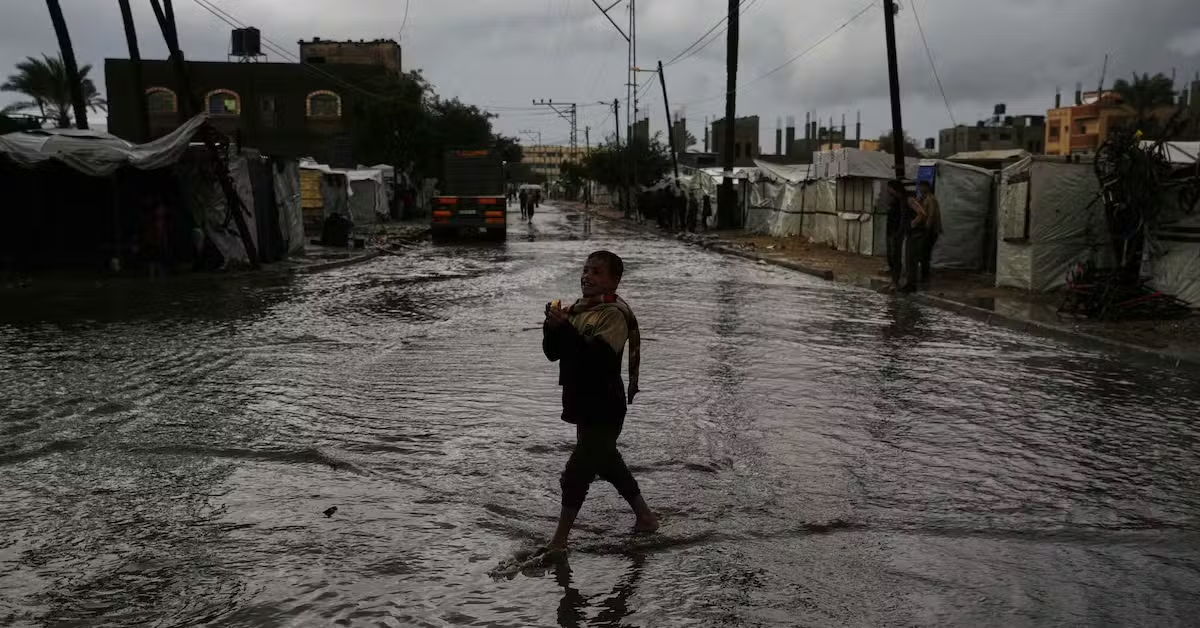
Floods kill four in Gaza as Israel's blockade of reconstruction extends past a year
Summary
- Israel has blocked the entry of shelter and reconstruction materials into Gaza for more than a year after the ceasefire imposed under Trump's plan.
- Floods from the first November storm killed four people in Deir al Balah and damaged more than 40,000 family shelters in Gaza's displacement camps.
- More than 150,000 tents are waiting at Gaza's border for Israeli authorization while 1.7 million Gazans live in tents or damaged buildings.
- The Board of Peace declared the situation a humanitarian emergency; Israel conditions reconstruction on Hamas disarming and blames it for delays.
- Displaced families, several in tents for nearly three years since their homes were destroyed in 2023, are facing their fourth winter without safe shelter.
Reactions
- The Board of Peace said Israel's response to humanitarian needs is 'insufficient' and urged it to immediately authorize winter and shelter supplies.
- Israel reacted angrily to the Board of Peace's criticism, saying it works in close cooperation with the United States and the body.
- Israel's Foreign Ministry wrote that Israel does not control the weather and accused Hamas of stealing aid while UN agencies look the other way.
- Israel blamed Hamas for delays in implementing the 20-point plan and said reconstruction will begin only when the group disarms.
- UNICEF mourned the children killed and warned that nearly half of the 950,000 displaced people in flood-vulnerable areas of Gaza are children.
- The Humanitarian Team for the Occupied Palestinian Territory said the storm's devastating impact could have been avoided.
Timeline newest first
Israeli troops now hold most of Al Tufah, a neighborhood in eastern Gaza City, with no one knowing for how long.
Gaza's Health Ministry reported on 9 November 2026 that a sand wall fell on a tent in Deir al Balah, killing three children aged four, five, and eight and a pregnant woman.
Sources newest first
Israel asfixia la esperanza en Gaza tras más de un año de bloqueo a la reconstrucción
An El País article by Seham Tantish and Antonio Pita reports on Israel's more than year-long blockade of Gaza's reconstruction. It follows Mohammed Al Jalis, displaced from Gaza City's Al Tufah neighborhood to a tent in Deir El Balah where water seeped in as he slept with his wife and two-month-old baby, and notes Al Tufah is now mostly held by Israeli troops.
Las lluvias y el bloqueo israelí arrasan Gaza: “No nos queda ningún colchón seco para dormir"
eldiario.es reports that recent floods and Israel's blockade devastated Gaza's displacement camps, killing four people — three children and a woman — when a sand wall fell on their tent in Deir al Balah, and damaging more than 40,000 family shelters. Over 150,000 tents await Israeli authorization at the border, while the Board of Peace calls the situation a humanitarian emergency and Israel blames Hamas; the UN says the storm's impact could have been avoided.
