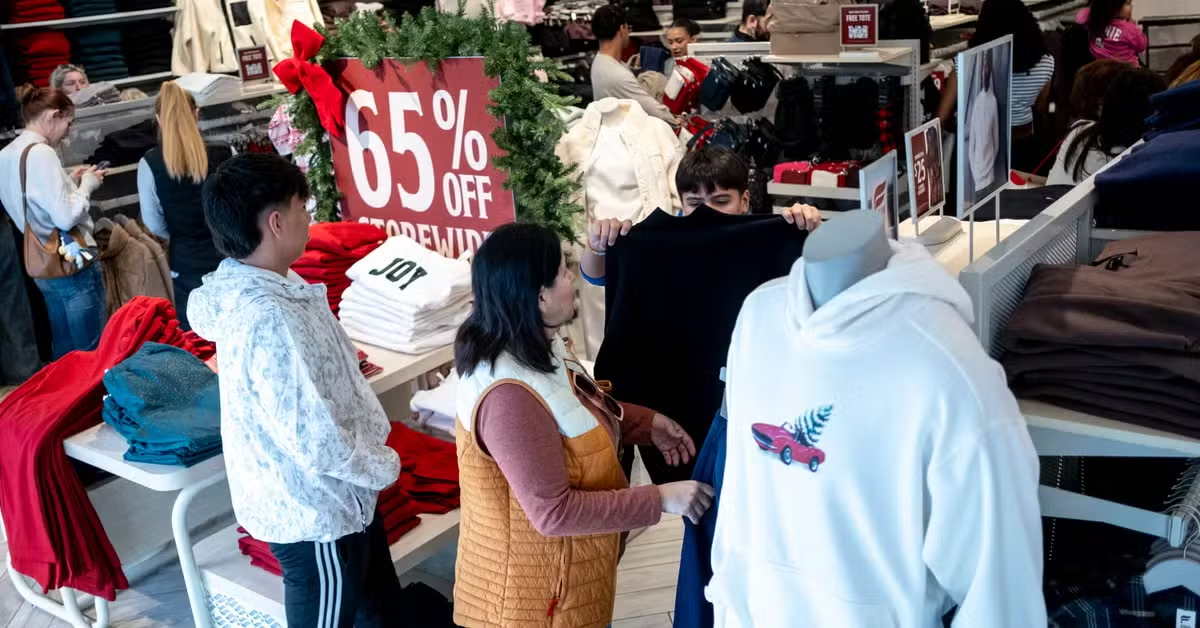
Americans shop Black Friday despite stretched budgets
Americans shop on Black Friday despite stretched budgets
independent.co.uk· 38h
US shoppers prioritize Black Friday deals and necessities
newsnationnow.com· 44h
Inflation has shoppers hunting for value. That bodes well for Black Friday
cnbc.com· 47h
US shoppers get ready for Black Friday and Cyber Monday
aljazeera.com· 47h
Cautious consumers gear up for Black Friday as inflation woes bite
reuters.com· 2d
Americans planned to shop through the holiday season in 2026 even as many had less money to spend and tried to manage costs. A November National Retail Federation survey found 82% of consumers were taking steps to manage holiday costs, while a Gartner survey found nearly 60% had less money for holiday spending than in 2025.
Deloitte found 87% of surveyed consumers planned to shop during the five-day period from Thanksgiving through Cyber Monday, the highest share in a decade. Yet middle- and lower-income shoppers were more likely than wealthy shoppers to spend less, and toy prices had risen 13.2% since the start of 2026.
Retailers began offering holiday discounts weeks before Black Friday, and Amazon started its sale on November 19. Walmart's sale ran four days longer than in 2025, while Target's ran one day longer; shoppers could also find steep discounts on selected goods.
Shopping remained split between online and in-person plans: shoppers expected to complete 52% of their holiday shopping online, down from 56% in 2025. One Texas shopper woke at 2 a.m. to line up at a Dallas store for a bag available only in person.
The cost pressures remained apparent in a November National Debt Relief survey: roughly 66% of US consumers were still paying off the previous year's holiday purchases, and about 81% of that group said the debt was stressing them.
US holiday spending forecasts showed gains of 4% to 6%, with much of the increase attributed to inflation at 3.8%.
A November 2026 National Retail Federation survey found 82% of consumers were taking steps to manage holiday costs.
Deloitte found 87% of surveyed consumers planned to shop during the five-day period from Thanksgiving through Cyber Monday, the highest share in a decade.
Middle- and lower-income shoppers were more likely than wealthy shoppers to spend less.
Toy prices had risen 13.2% since the start of 2026.
Squishy NeeDoh toys sold for $24.99 on Amazon in October 2026, nearly triple their October 2025 price.
Felicia Cox said she wanted to buy more gifts people would use or need and felt people could not afford as much as they used to.
Kohl's CEO Michael Bender said consumers were “increasingly choiceful” and “looking to stretch every dollar.”
Learning Resources CEO Rick Woldenberg said demand was roughly flat, demand was hard to predict before Black Friday, and people could not shop until after Thanksgiving.
Katie Thomas of Kearney said people still liked holiday spending despite an undercurrent of stress.
UBS analysts forecast that a market decline could dampen the wealth effect behind affluent shoppers' spending on gadgets and accessories.
Ryan Orabone forecast that the deepest discounts could come closer to Christmas as shoppers use AI to find deals and retailers adjust prices more quickly; he advised shoppers to be patient and not jump on the first deal.
The National Retail Federation forecast holiday retail sales would rise 4.2% year over year to just above $1 trillion.
The Mastercard Economics Institute and EY Parthenon forecast holiday sales would rise by more than 5%.
Many US retailers began offering holiday discounts weeks before Black Friday.
A Gartner survey found nearly 60% of Americans had less money for holiday spending in 2026 than in 2025, and 57% had begun holiday shopping in October or earlier.
Amazon began its 2026 Black Friday sales on November 19, offering discounts of up to 40% on some toys, 35% on select electronics, and 50% on Levi's clothing.
US shoppers expected to complete 52% of their holiday shopping online in 2026, down from 56% in 2025 and 60% in 2020.
The National Retail Federation expected 126 million Americans to shop on Black Friday and 66.1 million on Cyber Monday.
PwC forecast holiday gift spending would fall 2% from 2025, with millennials cutting gift spending by 10%.
The Conference Board forecast consumers earning under $125,000 would rein in holiday gift spending, while those earning more would spend 3.6% more.
Adobe Analytics forecast nearly $2 billion in Black Friday and Cyber Monday online purchases would use buy-now-pay-later services, and online discounts could reach 30%. It forecast toy discounts would peak at 29% on Black Friday and electronics discounts at 30% on Cyber Monday.
Deloitte estimated 55% of 2026 US holiday shopping would be online and 45% in stores.
A Texas shopper woke at 2 a.m. to line up at Portland Leather Goods in Dallas, hoping to buy a bag available only in stores.
The National Retail Federation forecast holiday spending would reach $1 trillion and said 82% of consumers would take measures to manage costs, including buying less expensive gifts, cutting spending elsewhere, or buying gifts for fewer people.
Deloitte found 87% planned to shop during the five-day Thanksgiving promotional period, average spending per person was expected to reach $625, and Gen Z and millennials were expected to make up 94% of participants.
The National Retail Federation said AI would play a role in holiday shopping.
Walmart's 2026 Black Friday sale ran four days longer than its 2025 sale, while Target's event ran one day longer.
Walmart offered discounts including Beats Studio Pro headphones for $99.99 and a Gourmia 8-quart air fryer for $39, each marked down 66%.
Target offered a Keurig K-Mini Mate for $49.99 after a 60% discount and a 6.5-foot pre-lit Christmas tree for $45, half off.
Amazon offered Black Friday discounts of up to 70%, while Best Buy advertised doorbuster deals on electronics and appliances.
A November 2026 National Debt Relief survey found roughly 66% of US consumers were still paying off the previous year's holiday purchases, and about 81% of that group said the debt was stressing them.
Adobe forecast record Black Friday spending of $12.9 billion and Cyber Monday spending above $15.1 billion, a combined $2 billion more than in 2025.
Chris Nile said inflation was higher and even a McDonald's McChicken cost more.
Adobe forecast that Black Friday bargain shoppers would find deals on electronics, apparel, sporting goods, appliances, and furniture.
Rose Lora said her household would still buy gifts but would be more cautious with money.

