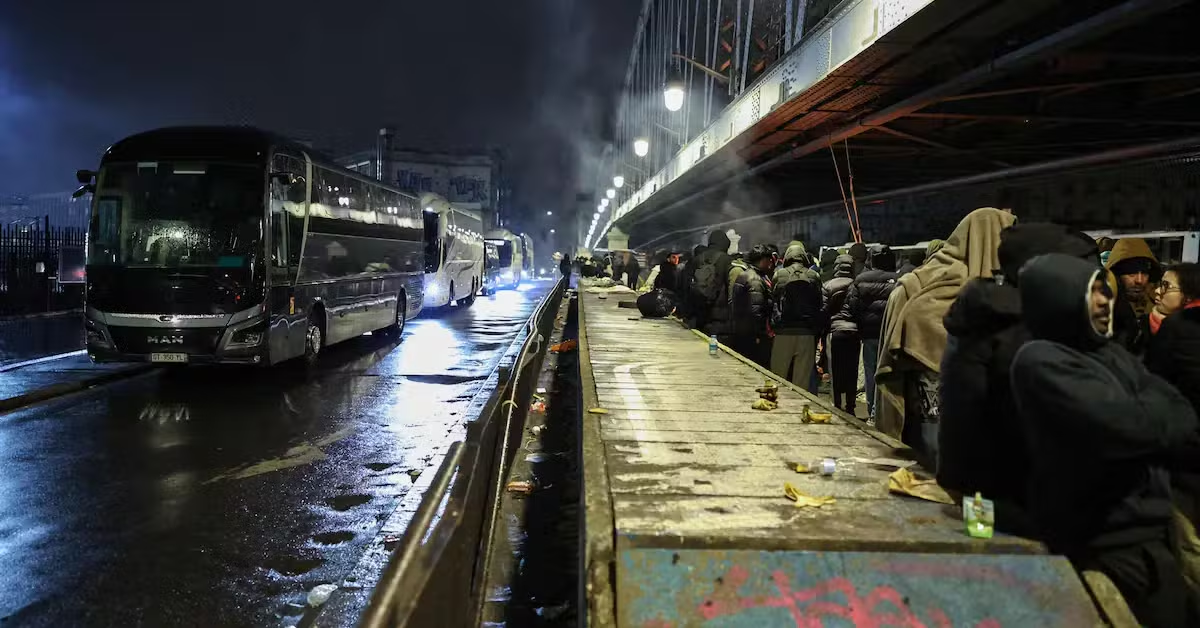
Paris evacuates last migrant camp under metro line 2 and installs grilles to prevent reoccupation
Paris : évacuation du dernier campement de migrants sous le viaduc du métro La Chapelle sur la ligne 2
liberation.fr· 22m
France: évacuation du dernier campement d'exilés sous la ligne 2 du métro parisien
rfi.fr· 1h
A Paris, le dernier grand campement de migrants sous la ligne 2 du métro aérien a été évacué
lemonde.fr· 2h
Police and the Paris regional prefecture evacuated more than 400 migrants on the morning of 25 November 2026 from the last camp under the line 2 aerial metro at the La Chapelle viaduct in the 18th arrondissement, in a joint sheltering operation with the City of Paris. The residents, mostly single men from Afghanistan and Sudan with international protection, had been told of the operation on 20 November by a prefectural order posted on both sides of the camp. From about 7 am, buses carried them to towns in Ile-de-France and elsewhere in France, with mediators offering places outside Paris first.
The prefecture said residents were sent to 119 places in regional transit centers and 235 places in assessment centers in Ile-de-France, while about sixty families with children on the edge of the camp were housed by the City of Paris in permanent accommodation centers, according to deputy mayor for emergency housing Adji Ahoudian. Médecins du Monde estimated 417 people were oriented in all.
The operation was calm but tightly controlled: police cordoned off the camp with tape and removed recalcitrant residents by force, including Médecins du Monde coordinator Paul Alauzy, while association representatives, journalists and non-mandated groups were kept outside the perimeter. It was the fourth evacuation since early October 2026 and the last phase of clearing the stretch of elevated line between Colonel-Fabien and Barbès, where grilles have been installed to stop a camp from being reinstalled.
Police and the Paris regional prefecture evacuated more than 400 migrants on the morning of 25 November 2026 from the last camp under the line 2 aerial metro at the La Chapelle viaduct in the 18th arrondissement, in a joint sheltering operation with the City of Paris.
The camp residents, mostly single men from Afghanistan and Sudan holding international protection, were sent by the prefecture to 119 places in regional transit centers and 235 places in assessment centers in Ile-de-France, according to the prefecture.
Adji Ahoudian, deputy mayor of Paris for emergency housing, said about sixty families with children on the edge of the camp were housed by the City of Paris in permanent accommodation centers.
Association representatives who came to support the homeless were pushed out of the camp perimeter by police, though the evacuation itself took place calmly.
The evacuation was the fourth since early October 2026 and the last phase of clearing the long stretch of the elevated line 2 between the Colonel-Fabien and Barbès stations.
Grilles were installed along the stretch between Colonel-Fabien and Barbès, which spans the 10th, 18th and 19th arrondissements, to stop a camp from being reinstalled.
Paris mayor Emmanuel Grégoire said in a statement that nearly 1,200 people in total were sheltered as part of the operation.
Grégoire said it is the first time since 2022 that there is no camp under Paris's metro line 2, and renewed his pledge to end what he called an unworthy humanitarian situation.
Grégoire pledged to create 4,000 emergency shelter places.
Utopia 56 coordinator Nathan Lequeux said the City of Paris keeps the figures vague and that three-quarters of the solutions offered by the state last no more than a month.
The camp's residents had been informed of the evacuation on 20 November 2026 by a prefectural order posted on both sides of the camp.
From about 7 am, buses carried the evacuees to towns in Ile-de-France and elsewhere in France, and mediators offered places outside Paris first, telling people who wanted to stay in Paris they would have to wait an hour.
Police cordoned off the camp with police nationale tape and removed recalcitrant residents by force, taking them outside the cordon.
Journalists and non-mandated associations were kept out of the camp during the operation, with only associations mandated by Paris city hall or the prefecture allowed inside.
Paul Alauzy, coordinator of Médecins du Monde, was among those removed by force from the camp.
Médecins du Monde estimated that 417 people were oriented after the evacuation, 63 of them placed in Paris by the city, 235 in temporary shelter in the Paris region and 119 in other French cities.
Paul Alauzy said he has become accustomed to being removed by force from camps, protested that even during the Paris Olympic Games people had the right to stay in the camps, and said he thought he would witness such an evacuation only if the far right came to power in France.
Alauzy said the evacuees are poorly oriented and end up in cities they do not know without being fully informed of their options.
Paris city hall said a social survey had been carried out at the camp and that the evacuees knew their destinations and could ask to stay in Paris.
Adji Ahoudian said the exclusion of the press and associations from the evacuation was the prefecture's choice, and the prefecture said only that these are the orders.
Médecins du Monde said the methods used maintain a certain opacity in evacuation operations.
Adji Ahoudian said some 1,546 shelter places have been created since the start of Emmanuel Grégoire's term as mayor of Paris in April.
Emmanuel Grégoire committed to ensuring that no child sleeps on the street in the winter of 2026 to 2027, and said the city is taking its full share, well beyond its obligations, while expecting the state to fully assume its responsibility for emergency housing.
Nathan Lequeux of Utopia 56 said that of 740 people redirected since the line 2 evacuations began, more than 600 received only temporary housing solutions, and denounced a strategy of relocating a problem that is only visually solved.
Lequeux said the City of Paris puts no one on the street, unlike the state, but accused it of being ill at ease with what he called a social clean-up.
Paul Alauzy of Médecins du Monde warned that within three weeks those sent to regional centers in Angers, Bourges, Toulouse and Rouen would find themselves homeless in those cities, and asked where newly arriving migrants will go.
Alauzy accused Paris city hall of barricading line 2 with anti-homeless furniture.
Adji Ahoudian said it falls to the arrondissement mayors to consider a positive occupation of the cleared sites.

