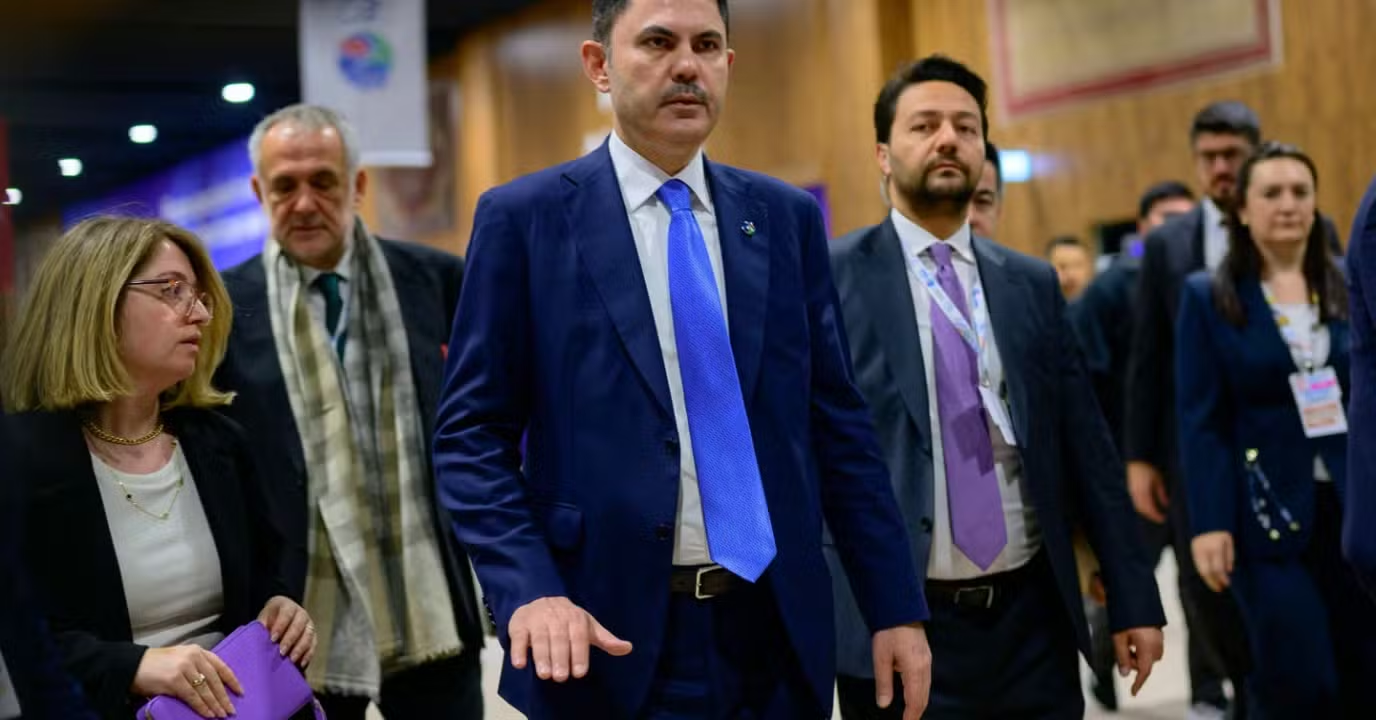
COP31 ends without agreement as EU and Panama reject draft omitting fossil fuels
Climat : l’UE et ses membres « s’opposent » à l’adoption de la décision finale proposée à la COP31
lemonde.fr· 1h
Weltklimakonferenz COP31 : EU lehnt COP31-Erklärung ohne Abkehr von fossiler Energie ab
zeit.de· 1h
Climat : la COP31 au bord de l’impasse ; le dernier texte proposé « nous ramène en arrière », dénonce la France
Cop31 live: A new draft deal on the table as talks go into final hours
theguardian.com· 4h
Climat : accord incertain à la COP31, des pays dénoncent l'absence de sortie des énergies fossiles
france24.com· 6h
Turkey's final draft at UN climate talks doesn't mention the fossil fuels that cause global warming
apnews.com· 8h
Cop31 live: world urged to avoid one of ‘most disappointing Cops ever’ as talks stretch past deadline
Fight over fossil fuels leaves COP31 climate talks in deadlock
bbc.co.uk· 29h
Activists, leaders criticize COP31 climate talks as fossil fuels go unmentioned in draft deal
pbs.org· 37h
Fossil fuel talks deadlock pushes COP31 climate summit into overtime
aljazeera.com· 37h
COP31 Declared a Failure as Declaration Text Excludes Mention of Fossil Fuels
truthout.org· 41h
La COP31 entre en prolongations pour tenter d'arracher un accord sur le climat
Uno-Klimakonferenz in Antalya: Streit über fossile Energien – Klimagipfel geht in die Verlängerung
spiegel.de· 44h
EU warns against COP31 becoming a ‘fossil fuel summit’
politico.eu· 44h
“A COP of Betrayal”: U.N. Talks Make No Progress on Fossil Fuel Phaseout, Climate Finance
democracynow.org· 47h
Nations Blast Fossil Fuel Sector’s Influence on UN Climate Deal
bloomberg.com· 47h
Climate talks drop fossil fuel phaseout and pivot to carbon capture
ft.com· 2d
Pacific islanders face a ‘sickening disconnect’ between Cop31 and the climate devastation at their doorstep
COP31 sur le climat : les énergies fossiles retirées du projet de décision finale
Latest COP31 Text Drops Fossil Fuel Phase-Out and Embraces “Magic Technologies”
Cop31 risks becoming ‘ghost’ summit after all mentions of ‘fossil fuels’ removed from draft text
Fossil fuels score 2 wins 5,000 miles apart
politico.com· 2d
COP31 : les énergies fossiles ont disparu du nouveau projet de « décision finale », à la veille de la fin théorique des négociations
COP31 Climate Talks Drop Push to Spur Retreat From Fossil Fuels
LIVE: COP31 president Murat Kurum holds press conference
youtube.com· 2d
“This Is Not Going Well”: COP31 Draft Text Avoids Fossil Fuel Phaseout, Bets on “Magic Technologies”
Climate Talks Ditch Call to Quit Fossil Fuels as Deal Nears
Cop31 live: Fossil fuels dumped from latest draft deal at climate summit
The UN climate summit COP31 in Antalya, Turkey, ended without agreement after nearly 200 countries failed to settle a final declaration over the future of fossil fuels. A second draft of the cover decision, released on 19 November, cut every mention of fossil fuels from a first draft that had named them six times, halving the text and replacing the Cop28 language on transitioning away from oil, gas and coal. Observers suspected oil-producing states such as Saudi Arabia and Russia of being behind the removal.
The draft drew a broad backlash. Panama threatened to block any deal that did not cap oil production, and the EU's 27 member states warned in a letter that the conference risked turning into a 'fossil fuel summit', while NGOs and campaigners called the text a gift to the fossil fuel industry. The talks ran past their scheduled close on 20 November without a deal, delegates bargaining through the night into deadlock, and the draft agreement, known as the Antalya Accords, for the first time at a COP acknowledged that the goal of keeping temperature rise below 1.5C has been missed.
A new and possibly final draft appeared after 3am on Sunday 22 November, giving negotiators about three hours to object. It recalled the Cop28 agreement 'in its entirety' but contained none of the words 'fossil', 'oil', 'coal' or 'phase out', kept a goal of 35 percent of final energy from electricity by 2035, and omitted a $120bn adaptation finance target. With many negotiators already departing, the European Union rejected the final draft at the closing plenary and Panama lodged a formal objection, and after running far into overtime the summit ended with no agreement.
The second draft of the Cop31 cover decision, released on Thursday afternoon at the summit in Antalya, Turkey, removed every mention of fossil fuels, which the first draft published on Monday had contained six times.
The new draft was cut to 9 pages and 80 paragraphs from 144 items in the earlier 18-page version.
In place of the transition away from fossil fuels agreed at Cop28 in Dubai, the draft promises a transition towards low greenhouse gas emissions and climate-resilient development.
The draft retained the commitment to holding temperatures to 1.5C but dropped its expression of deep concern about overshooting that target.
The goal of deriving 35 percent of final energy from electricity by 2035 was downgraded to a voluntary option countries may take according to their national circumstances.
The draft calls on countries to resolve their differences over the Intergovernmental Panel on Climate Change so its latest science can inform negotiations at Cop33.
Some countries pushed for the fossil fuel language to be removed, others including the Pacific islands insisted it be retained, and some indicated willingness to consider compromises.
The draft text offered potential compromises on climate finance, trade curbs and the timing of key science reports, raising the chances of a broad deal among almost 200 nations.
The draft put the summit on track to endorse efforts to electrify the global economy.
The second draft emphasised carbon capture and storage, a technology critics call largely unproven and impossible to deploy at scale.
Activists criticised the draft for stripping out language on accountability from Global North countries and legal anchors protecting the countries most vulnerable to climate change.
Teresa Anderson, global lead on climate justice at ActionAid International, said the negotiations were 'looking bleak'.
Luisa Neubauer said the draft strips out the mention of having to get away from the use and exploitation of oil, coal and gas.
Luisa Neubauer said Saudi Arabia and some petroleum states have won big with 'magic technologies' that suck CO2 out of the atmosphere and will not deliver at scale.
Luisa Neubauer said the COP31 conference is not going well.
Turkey's climate minister Murat Kurum, president of COP31, held a press conference in Antalya as the meeting approached its 20 November deadline.
Delegates waited hours for the release of the new draft text.
The draft dropped a flagship number for adaptation funding and raised the prospect of a final deal on electrification, climate science and trade.
Panama threatened, just before the draft's publication, to block the consensus needed for adoption unless the text referred to a phase-out of oil and the importance of climate science.
France's minister of ecological transition, Monique Barbut, called the draft's absence of any mention of the transition away from fossil fuels a 'black spot' and said France will fight for clean electrification.
Chris Bowen, the Australian president of the COP31 negotiations, announced that intense consultations would be opened with all negotiating groups that afternoon and through the night.
Mohamed Adow, director of Power Shift Africa, said that if this version of the text remains, COP31 will be a ghost COP.
Inga Fritzen Buan of WWF said some large fossil fuel producers are trying to undermine everything concerning emissions reduction and the energy transition.
The earlier version of the final decision had called for 'accelerated action to phase out' the use of oil, gas and coal.
The fresh draft omitted direct references to 'clean' electricity, suggesting countries could meet rising power demand with fossil fuels.
Panama wrote to the Australian and Turkish presidents of Cop31 announcing it would block any outcome unless all its demands were met.
A separate climate finance negotiating strand produced a largely empty document, with no progress on delivering the $300bn a year developed countries have pledged to the developing world by 2035.
The joint Australian and Turkish presidencies halved the 18-page first draft, cutting the fossil fuel phaseout and stronger adaptation support for developing countries.
The presidencies began meetings with the main negotiating groups and individual countries scheduled to run through Thursday night, with the talks scheduled to end on Friday at 6pm in Turkey.
In a letter to the Cop31 presidencies, Panama's environment minister Juan Carlos Navarro wrote that while the speeches at the talks are beautiful, the planet is being destroyed, and that the world needs and expects radical change which the negotiators are not delivering.
Mohamed Adow said the talks were 'muzzled' by the refusal of some fossil fuel producing countries to allow a commitment to transition away from fossil fuels to stand, and that frontline communities will look on with despair.
Rachitaa Gupta, global coordinator of the Global Campaign to Demand Climate Justice, said what remains is the global north's political resolve to provide the finance, and that its moral bankruptcy is very visible to everyone in the global south.
Andreas Sieber of 350.org said the Cop31 presidencies are on the brink of an outrageous and utterly embarrassing lack of leadership, having reduced a defining challenge to an inconvenient paragraph they would rather delete, and called rich countries' failure on finance a historic disgrace and a shameless abdication of political responsibility.
Australia's climate and energy minister Chris Bowen laid the blame for the weak text at the door of the countries present, saying the presidencies put forward what gives the best chance of the most ambitious results that consensus will allow.
Turkey's Murat Kurum said there is 'great enthusiasm' among the countries negotiating, that the text shows a 'strong commitment to the Paris agreement', and that removing the words fossil fuels had been agreed at previous Cops, so he does not think there is any backsliding.
Adoption of the draft final decision requires the consensus of the nearly 200 countries represented in Antalya.
A push emerged for the final Cop31 agreement to reference the International Court of Justice advisory opinion, though its success was far from guaranteed.
Pacific nations feared the Cop31 process in Turkey might fail them again as the talks neared their scheduled Friday close.
Fiji's climate minister Lynda Tabuya said Cop31 must have 'red lines', and that if the final deal does not articulate the need to transition away from fossil fuels and keep the 1.5C target alive, 'this Cop will be a failure', in which case the Pacific will need to find other ways to achieve the transition.
Shiva Gounden, lead Pacific campaigner at Greenpeace, said there is a 'sickening disconnect' between the negotiating rooms and the devastation facing Pacific communities, that the Pacific will not be 'passive victims', and forecast it will secure its survival, justice and financing whether developed countries join it or are dragged there through the courts.
Vanuatu's climate change minister Ralph Regenvanu said the region's nations are engaging in the Cop31 talks 'in good faith'.
UN special rapporteur Elisa Morgera said the International Court of Justice opinion has been challenged in negotiating rooms.
Anthony Albanese said at Cop31's opening that he is 'proud to be here fighting for the interests of our Pacific family'.
Nations from Europe, Central America and the Pacific criticised the draft deal and accused the oil and gas sector of swaying the negotiations in the industry's favour.
A number of NGOs announced their rejection of the COP31 final declaration text, which contains no mention of fossil fuels and no clear financial commitments from polluter countries.
Harjeet Singh, founding director of the Satat Sampada Climate Foundation, said the summit, touted as a 'COP of implementation', has become 'a COP of betrayal and a COP of distraction'.
Nafkote Dabi of Oxfam International said rich countries, especially the EU, say there is no money at home, but that they can tax the richest, the excess profits of fossil fuel companies, private jets and extreme wealth to raise the funds needed to support communities.
EU Climate Commissioner Wopke Hoekstra and Irish Climate Minister Darragh O'Brien sent a 19 November letter to Australia and Turkey on behalf of the EU's 27 member states warning the conference risks turning into a 'fossil fuel summit'.
The letter asked the joint presidencies to address the EU's demands, saying the draft would be perceived as a retreat from previous commitments and as disproportionately accommodating continued fossil fuel production and consumption.
The draft called on countries to scale up carbon capture and storage to meet a specific target, and France heavily criticised the inclusion of carbon capture targets.
Wopke Hoekstra and Darragh O'Brien wrote in the letter: 'The EU must be clear that it cannot join consensus on a package that would represent a substantive step backwards for global climate action,' adding that 'The EU always prefers an ambitious negotiated outcome but cannot accept agreement at any cost.'
Monique Barbut told reporters: 'When it comes to carbon capture, we're completely opposed, and this is a real red line, to any figures, any targets, or any quantified objectives.'
Talks ran past the scheduled 6pm close on 20 November, with nearly 200 states still negotiating and waiting for a revised overarching conference decision.
France and eleven other states demanded in a joint paper that the closing declaration contain a clear farewell to fossil energies and much faster cuts in methane emissions.
Germany's Carsten Schneider spoke at a press conference alongside an alliance of around 25 states applying pressure for a gradual phase-out of fossil energies.
Ghana's Zanetor Agyeman-Rawlings said the proposal to triple adaptation funds was not even put on the agenda, with public adaptation funds from industrialised states at 28.2 to 31.7 billion dollars in 2024 against a need of about 305 billion dollars a year until 2035.
The Turkish presidency proposed raising the share of electricity in global final energy consumption from 23 to 35 percent, with dispute over whether the text should say the electricity must come from clean sources.
Observers suspected oil-producing states such as Saudi Arabia and Russia of being behind the removal of the fossil fuel language.
EU negotiators in Antalya said the draft closing declaration on the table was 'not acceptable'.
Monique Barbut called it a 'slap in the face' that the closing declaration is not even to mention the unavoidable phase-out of oil, gas and coal.
Juan Carlos Navarro said it is not acceptable to have a COP closing declaration that does not even mention fossil fuels, adding 'We simply will not put up with that.'
Carsten Schneider said some do not want to use the term fossil fuels because 'There are some who earn a lot of money with it,' and that oil, gas and coal are the main drivers of the climate crisis: 'We must stop burning our world.'
Zanetor Agyeman-Rawlings said: 'We demand a fixed baseline for the tripling, annual milestones, public monitoring, and an implementation plan.'
A dozen countries including France, Panama and Côte d'Ivoire demanded that the final decision mention 'a clear transition away from fossil fuels'.
Demonstrators held placards reading 'Shame!' during a COP31 session.
The EU, the Least Developed Countries and small island states want the IPCC's next series of reports to be available before the 2028 global stocktake, while countries including Saudi Arabia and India are pushing to postpone them to 2029.
A new compromise proposal was expected on the evening of 20 November.
Chris Bowen said 'electrification' is the key to gradually exiting fossil fuels and 'the way forward'.
Tracy Carty of Greenpeace said the draft text, without a mention of the end of fossil fuels, would be a colossal setback and totally unacceptable.
Aloisio Lopes Pereira de Melo, climate chief at Brazil's Ministry of the Environment, said that at this stage nobody is satisfied.
Zanetor Agyeman-Rawlings warned that Africa will not accept an outcome limited to declarations without the resources needed to implement them.
Panama's Juan Carlos Navarro threatened to block any final agreement that does not include a cap on oil production, speaking flanked by representatives from Finland, Vanuatu, Belgium, Ivory Coast, France, Guatemala and other countries.
Activists at a packed Climate Action Network news conference called out the European Union and other developed nations for obstruction as the room repeatedly broke into chants of 'shame'.
Juan Carlos Navarro said 'We are being held hostage by the petroleum mafia', said everything in the final declaration must be based on science, demanded a clear, orderly transition away from fossil fuels, said fair contributions must come from those with the greatest responsibility, saying 'You pollute, you pay', and said the COP can still be saved if the declaration focuses on six key issues.
Tasneem Essop, executive director of Climate Action Network International, said there is nothing on the table that protects people or addresses the priorities of the Global South, that the decisions leaving COP31 promote the interests of the culprits, and that a commissioner of a very important regional bloc came saying 'We're not coming with any finance. Finance is dead in the water.'
Tasneem Essop said COP31 has had the highest number of lobbyists, including fossil fuel, AI, CCUS and CDR lobbyists, and that adaptation finance pledges totaled around $50 million, half the cost of an F-35 fighter jet.
Avantika Goswami of CSE India said the European Union has taken on the mantle of the blocker the United States left vacant at COP31.
Anabella Rosemberg of Climate Action Network International said the COP is not dying but being killed because it is the last space where civil society and developing countries can hold developed countries accountable, and civil society will fight back.
Mohamed Adow said COP31 has been the worst COP ever and that communities living through drought, floods and failed harvests cannot survive on an annual renewal of promises.
Harjeet Singh said there was a clear agreement to scale adaptation finance to $120 billion annually for developing countries, that dropping the fossil fuel phaseout reference is just not acceptable, and called on developing countries to stand up loudly and reject the text.
Meena Raman of Third World Network said the most important aspect of the COP is money, and there is no point in higher ambition on emission reductions, fossil fuel phaseout or electrification targets when the means to implement them is not available.
Nafkote Dabi said taxing private jets alone could raise $45 billion a year and taxing the excess profits of fossil fuel companies $400 billion.
A late closing session on 20 November approved some technical matters but not the wider political deal.
The Thursday draft removed every mention of fossil fuels after Saudi Arabia and other major oil and gas producers objected.
The revised draft also dropped a $120bn target for money to help poorer countries adapt to climate change.
Panama signed a letter with a dozen other countries demanding 'a clear transition away from fossil fuels' and threatening to walk away from the talks.
A third draft of the deal was expected on Saturday 21 November.
Murat Kurum said at a plenary session: 'We are close to the finish line, but we are not there yet.'
Vanuatu's Climate Minister Ralph Regenvanu said: 'We want to see the references to false solutions removed.'
Ghana's Environment Minister Zanetor Agyeman-Rawlings said: 'We didn't come here to beg.'
During a late-night session delegates passed a protest banner reading 'failure', and a demonstrator interrupted Murat Kurum shouting 'you are killing the future'.
The draft said a fund to compensate countries ravaged by climate change should be tripled but specified no amount, where a previous version said at least $120 billion annually would be needed.
Panama said it would formally object if the final agreement does not add climate finance, cap oil production and acknowledge failing goals.
Murat Kurum said the electrification push implies a transition away from fossil fuels and 'We are not here to discuss decisions at previous Cops'.
Alden Meyer of E3G said it would be a real setback if the talks end with no signal that participants were serious about what they agreed to in 2023, and warned that unless things changed the talks were heading for a very disappointing outcome.
Juan Carlos Navarro said the talks are being held hostage by a 'petroleum mafia' and need to be reformed, and reminded Murat Kurum that a final decision cannot be rammed through without allowing countries to object.
Ghiwa Nakat, executive director of Greenpeace in the Middle East and North Africa, said weakening commitments on fossil fuel phase-out risks undermining progress.
Iskander Erzini Vernoit, an adviser to African negotiators, said disappointment is rife and, absent a course correction, the talks are headed toward a low-ambition set of outcomes.
Negotiations ran through the night into deadlock, and a new and potentially final agreement was expected on Saturday.
In a late intervention on Friday a group of countries led by France and Panama pushed back against the draft, supported by ministers from island states and EU nations including Spain, Belgium, Sweden and Finland, while fossil fuel producers led by Saudi Arabia pushed for the commitment's removal.
For the first time at a COP, the draft agreement, known officially as the Antalya Accords, acknowledged that the goal of keeping global temperature rise below 1.5C has been missed.
Other EU nations asked to join the rebellion against the draft declined, considering it unhelpful to the negotiations.
One proposal under discussion was to keep fossil fuels off the table in exchange for Saudi Arabia and other petro-states signing up to a pledge for 35 percent of their energy consumption to come from electricity by 2035.
An observer said Turkey has been unpopular as host after its lead negotiator walked out of some crucial negotiations, leaving many countries feeling 'disrespected'.
Monique Barbut criticised the draft's references to carbon capture, use and storage as a licence for other countries to keep burning oil and gas, and said: 'We cannot be announcing to the world that we are now getting to 1.5 increase in the temperature and do business like nothing was happening.'
Chris Bowen said the summit is about implementation and should focus on the move towards clean energy sources.
The Cop31 talks officially ended on 20 November without a final deal, with delegates told to go home and return the next morning.
One hundred civil society organisations wrote overnight to the presidencies warning Cop31 risks being 'one of the most disappointing Cops the UNFCCC has ever had' and calling the draft cover text 'a gift to the fossil fuel industry'.
The letter called on the presidencies to remove carbon capture targets, welcome the International Court of Justice advisory opinion, link the electrification goal to renewable energy and the transition away from fossil fuels, and take the Cop30 roadmap forward through to the second Global Stocktake.
Australia and China signed a joint statement on Friday night endorsing the 35 percent electrification goal for 2035.
Panama's Thursday letter warned it would block any deal that did not include its eight requirements, which include real transparency, new rules of engagement and a cap on oil production.
African ministers warned the summit that rich countries were undermining the trust and credibility of the UN climate process by failing to live up to their Paris agreement commitments.
Seventeen campaigners were refused entry to Cop31 and everyone attending on a badge linked to Colectivo VientoSur was barred after one of them staged an unauthorised protest in the closing plenary.
By midday on 21 November the expected new draft had not appeared, putting the planned afternoon closing plenary under threat, with reports the presidency held bilaterals with parties until 5am.
The civil society letter said 'The Global South is being abandoned' and that developed countries blocked progress across the negotiations and arrived with no new finance commitments, and that the draft has 'all the hallmarks of a deal to let carbon capture through in exchange for an electrification target that does not even require renewables-based electricity', adding 'None of this is defensible'.
Amalen Sathananthar of the Artivist Network shouted from a table at the closing plenary: 'You are killing the future. Why don't you just kill me now. The climate crisis is killing us, and you do nothing. You don't remove fossil fuels, you are killing 1.5C.'
Katharine Hayhoe said in a social media post: 'A climate deal that leaves out fossil fuels is like a plan to quit smoking that never mentions cigarettes.'
Jeff Masters quoted climate scientist Ricky Rood's analogy comparing the climate deal to announcing an ambitious investment in towels while a bathtub overflows instead of turning off the tap.
Turkish Environment Minister Murat Kurum released the newest and possibly final 10-page draft after 3am on Sunday 22 November, giving negotiators about three hours to object before what may be the summit's final meeting.
The draft references the Dubai agreement but contains none of the words 'fossil', 'oil', 'coal' or 'phase out'.
The draft includes a specific goal of supporting carbon capture and storage to capture, reuse and store 1 billion metric tons of carbon.
Several nations made serious objections to the draft, which needs near-unanimous consensus for approval.
Deliberations continued on Sunday nearly 40 hours past the official deadline, and organisers worried that with negotiators departing there may not be enough delegates left in the room to pass the draft.
Rachel Cleetus of the Union of Concerned Scientists said: 'Fossil fuels are the root cause of climate change and there is no plausible pathway to limit climate overshoot without rapidly phasing them out.'
Bill Hare, CEO of Climate Analytics, said: 'Electrification that runs on coal and gas does not limit warming.'
David Waskow, international climate chief at the World Resources Institute, said: 'It's been a bit of a rocky road and I think took a lot longer than was expected to get close to a conclusion here.'
Many negotiators had already left COP31, creating the risk that too few participants remain to legally approve an agreement.
A plenary of the nearly 200 countries gathered in Antalya was expected on the morning of Sunday 22 November.
A European Union official said there is a 'very real possibility' that the conference ends without an agreement, adding 'I think we are going backwards. I am more pessimistic today than yesterday.'
Michael Joseph, Antigua and Barbuda's environment minister, said he is very disappointed by the form the draft text is taking, though negotiations are continuing.
Sara Shaw of 350.org said world leaders are about to fall into the trap of carbon capture, a 'swindle' pushed by the fossil fuel industry.
The third draft of the cover decision runs to 94 paragraphs across 10 pages.
The draft opens by stating that countries 'recall' the Cop28 UAE consensus 'in its entirety', intended to acknowledge support for transitioning away from fossil fuels without using those words.
The third draft removed the hard numerical target for carbon capture development, acknowledged that as much electrification as possible should be powered by clean energy, kept the goal of 35 percent of final energy from electricity by 2035, and omitted the $120bn adaptation finance target backed by developing countries.
The closing plenary slipped from a planned 9am start to 10am and then to 11am local time.
Talks nearly halted on Saturday as the co-presidents held meetings with scores of countries until late evening with little sign of resolution.
Murat Kurum said 'There are very few issues left', that the cover decision took the views of the countries, and that he believes the decision will be made in the hall.
Bill Hare of Climate Analytics said there is widespread unhappiness about the new text among the Alliance of Small Island States, the Least Developed Countries, the European Union and the Environmental Integrity Group, and that he cannot predict what will happen.
A diplomat from the High Ambition Coalition said there was from the very beginning a sense of a stitch-up between the presidency and Saudi Arabia, with one getting the electrification target and the other the carbon capture and storage target.
Harjeet Singh, global convenor of the Fill the Fund campaign, said the package gives mostly processes on finance, with no $120bn figure and parties only agreeing to discuss a tripling pathway in 2027, adding that 'floods and heatwaves will not wait for 2027'.
Andreas Sieber of 350.org said the final draft confirms an indefensible failure of leadership by the presidencies, which kept a 2035 carbon capture target and struck the transition away from fossil fuels from the text.
Jasper Inventor, head of the Greenpeace Cop31 delegation, said no deal is better than a deal with the fossil fuel industry, and that if the current text is the final outcome it is fundamentally unacceptable.
Cat Abreu, director of the International Climate Politics Hub, said the carbon capture provision came out of nowhere and was parachuted into Cop31 by fossil fuel interests, and must not make it into a final global agreement.
Monique Barbut said in a statement that the text proposed by the presidency 'takes us backwards' and is an 'unacceptable' step back, denouncing the absence of any mention of a fossil fuel exit and saying 'the clock is ticking and the tally still falls short'.
Murat Kurum told journalists 'The ball is now in the countries' court' and that if the text is not adopted, those pushing the COP process into a dead end will have to reflect on their position.
Cosima Cassel of the think tank E3G said the text is weakened on many key points and a compromise is far from certain at this stage.
Shortly before the closing plenary, host country Turkey presented a slightly revised decision text that still omitted the words 'fossil' and 'oil' but slightly changed the wording on the contested carbon capture technologies.
At the closing plenary the European Union rejected the final draft of the closing declaration, and Panama formally lodged an objection against the overall decision text.
In the final phase more than 130 countries, including small island states, African and Latin American countries and less developed states, demanded more ambition on climate protection, a clear majority of the nearly 200 states.
The 31st UN climate conference ended without an agreement after running far into overtime.
Irish Climate Minister Darragh O'Brien, speaking on behalf of the EU Council presidency, said at the closing plenary: 'We will not accept a closing declaration that does not even mention fossil fuels.'
Darragh O'Brien said the EU firmly rejects the text and will not enter into alternative arrangements that do not meet its standards.
Murat Kurum expressed disappointment that no agreement was reached.
Darragh O'Brien announced that the chances of a deal are diminishing 'hour by hour', told the plenary 'We will not approve a decision that does not even mention fossil fuels, the main driver of climate change', said the text 'lacks the necessary climate ambition', and called the absence of a fossil fuel mention 'inadmissible'.