Shenzhou-24 docks at Tiangong as Pakistani astronaut recites national poet's verse
Iqbal in space: Urdu poet’s verses unite India, Pakistan beyond Earth
aljazeera.com· 24h
Why has China sent the first Pakistani astronaut to space?
bbc.com· 47h
Pakistan rejoices as country’s first astronaut enters orbit
Flug zur Weltraumstation »Tiangong«: Chinesische Raumfahrer starten mit Premiere
spiegel.de· 2d
China launches Shenzhou 24 spacecraft carrying first foreign astronaut
euronews.com· 2d
China launches first space mission with foreign astronaut
ft.com· 2d
China rocket blasts off on Shenzhou-24 mission: State media
channelnewsasia.com· 2d
China launches Shenzhou 24 spacecraft carrying 2 Chinese and a Pakistani astronaut
apnews.com· 2d
China's Shenzhou-24 space flight takes off with Pakistani national as first foreign astronaut
reuters.com· 2d
Shenzhou-24 live: China launches crew including Pakistani to its space station
Pakistani astronaut carries ‘hopes of 250 million’ on China space mission
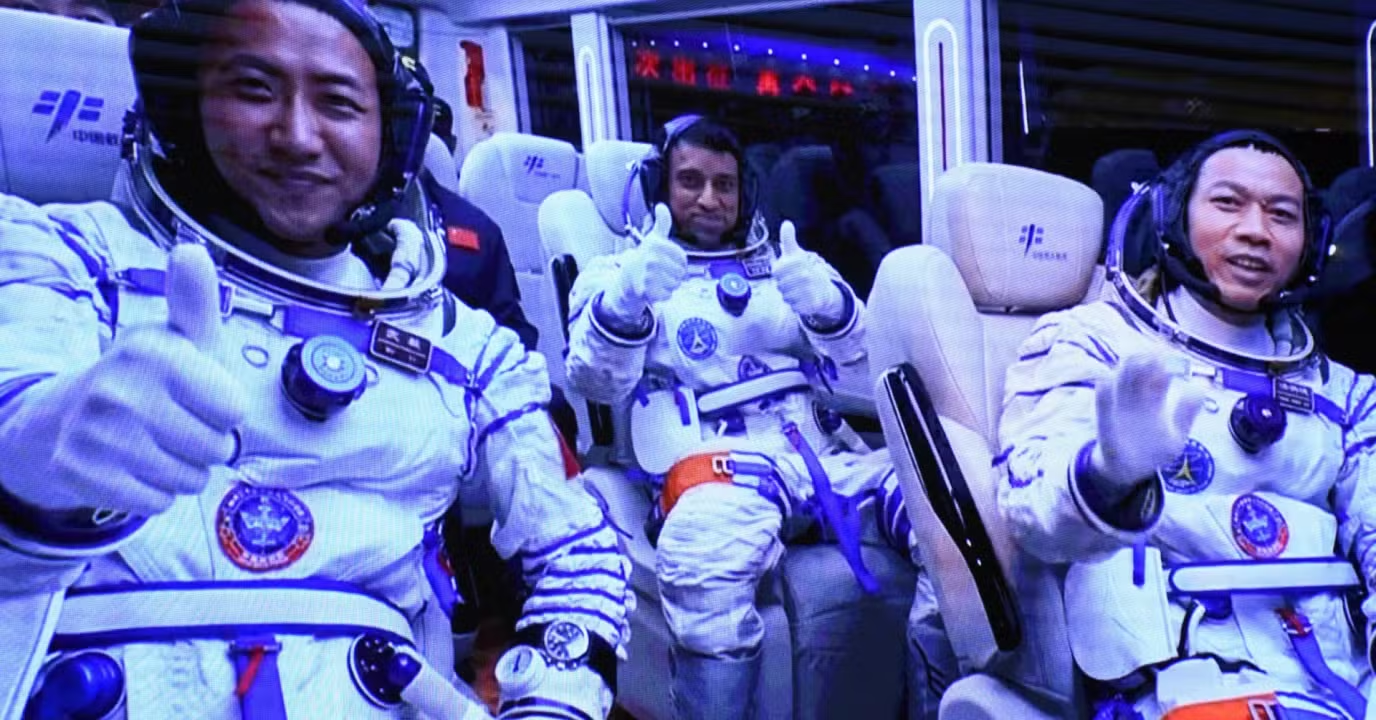
China launched the Shenzhou-24 spacecraft from the Jiuquan Satellite Launch Center on a Long March-2F rocket on 25 November 2026, carrying its first foreign astronaut. The three-person crew consists of Chinese commander Tang Hongbo, flight engineer Wu Yi and Pakistani payload specialist Muhammad Zeeshan Ali, a 40-year-old Pakistan Air Force pilot. He is the first Pakistani in orbit and the first foreign national to board China's Tiangong space station, in the first joint flight with foreign astronauts in the history of China's manned space program.
The spacecraft docked at Tiangong in the early hours of 25 November, hours after liftoff, and China's Manned Space Agency reported a successful launch shortly after. The incoming crew will overlap for a few days with the three Shenzhou-23 astronauts already on board, who will then depart. Zeeshan Ali is expected to spend only five to 10 days on the station before returning to Earth in the Shenzhou-23 return capsule.
According to Pakistan's space agency SUPARCO, he will work on four research projects, including radiation-shielding graphene composites and quinoa seed growth. The mission stems from a space cooperation agreement China and Pakistan signed in February 2025, and the crew will carry out more than 90 scientific experiments and technology tests.
While floating in the station on 25 November, Zeeshan Ali recited a couplet by Pakistan's national poet Muhammad Iqbal, wearing a blue flight suit bearing the Pakistani flag alongside five Chinese crewmates. When he finished with a thank-you and a smile, his crewmates broke into applause and cheers before joining him for midair hugs and laughter.
China launched the Shenzhou-24 spacecraft on 25 November 2026 from the Jiuquan Satellite Launch Center on a Long March-2F rocket, carrying its first foreign astronaut.
The three-person Shenzhou-24 crew consists of Chinese commander Tang Hongbo, flight engineer Wu Yi and Pakistani payload specialist Muhammad Zeeshan Ali, a 40-year-old pilot.
Muhammad Zeeshan Ali is the first Pakistani in orbit and the first foreign national to board China's Tiangong space station, flying as a payload specialist who will carry out scientific experiments.
According to Pakistan's space agency SUPARCO, Zeeshan Ali will work on four research projects, including radiation-shielding graphene composites, self-healing carbon fiber composites, quinoa seed growth and microalgae cultivation for oxygen and food production.
The incoming Shenzhou-24 crew will overlap for a few days with the three Shenzhou-23 astronauts already on board Tiangong, who will then depart, while Shenzhou-23 commander Zhu Yangzhu stays on for a further six months.
Zeeshan Ali is expected to spend only five to 10 days on the Tiangong space station before returning to Earth with two members of the previous mission.
State broadcaster CCTV reported that the Shenzhou-24 spacecraft separated from its rocket, reached its designated orbit and that the crew are in good condition.
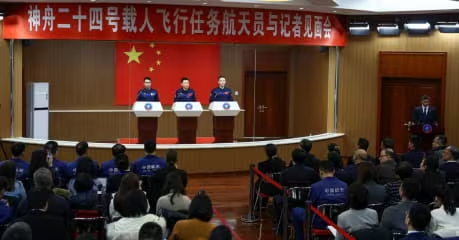
At a news conference on 24 November 2026, Muhammad Zeeshan Ali told reporters, "I carry the name of Pakistan on my shoulder, the hope of 250 million Pakistanis."
Minutes after the launch, the three Shenzhou-24 crew members were seen flipping through a manual on a live feed broadcast by state-run CCTV.
The Shenzhou-24 mission is part of broader China-Pakistan space cooperation.
Blaine Curcio, founder of Hong Kong-based Orbital Gateway Consulting, said the flight brings Pakistan prestige, science and technology know-how, and deeper collaboration and diplomatic goodwill with China.
In a post on X on 24 November 2026, Pakistani Prime Minister Shehbaz Sharif called the Shenzhou-24 flight "a historic first" and thanked Chinese President Xi Jinping, writing that Pakistan-China friendship is surpassing the heights of the Himalayas in its journey to outer space.
The Shenzhou-24 launch marked the first joint flight involving Chinese and foreign astronauts in the history of China's manned space program.
Muhammad Zeeshan Ali and the two Chinese crew members attended a see-off ceremony at the Jiuquan Satellite Launch Center on 25 November 2026.
Muhammad Zeeshan Ali is a Pakistan Air Force pilot who is expected to return to Earth after about five days aboard the Shenzhou-23 spacecraft.
The Shenzhou-24 flight stems from an agreement China and Pakistan signed in February 2025.
China's state media reported that the Shenzhou-24 crew will carry out more than 90 scientific experiments and technology tests.
According to state broadcaster CCTV, Tang Hongbo is set to become the first astronaut to board the Tiangong space station three times.
At a press conference on 24 November 2026, Tang Hongbo said differences in language, culture and psychology had made the joint training harder, but that the effort was paying off.
In a post on X, Pakistani Prime Minister Shehbaz Sharif called the mission a source of national pride and an inspiration for the country's youth, writing it is "not just one astronaut's journey, but the journey of 240 million Pakistanis."
Pakistan's Planning Minister Ahsan Iqbal, speaking at the national space agency's headquarters, thanked President Xi Jinping, China's leadership and its scientists and engineers, and said he hoped the flight would start broader cooperation between the two countries.
Ahsan Iqbal said, "The sky is no longer our limit; it is our launching pad," and called the mission an inspiration for young Pakistanis hoping for careers in science and technology.
Asked whether Pakistan could one day send astronauts on its own, Ahsan Iqbal said, "Certainly that day will come."
Muhammad Zeeshan Ali said he hoped cooperation would grow from one astronaut on one flight to multiple joint missions and eventually to the Moon, Mars and beyond.
Muhammad Zeeshan Ali told the press conference in Mandarin, citing a line of Chinese poetry about climbing higher to see farther, and said, "It's like my daily training. Day after day, reaching new heights."
Zeeshan Ali is to take the free seat in the Shenzhou-23 return capsule next to Zhang Zhiyuan and the Hong Kong astronaut Lai Ka-ying.
China's Manned Space Agency officially reported a successful launch shortly after liftoff.
At a press conference the day before the launch, Muhammad Zeeshan Ali said, "Together with my Chinese crewmates I will show that this friendship is real."
The Shenzhou-24 spacecraft carrying Zeeshan Ali and his two Chinese crewmates docked at the Tiangong space station in the early hours of 25 November 2026.
Muhammad Zeeshan Ali trained for months in China, including learning Chinese, to make the flight happen.
Chinese President Xi Jinping said the joint mission with astronauts from China and Pakistan was "a vivid embodiment of the deep-rooted friendship between the two countries".
In a post on X, Pakistani Prime Minister Shehbaz Sharif wrote, "This is living proof of the ironclad friendship between Pakistan and China. We are grateful to our brother country, China, for making Pakistan part of this historic mission."
While floating in the Tiangong space station on 25 November 2026, Muhammad Zeeshan Ali recited a couplet by Pakistan's national poet Muhammad Iqbal, wearing a blue flight suit bearing the Pakistani flag alongside five Chinese crewmates.
After Zeeshan Ali finished the recitation with a thank-you and a smile, his five Chinese crewmates broke into applause and cheers before joining him for midair hugs and laughter.
From the Tiangong space station, Muhammad Zeeshan Ali recited Muhammad Iqbal's couplet, "Sitaron se aage jahan aur bhi hain, abhi ishq ke imtihan aur bhi hain."
Switching to Mandarin, Muhammad Zeeshan Ali translated the couplet for his Chinese crewmates, saying, "Countless worlds lie beyond the stars, and countless trials are still ahead."