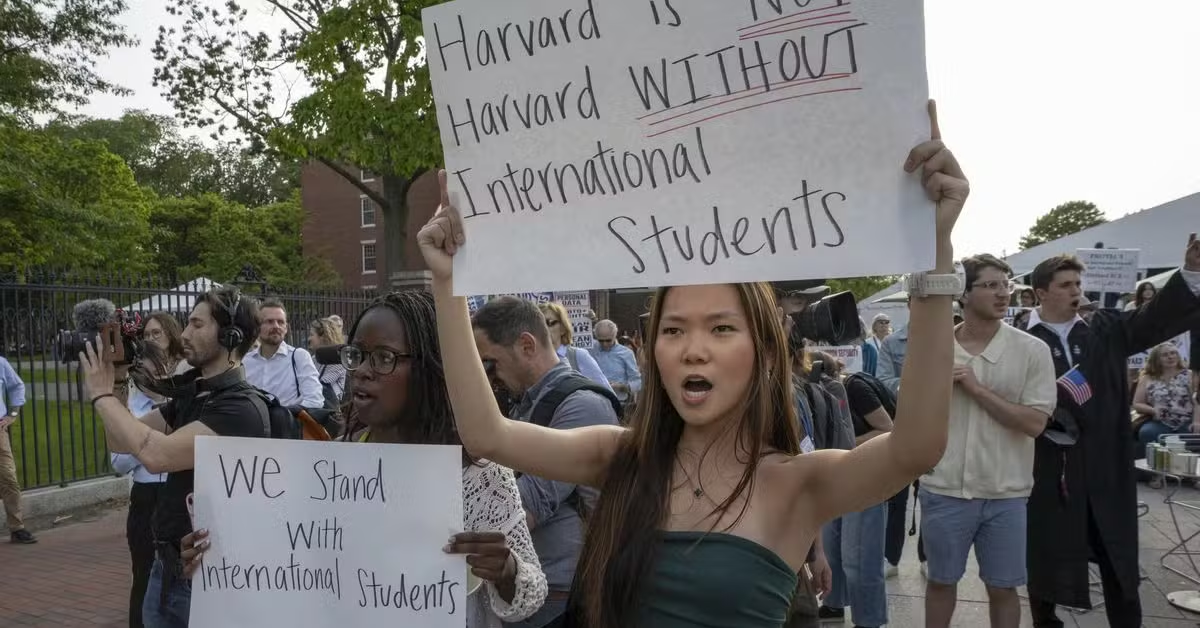
International enrollment at US colleges sinks 15% as Trump visa crackdown takes hold
La persecución de Trump a los migrantes espanta a los estudiantes internacionales de las universidades de EEUU
eldiario.es· 16h
Trump’s immigration crackdown drives international students away from US universities
theguardian.com· 4d
International student enrollment drops sharply, putting more U.S. colleges in financial jeopardy
cnbc.com· 10d
US colleges struggle as international students turn away
politico.com· 10d
New international enrollment at US colleges fell 15% in the fall 2026 semester from the prior academic year, according to a fall snapshot by the Institute of International Education. New international student numbers had already dropped more than 17% over the 2025-26 academic year, largely because fewer graduate students came from countries such as India and China.
The decline tracks the Trump administration's visa crackdown. In May 2025 it ordered US embassies to stop scheduling student visa interviews while it prepared to implement social media screening for applicants, and in January 2026 the State Department announced it had revoked 8,000 student visas. In October 2026 the administration proposed that universities pay $70,000 for each student using Optional Practical Training, alongside fees of more than $100,000 for certain new H-1B petitions, while a federal court in September had already blocked a rule requiring foreign students to apply for visa extensions after four years.
Individual campuses show the scale. The University of Washington's Seattle campus fell to its lowest level in at least a decade, Ohio State saw its fewest foreign students in 16 years, and enrollment at Cleveland State University dropped 46%. At Indiana University Bloomington, two students offered a Wells Scholars award in 2025 declined it.
The stakes are wide: international students contributed nearly $40 billion to the US economy in 2025-26, colleges with large graduate and STEM programs may be hardest hit, and schools in continental Europe and Asia reported rising enrollments instead. As of November 25, the decline is being felt across the whole economy, especially in the country's many small college towns.
Tighter visa restrictions, stricter vetting, and visa interview bottlenecks point to a steep decline in international student enrollment nationwide in fall 2026.
International student enrollment at the University of Washington's Seattle campus fell for a second straight year to its lowest level in at least a decade.
International enrollment at The Ohio State University fell nearly 13%, the fewest foreign students the university has seen in 16 years.
A federal court in September 2026 blocked a Department of Homeland Security rule, finalized the month before, requiring foreign students to apply for visa extensions after four years.
In October 2026 the Trump administration announced a plan to sharply raise visa fees, proposing that universities pay $70,000 for each student using Optional Practical Training.
The administration also proposed fees of more than $100,000 for certain new H-1B petitions and moved to make gaining US work experience much harder for foreign students.
A November 2026 survey by NAFSA and Study Portals found 50% of colleges in continental Europe and 59% of Asian schools saw higher international enrollments between August and October 2026.
Stan Veuger, an economist at the American Enterprise Institute, says the Trump administration's goal is to cut off all forms of migration to the maximum extent it can.
Veuger forecasts additional limits could be ahead, including more fees, suspending universities' ability to issue the documents students need to renew visas, and making appointments even harder to get.
Zuzana C. Wootson of the Presidents' Alliance says the data shows that in bachelor's programs at public universities every international student opens up two spots for American students.
Denison University President Adam Weinberg says his school is getting questions from concerned parents of foreign students over the policy changes, and he expects pretty steep declines in its foreign enrollment.
Trinity Washington University President Patricia McGuire says the administration's immigration policies have spread a great deal of fear and anxiety among international students, faculty on visas, and undocumented students.
McGuire says one of her international students was assaulted near a Washington, D.C. metro station and did not call for help because she feared that calling the police would lead to her arrest and deportation.
In October 2026, the Department of Homeland Security and officials including Vice President JD Vance argued the stricter policies are designed to discourage visa fraud and that Americans should not have to compete against international students for work.
A Department of Homeland Security spokesperson said the media showed no outrage when foreign nationals abused the system and would be thanking President Trump for cracking down on rampant fraud if they truly cared about legitimate international students.
The spokesperson called NAFSA's reporting completely misleading and said the Student and Exchange Visitor Program has not experienced a 10% drop in foreign student enrollment.
NAFSA executive director Fanta Aw says the visa appointment situation in the summer of 2026 was even more difficult than during the Covid-19 pandemic and that there is a very intentional attempt by the government to close the doors.
Aw says uncertainty has become the policy of the administration and that expression of interest in the US has declined significantly, with students refocusing on other destinations.
Wesleyan University President Michael Roth says making it harder for international students in the name of nationalism is shooting the United States in the foot just to see how good its boots are.
Roth says Wesleyan could not afford to pay the proposed Optional Practical Training fees for its graduating international students, since even a small liberal arts college would face costs of millions of dollars.
Ohio State spokesperson Benjamin Johnson says the university's international enrollment strengthens the academic experience for all students and that it wants the world's best and brightest to choose the university and stay to build a life in Ohio.
House Education and Workforce Chair Tim Walberg argues the policies ultimately benefit domestic students, making sure schools are there for who they are supposed to be for, and that international students can be looked at once there are plenty of places for qualified American students.
A fall snapshot by the Institute of International Education found new international enrollment at US colleges fell 15% in the fall 2026 semester from the prior academic year.
New international student numbers fell more than 17% over the 2025-26 academic year, largely because fewer graduate students came from countries such as India and China.
The report found a growing number of colleges named international recruitment a top concern, citing the high cost of a US degree and uncertainty around new rules ending duration of status and limiting most F-1 and J-1 visas to four years.
A NAFSA analysis found international students contributed nearly $40 billion to the US economy during the 2025-26 academic year.
An August analysis by Fitch Ratings found colleges with large graduate and STEM programs may be hardest hit by the enrollment decline, since time to degree completion there can exceed four years.
The Institute's survey of 809 institutions found 57% of international students study in STEM fields, and 91% of colleges and universities said recruiting them is a key priority.
Robert Franek, editor-in-chief of The Princeton Review, says foreign students typically pay full tuition, making international enrollment an important revenue source, and warned, "There are going to be fewer research dollars, fewer scholarship dollars for students here in the states."
NAFSA executive director Fanta Aw says, "The data again reflect the harsh reality that the barriers the U.S. government is putting in place to block talented international students are having a real impact."
Aw says, "All Americans will feel the effects as international students' tuition payments, local spending, and contributions to U.S. excellence in research and innovation diminish."
Fitch's analysts write, "Sustained drops in new international student enrollment can have outsized revenue effects, as international students often pay full tuition or receive less institutional aid than domestic students," and that "lost revenue is hard to replace quickly."
NAFSA's analysis forecasts the 2025-26 enrollment decline will cost the US economy roughly $2.4 billion.
In May 2025, the Trump administration ordered US embassies to stop scheduling visa interviews for foreign students as it prepared to implement social media screening for applicants.
In 2025, Indiana University professor Christoph Irmscher offered the Wells Scholars award to a man from South Africa and a woman from Central America, and both declined.
In January 2026, the State Department announced it had revoked 8,000 student visas.
International enrollment at Indiana University Bloomington fell 15%, from 4,428 students in fall 2025 to 3,768 in fall 2026.
International enrollment at Cleveland State University fell 46%, from 1,542 students in fall 2025 to 828 in fall 2026.
College leaders say interest in coming to the United States has waned since Donald Trump retook office in January 2025 and deployed Immigration and Customs Enforcement agents across the country to conduct raids and deportations, with images of masked officers spreading across the globe.
Christoph Irmscher says people are cautious now, weighing the benefits against the disadvantages and whether to take the risk.
Irmscher says that in the culture of social media and TikTok, clips of ICE agents brutalizing people on the street have an enormous ripple effect, and that looking or feeling different affects a student's decision to study in the US.
Donald Trump said, "We have people who want to go to Harvard and other schools; they can't get in because we have foreign students there."
Cleveland State University provost Nigamanth Sridhar said the enrollment drop was largely due to potential students having trouble obtaining visas, and he estimated it cost the university between $2 million and $4 million.
The federal judge who blocked the four-year rule stated that the Department of Homeland Security is seeking to prevent or discourage the very activity, providing educational opportunities for foreign students in the United States, that Congress sought to permit and encourage.
Veena Dubal, general counsel for the American Association of University Professors, says thinking the system could keep functioning politically, socially, and economically without international students is to misunderstand what US higher education has always been.
Dubal says she is optimistic, particularly after the Democrats' wins in the midterm elections, that higher education can overcome the Trump administration's treatment of foreign students.
Dubal says if the administration cares about native-born Americans getting access to higher education, the answer is not to push out immigrants but to make it more accessible by lowering prices.
The enrollment decline is being felt across the whole economy, especially in the country's many small college towns.

