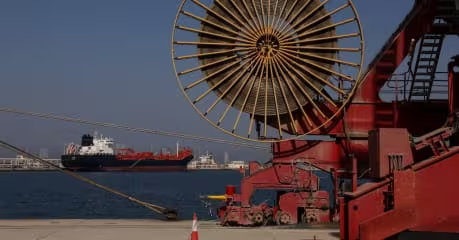
Oil prices fall as supply glut prospect outweighs Gulf tanker mine strikes
Oil little changed as supply concerns linger after Iran claims mine strikes on ships
channelnewsasia.com· 25h
Oil prices fall as supply concerns linger after Iran claims mine strikes on ships
Most Gulf markets retreat on Saudi energy strikes, maritime dangers
reuters.com· 25h
Oil slips 1% as supply glut prospect offsets Middle East disruption fears
Oil steady as supply glut prospect offsets Middle East disruption fears
Oil slips over 1% as supply glut prospect offsets Middle East disruption fears
Oil prices near three-month lows as rising supply offsets Hormuz threat
Oil holds near three-month low as rising supply offsets Hormuz threat
Oil slips with Mideast flows in focus
Oil holds in tight range as Gulf attacks sustain risk premium
Oil prices fall amid equity selloff though Iran war attacks limit losses
Trump whines about voters who 'didn't understand' in bonkers oil 'hoax' rant
rawstory.com· 4d
Oil prices have slid through November as a growing prospect of oversupply outweighed repeated attacks on Gulf shipping during the US war on Iran. Crude fell from about $104 a barrel on 30 October to about $83 by 21 November, still above the roughly $67 recorded before the war began, and Brent extended a three-week losing streak on 23 November as a global selloff driven by doubts about the artificial intelligence sector spilled into commodities.
The attacks kept limiting the losses. The Iran-aligned Houthi movement claimed it struck Saudi Arabia's Ras Tanura refinery, the country's largest, and Riyadh's financial district, and Iran's Revolutionary Guards Navy reported oil tankers hitting naval mines and catching fire in the Strait of Hormuz. On 25 November those claims sent Brent up 3.5% and West Texas Intermediate up 2%, though Bahrain also said an Iranian attack had hit a civilian industrial facility there on 21 November.
The surplus case kept pulling prices back down. Deutsche Bank said global inventories rose 52 million barrels in October, an oversupply of 1.7 million barrels a day, and Libya's National Oil Corporation said the Sharara pipeline had reopened. Brent fell 0.87% to $93.79 on 26 November after the previous session's sharp rise.
OPEC+ ministers meet on 29 November to decide 2027 output policy, with Iraq pressing the group to lift its estimated production capacity. The newest hazard is that shipping through the Strait of Hormuz has been disrupted just as oil supply there had been recovering to near pre-war levels.
Crude oil fell from about $104 a barrel on 30 October 2026 to about $83 by 21 November 2026, still above the roughly $67 recorded before the US war on Iran began.
Donald Trump wrote on Truth Social that "Both the Dems and Iran fought like hell to keep the Oil price up as long as possible and, since the Election, the Oil price has dropped by a record level."
Donald Trump called the pre-election oil price spike "a Giant Hoax" and said he had predicted prices would drop after the midterm elections.
Oil prices fell on 23 November 2026 as a selloff in global financial markets, driven by doubts about the artificial intelligence sector's ability to boost growth, spilled over into commodities, though attacks on Gulf shipping limited the losses.
Brent crude fell 28 cents to $92.29 a barrel and US West Texas Intermediate slipped to $83.26 on 23 November, extending a three-week losing streak after Brent lost 4% and WTI 5% the previous week, when the Nasdaq plunged 10%.
The Iran-aligned Houthi movement said on 22 November 2026 that it attacked a Saudi Arabian oil refinery.
Multiple attacks on shipping in the Gulf and near the Strait of Hormuz were reported over the weekend of 21 to 22 November 2026.
OPEC+ ministers were due to meet on 29 November 2026 to decide their 2027 output policy.
Mukesh Sahdev, chief oil analyst at XAnalysts, said momentum was carrying oil prices down but cautioned that the Gulf shipping attacks posed a risk to crude flows that would soon start to be priced in.
Brent crude rose 0.11% to $92.67 a barrel and West Texas Intermediate gained 0.19% to $83.57 in Asian trade on 23 November 2026, holding in a tight range as investors kept a Middle East risk premium priced in.
Iran's Revolutionary Guards said they launched a missile-and-drone assault on US military positions in Bahrain, home to the US Navy's 5th Fleet.
Bahrain said an Iranian attack hit a civilian industrial facility on 21 November 2026.
Vandana Hari of Vanda Insights forecast that the ebb and flow of threats and harsher rhetoric between Washington and Tehran would keep prices broadly rangebound unless either side escalated, with a tense US-Iran stalemate the base case through year-end.
Brent crude fell 60 cents to $91.97 a barrel and West Texas Intermediate dropped 49 cents to $82.92 later on 23 November 2026 as investors focused on Middle East oil flows.
Tamas Varga of PVM said oil had recorded its third successive weekly loss with pressure coming primarily from the supply side, and that Iranian attacks on ships transiting the Strait of Hormuz were taking their toll.
Tamas Varga of PVM warned it would be irresponsible to conclude that oil will now be supplied uninterruptedly and in vast volumes.
Oil fell to near a three-month low on 24 November 2026, with Brent down 0.45% to $88.97 a barrel after its lowest close since 31 August and West Texas Intermediate slipping to $79.94, as rising supply outweighed the Strait of Hormuz shipping risk.
Deutsche Bank said global observed liquids inventories rose 52 million barrels in October 2026, implying an oversupply of 1.7 million barrels a day, with evidence accumulating that the market is rebalancing into surplus.
Libya's National Oil Corporation said on 23 November 2026 that the Sharara oil pipeline had reopened and oil had begun flowing into storage tanks at the Akakus facility in Zawiya.
Iran's Revolutionary Guards navy said three oil tankers caught fire after hitting naval mines in the Strait of Hormuz on 23 November 2026.
The United States was reported to be investigating whether Iran was involved in cyberattacks on as many as 50 energy tankers.
Daniel Hynes of ANZ said the oil system appears to be moving from acute scarcity towards persistent vulnerability rather than returning to normal, with logistics constrained and inventory buffers thin.
Suvro Sarkar of DBS Bank said Brent had largely lost upward impetus as the market weighed a possible future supply glut against persistent Middle East tensions and shipping disruptions.
Suvro Sarkar of DBS Bank said the risk of prices rising again could not be ruled out because nothing had moved in US-Iran talks and either side could test the other's resolve over blockading the Strait of Hormuz.
Crude oil fell more than 1% on 25 November 2026, with Brent down 1.5% to $90.05 a barrel and West Texas Intermediate down 1.7% to $80.70, paring gains of more than 2% from the previous day.
Iraq is pressing OPEC+ to lift its estimated production capacity ahead of the group's 29 November meeting.
US crude stocks rose 126,000 barrels in the week ended 20 November 2026, according to American Petroleum Institute data cited by market sources.
Zhenqiang Seto of LSEG said supply surplus concerns going into 2027 were outweighing ongoing shipping risks, citing uncertainty over OPEC's 2027 policies, the UAE no longer restricted by OPEC+ rules, Iraq seeking higher output capacity, and broader market risk-off.
Tsuyoshi Ueno of NLI Research Institute said perceptions of a global supply glut since a November 2026 IEA report had kept prices in check, with attention focused on how 2027 production quotas would be set at the OPEC+ meeting.
Yemen's Houthis claimed they attacked Saudi Arabia's Ras Tanura refinery, the country's largest, and Riyadh's financial district.
Crude oil steadied on 25 November 2026, with Brent at $91.36 a barrel and West Texas Intermediate at $81.77, as the prospect of a market surplus offset Middle East disruption concerns.
Eight analysts polled estimated crude inventories rose by about 1.5 million barrels on average in the week ended 20 November 2026.
Crude oil fell about 1% on 25 November 2026, with Brent down 0.9% to $90.58 a barrel and West Texas Intermediate down 1.3% to $80.96, as Middle East exports resumed and oversupply projections outweighed shipping risks.
Iran's Revolutionary Guards said a container ship was targeted near the Strait of Hormuz, and UK Maritime Trade Operations reported three vessels struck by projectiles there.
Most Gulf stock markets closed lower on 26 November 2026 as investors weighed reported attacks on Saudi energy assets and ongoing dangers to shipping, though Saudi Arabia's benchmark edged 0.1% higher and Dubai's index rose 1.5%.
The Saudi-led coalition said it downed a Houthi drone near Jeddah Islamic Port with no civilian injuries.
Iran's Revolutionary Guards Navy reported that two oil tankers hit naval mines, exploded and caught fire in the Strait of Hormuz on 25 November 2026.
Crude oil fell on 26 November 2026, with Brent down 0.87% to $93.79 a barrel and West Texas Intermediate down 0.42% to $83.33, after the previous session's sharp rise; there was no WTI settlement because of the US Thanksgiving holiday.
Brent settled up 3.5% and West Texas Intermediate climbed 2% on 25 November 2026 after the Houthi claims of attacks on the Ras Tanura refinery and Riyadh's financial district.
Shipping through the Strait of Hormuz has been disrupted just as oil supply there had been recovering to near pre-war levels.
Analysts forecast that the latest reported Houthi attacks would increase oil's geopolitical risk premium.
Tamas Varga of PVM said the perceived supply surplus in coming months and sticky inflation, which forces central banks to raise rates and strengthens the dollar, could cap any attempt to push prices significantly higher.
Tamas Varga of PVM said Brent's new trading range appears to be around $88 to $97 a barrel.
Daniel Hynes of ANZ said the broadening Middle East conflict threatens to halt the recent recovery in oil flows, with Persian Gulf crude exports rising in the prior week but remaining on a declining trend.