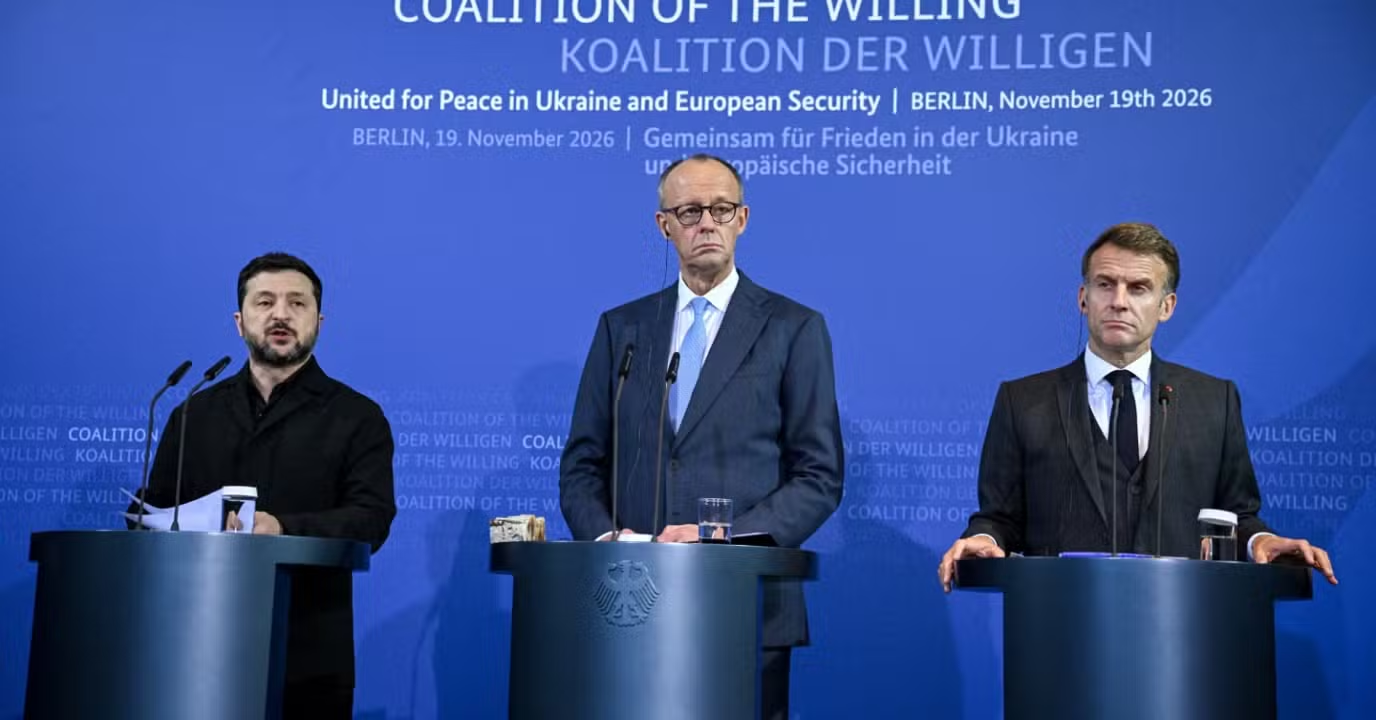
Merz says Europe expects to join new Ukraine peace talks with Russia soon
Europe expects to join new Ukraine peace talks soon, says German chancellor
lemonde.fr· 2d
Coalition of the Willing calls on Russia to accept winter energy truce
kyivindependent.com· 2d
(S+) Donald Trump: Und dann platzt der Anruf des US-Präsidenten in den Berliner Ukrainegipfel
spiegel.de· 2d
European leaders unite in Berlin to reaffirm support for Ukraine
aljazeera.com· 2d
Europe ready for talks with Russia on ending war in Ukraine, leaders say
bbc.com· 2d
Finland's Stubb urges Europe to take Russia talks into its own hands after 'irresponsible' US reliance
EU foreign policy died in Dublin on Friday
substack.com· 6d
Russia is ‘setting traps’ in Ukraine talks, EU foreign policy chief warns
theguardian.com· 8d
Europe wants a seat at the table with Russia. It can't agree on who gets it
Europeans to join Russia-Ukraine talks in Abu Dhabi, says France
euronews.com· 13d
European leaders said at a Berlin summit on November 19 that they are ready for talks with Russia on ending the Ukraine war.
Coalition of the Willing leaders urged Russia to accept a winter energy ceasefire and Black Sea food truce, pledging 90 billion euros for Ukraine.
Putin has not rejected European participation but wants first to clarify what Europe would bring and has invited European officials to Moscow.
US-brokered Ukrainian and Russian talks in Abu Dhabi earlier in November failed to produce a breakthrough, and Moscow says more trilateral rounds may be needed.
The EU chose a seven-member negotiating team in Dublin that excludes foreign policy chief Kaja Kallas, exposing divisions over who speaks for Europe.
Kushner said Moscow is comfortable with Ukraine receiving security guarantees based on Nato's Article Five.
French Foreign Minister Jean-Noël Barrot announced on November 8 that Europeans, including France, would join the Russia-Ukraine talks opening in Abu Dhabi on November 10, until then planned as trilateral.
French Foreign Minister Jean-Noël Barrot said 'no one will speak in our name' and that no agreement with consequences for the European security architecture can be designed or even discussed without the Europeans.
European leaders gathered in Dublin on November 12 were still struggling to agree on who should represent Europe in the peace talks with Russia.
Volodymyr Zelensky said on November 12 that the US-Russia talks concern a new security framework between Europe and Russia, not only security guarantees for Ukraine.
Friedrich Merz said Vladimir Putin appears ready to have talks with Europe.
Estonian Prime Minister Kristen Michal said Antonio Costa and Kaja Kallas should represent the EU at the negotiating table, as both are clearly accountable to EU countries.
US envoy Steve Witkoff forecast that the next round of talks with Russia would involve European officials, saying Europeans are partners and it is important for them to be involved.
Volodymyr Zelensky said Europe must have a direct role in negotiations over Ukraine's future and become a regular part of the negotiations.
European Council President António Costa said EU leaders meeting in Dublin had agreed on a negotiating team of EU institutions and the E5 countries, Britain, France, Germany, Italy and Poland.
Russia revived its hardline demands for a total overhaul of European security in the talks on the Ukraine war.
Russia quickly contradicted Jared Kushner's assurance that Russia and Ukraine had agreed to include the Europeans in the next round of peace negotiations.
The Kremlin said it could decide on holding talks in an expanded format once it understands Europe's real intentions and willingness to contribute to the peace process.
Kaja Kallas warned against 'walking into the traps that Russia is setting', saying Moscow was trying to start a debate about European security to divert attention from its aggression.
Friedrich Merz said of Russia's push to discuss European security, 'We do not need to discuss that; it already exists', and called it a 'given' that Germany would be part of any European delegation.
European Commission President Ursula von der Leyen said it was 'self-explanatory that Europe is included in the peace talks to safeguard our interests, but also to support Ukraine'.
António Costa said 'Europe must speak with one clear and united voice in all discussions that shape the future of Ukraine and the security of our continent', calling it 'ultimately a team effort'.
Russia's lead negotiator in Abu Dhabi, Vladimir Medinsky, said it was 'unclear what there is to discuss' with Europe.
The seven-member team agreed at the European Council summit in Dublin excluded Kaja Kallas, the EU foreign policy chief whose job is to represent the bloc in foreign and security affairs.
Ukrainian President Volodymyr Zelensky called for the EU to quickly decide who will represent Europe in the peace talks with Russia, reportedly favoring Kaja Kallas.
EU foreign policy chief Kaja Kallas said, 'All the member states agreed that I'm the one who is representing Europe in foreign and security policy. That was in 2024 when it was clear that talks would be needed with Russia. I know the Russians don't want me, but do we have a say who is representing Russia? No we don't.'
Dave Keating forecast that the team of seven chosen in Dublin would almost certainly be shut out of the negotiations and deemed an irrelevance by the Americans and Russians.
Kremlin aide Yury Ushakov said on November 16 that several more rounds of trilateral negotiations would probably be needed before the talks could be expanded to include Europe.
Russia said it had not agreed to expand the negotiations after the Abu Dhabi talks failed to produce a significant breakthrough.
Finnish President Alexander Stubb called for the EU to secure a seat at the negotiating table with Russia, an idea the Kremlin has repeatedly rejected.
Finnish President Alexander Stubb recommended that European leaders engage directly with Putin with the same message to avoid what he called an irresponsible reliance on the United States, and said Europe must become an agenda setter.
Russian President Vladimir Putin said Russia is not against European participation in the talks but wants first to clarify what Europe would bring, and has invited European officials to Moscow through diplomatic channels.
Jared Kushner said the Russians are willing to accept Europeans at the table and that Moscow is comfortable with Ukraine having security guarantees based on Nato's Article Five.
Friedrich Merz said Europe will enter serious discussions on European security with Russia only after a peace agreement with Ukraine has been reached.
Friedrich Merz said Moscow's maximalist demands are not realistic, and that while sceptical about the talks he believes the chance of peace is increasing with US involvement.
Vladimir Putin said Russia has no desire at all to continue the armed conflict and claims to be ready to make compromises, while saying Ukraine and Europe are not.
More than 40 of Ukraine's partners, including US envoys Steve Witkoff and Jared Kushner, met at the Chancellery in Berlin on November 19 to coordinate Europe's role in future peace talks.
British Prime Minister Andy Burnham said Europe is ready to enter negotiations with Russia and has a clear, consistent and united negotiating position.
President Zelensky wrote on X, 'We do not want Russia to drag all of this out into the winter', saying pressure is needed and that Europe stands ready with new sanctions and steps of support.
British Prime Minister Andy Burnham said Europe is 'ready to enter negotiations' and that 'a peace agreement between Ukraine and Russia must come first', welcoming the United States' presence at the talks as adding momentum.
French President Emmanuel Macron called on Ukraine's allies to ramp up efforts to end the war, saying the priority is to deploy anti-missile systems and interceptors immediately.
Emmanuel Macron said that, faced with the maximalist nature of the Russian position, the question of Ukraine's accession to NATO needs to be reopened.
Friedrich Merz dismissed the Shenzhen summit between Donald Trump, Xi Jinping and Vladimir Putin as a 'photo op' and said peace talks 'can only be successful with Ukraine and Europe'.
A phone call from US President Donald Trump burst into the Ukraine summit being held in Berlin.
At a Coalition of the Willing summit in Berlin on November 19, Ukraine and its European partners called on Russia to accept a winter energy ceasefire and a truce allowing safe passage for Black Sea food exports.
The Berlin joint statement pledged Ukraine additional air defense systems and 90 billion euros under the European Union's Ukraine Support Loan, and proposed new sanctions on Russian oil and cryptocurrency.
The joint statement affirmed the Coalition of the Willing's readiness to take part in peace negotiations and provide postwar security guarantees for Ukraine.
President Zelensky told reporters after the Berlin summit, 'If you want to stop war, stop trade with Russia.'
German Chancellor Friedrich Merz said on November 19 that he expects new Ukraine peace talks to take place soon with Europe at the table, naming the United Arab Emirates as a possible venue.
Jared Kushner said Donald Trump wants to make a deal on Ukraine with Europe by his side and is not looking to impose anything unilaterally.
Ukrainian President Volodymyr Zelensky told reporters he saw a huge chance for peace if the United States really puts pressure on Putin.
President Volodymyr Zelensky told reporters he saw a 'huge chance' for peace if the United States really puts pressure on Putin.

