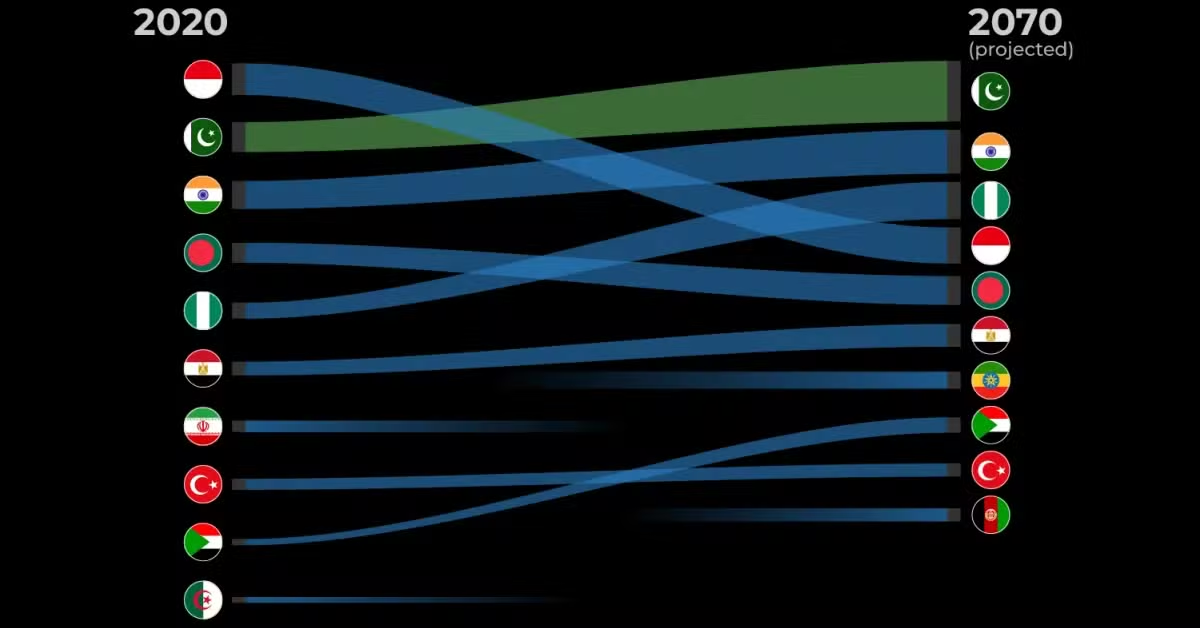
Pakistan projected to overtake Indonesia as the world's largest Muslim population
Islam set to be the largest religion by 2035: Where will most Muslims live?
aljazeera.com· 41h
This religion may soon be bigger than Christianity, new research says
usatoday.com· 2d
Islam expected to surpass Christianity as world’s largest religion by 2035
nbcnews.com· 2d
Islam forecast to soon exceed Christianity as world's biggest faith
reuters.com· 2d
Muslims are projected to outnumber Christians by 2035 as the world's largest religion
pbs.org· 3d
L’islam devrait devenir la religion la plus pratiquée au monde d’ici à 2035, dépassant le christianisme, selon le Pew Research Center
lemonde.fr· 3d
Muslims to outnumber Christians worldwide by 2035, study finds
washingtonpost.com· 3d
Religionen: Islam wird voraussichtlich 2035 die größte Weltreligion
spiegel.de· 3d
Muslims are projected to outnumber Christians by 2035 as the world's largest religion
apnews.com· 3d
The Pew Research Center projects that Islam will surpass Christianity as the world's largest religion by 2035, with 2.57 billion Muslims and 2.52 billion Christians.
Higher fertility drives the growth: Muslim women averaged 3.1 children against 2.5 for Christians and 1.6 for all other women in 2020-2025.
By 2070 Pew projects 3.64 billion Muslims, up 80 percent, and about 3 billion Christians, up 30 percent, against 29 percent world population growth.
Most growth is where each group is already the majority; Pakistan is projected to pass Indonesia as the largest Muslim population, with India second.
The projections come from Pew's Future of World Religions project with Poland's CASPAR, covering 201 countries and territories and assuming current trends continue.
Pew also projects Christians falling below half of the United States population by 2065 and the religiously unaffiliated shrinking as a global share.
Buddhists are projected to decline 23 percent between 2020 and 2070, and religiously unaffiliated people 10 percent.
The Future of World Religions project was carried out by Pew Research Center and Poland's Center for Advanced Studies of Population and Religion.
Nigeria's Muslim population is projected to double to 282 million by 2070 on the strength of its young age and high fertility.
Hindus are projected to grow by 199 million to 1.4 billion by 2070, and Jews from 15 million to 18 million.
American Christians are projected to slip from 64 percent of the United States population in 2020 to 48 percent in 2070.
All 53 countries and territories that were majority-Muslim in 2020 are projected to remain so, with Muslims at 90 percent or more in most.
Because of a projected 421 million decline in China's population, the religiously unaffiliated are projected to shrink from 24.2 percent of the world's population to 17 percent.
Future of World Religions co-leader Conrad Hackett said it is a misconception that Muslims becoming the largest religious group comes at the expense of Christians, noting 74 percent of Muslim growth is in already Muslim-majority countries.
Historian Mark Noll said American Christians slipping into the minority will set up "complex" questions about whether United States democracy relies in some ways on the contributions of Christianity and Judaism.
Sub-Saharan Africa is projected to be home to 27 percent of the world's Muslims by 2070.
The Pew Research Center projects Islam will surpass Christianity as the world's largest religion by 2035, with 2.57 billion Muslims and 2.52 billion Christians.
Muslim women averaged 3.1 children each in 2020-2025, against 2.5 for Christian women and 1.6 for all other women, below the 2.1 replacement level.
Pew estimates there were 2.27 billion Christians and 2.02 billion Muslims worldwide in 2020.
About 252 million babies were born to Muslim mothers in 2020-2025, compared with 208 million born to Christian mothers.
By 2070 Pew projects more than 3.6 billion Muslims, up 80 percent, and just under 3 billion Christians, up 30 percent, against 29 percent world growth.
Christians are projected to fall below half of the United States population by 2065, and Canadian Christians below half by 2030.
People with no religion are projected to make up 41 percent of the United States population by 2070 and to outnumber Christians in Canada.
Congo is projected to surpass the United States by 2070 as the country with the most Christians, 299 million, with over half of all Christians in sub-Saharan Africa.
Christians in Europe are projected to drop by a third, from 505 million to 324 million, while Muslims rise from 6 to 13 percent of Europe's population.
Excluding China, the ranks of religiously unaffiliated people are projected to grow by more than 180 million by 2070.
Religiously unaffiliated people already form majorities in 10 countries, and South Korea, France and the United Kingdom are projected to join them by 2070.
Pew senior demographer Conrad Hackett said "It's the babies," explaining that conversion and other ways of changing religious identity are much smaller factors than fertility rates.
Pew religion research director Alan Cooperman said, "I don't think this is a situation in which the growth of Muslims is coming at the expense of Christians."
Cooperman said, "I do worry about mischief being made with headlines or narratives that take this finding and portray it as sort of a clash where Christians are losing to Muslims."
Harvard Divinity School senior researcher Gina Zurlo said Christian-Muslim relations are "extremely important" in light of the evolving trends.
Zurlo said, "The 'clash of civilization' theory still looms large in some religious communities and there is a lot of misunderstanding of both religions from both sides."
Zurlo said many Christians are unhappy to see Islam become the world's largest religion, and she hopes people seek greater interreligious education and personal contact across religious differences.
California State University, Sacramento religious studies professor Jeffrey Brodd suggested a rebound of mainline Protestant denominations is possible after Democratic congressional election victories in November 2026.
Islam is projected to rise from 26 percent of the world's population in 2020 to 37 percent in 2070, with Christianity steady at about 29 percent.
Muslims are projected to lose 8 million adherents to religious switching between 2020 and 2070, compared with 105 million for Christians.
Religiously unaffiliated people are projected to be the world's third-largest religious group after Muslims and Christians.
Pew projects Pakistan, whose Muslim population trailed Indonesia's by 12 million in 2020, will overtake it as the largest, doubling to 461 million while Indonesia's grows 15 percent.
India's Muslim population is projected to rise from third to second place by 2070, growing from 213 million to 334 million.
Four of the top 10 Muslim-population countries in 2070 are projected to be in Africa, Nigeria, Egypt, Ethiopia and Sudan, with Ethiopia and Afghanistan replacing Iran and Algeria.
Sudan's Muslim population is projected to more than double to 116 million by 2070, climbing above Turkiye's.
The world's 53 Muslim-majority countries are projected to gain 1.2 billion Muslims by 2070, 74 percent of the global increase.
The projections cover 201 countries and territories holding 99.98 percent of the world's population and assume current trends that wars, disasters or economic shifts could change.

