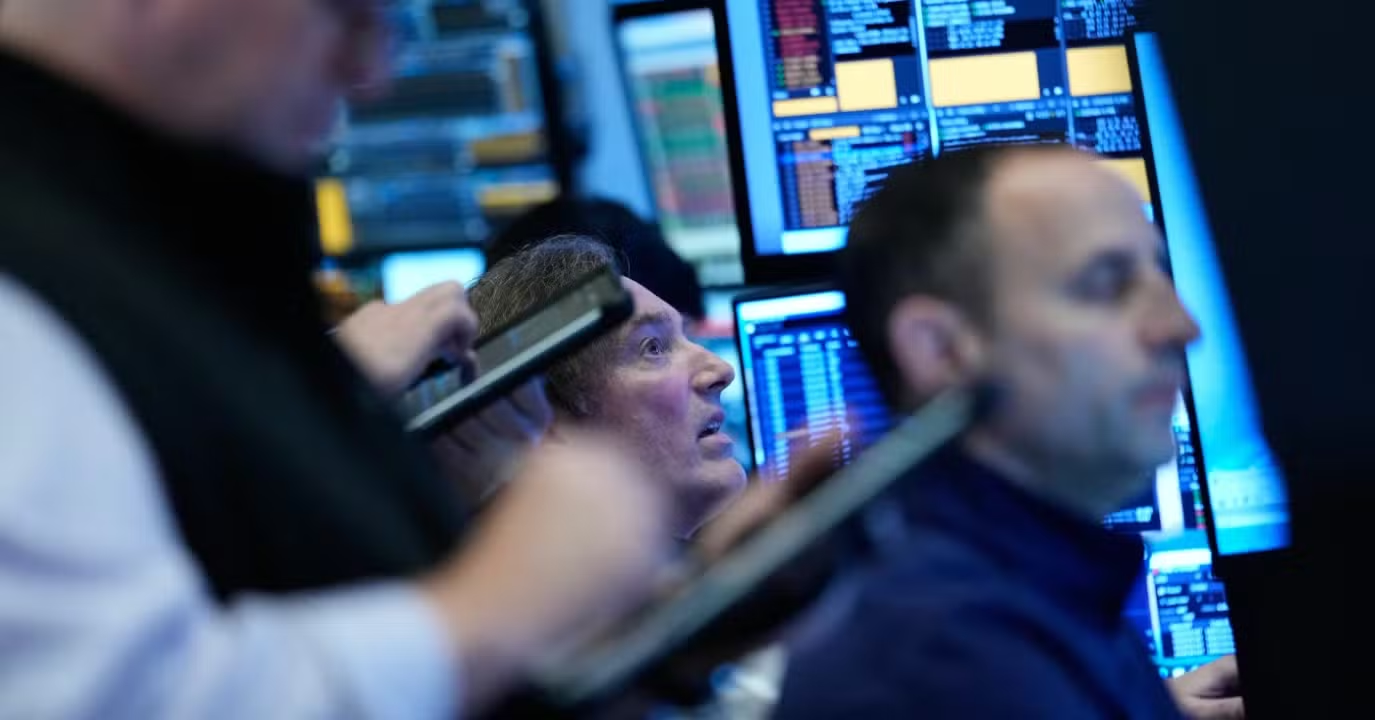
S&P 500 sinks 3.7% and Nasdaq goes negative for the year as AI sell-off deepens
S&P 500 sinks 3.7% and the Nasdaq composite goes negative for the year
npr.org· 33h
Western Digital Stock Falls 12% in the Memory Chip Selloff. It Spun Off Its Flash Business Last Year and Now Sits 65% Below Its Record
247wallst.com· 37h
Nasdaq wipes out gains for the year as Anthropic IPO fails to quell AI nerves | CNN Business
cnn.com· 38h
NuScale Power Sinks 9% as AI Power Sell-Off Hits Nuclear Stocks; Constellation Drops 4%, Oklo Holds Steady
Applied Digital and Core Scientific Sink 12% as AI Infrastructure Sell-Off Deepens; TeraWulf Tumbles 10%
Vanguard's VXUS Falls 7% and VWO Drops 8.5% This Week as Taiwan's Stock Market Posts Its Worst Week Since 1991. Here's the Loss on a $1 Million IRA and What Rebalancing Rules Say to Do
AMD Stock Drops Another 7.0% Before the Bell and Taiwan Semiconductor Slides 4.2% as Nasdaq Futures Fall 1.6% After Asia's Chip Selloff
Global stock markets slump as Anthropic IPO fails to stem AI sell-off
theguardian.com· 45h
Anthropic shares fall 6% in premarket amid AI selloff as Nvidia, AMD shares drop
cnbc.com· 46h
Tech stocks fall as Anthropic IPO fails to stem broader AI sell-off
ft.com· 2d
South Korea's Stock Market and the Nikkei 225 Sink More Than 4% as the AI Selloff Spreads From Wall Street. Here's How Much of a Target-Date Fund Is in Samsung, SK Hynix and TSMC
Nikkei 225 Falls 4.5% and SoftBank Plunges 15% as Wall Street's AI Selloff Puts Asian Stocks on Track for Their Worst Week Since 2020
South Korea's Stock Market Sinks 4.6% as KOSPI Heavyweights SK Hynix and Samsung Fall 6% After Wall Street's AI Selloff
SoftBank plunges over 16% as AI sell-off hits Asian tech stocks following Anthropic debut
Asian tech stocks fall sharply after Anthropic's blockbuster IPO
nikkei.com· 2d
Data centre construction stocks lose $4.2tn as boom in AI trade unravels
By mid-November 2026 the boom in the AI trade had unravelled, leaving data centre construction stocks $4.2 trillion poorer in value. Wall Street's main indices all fell more than 2% on Thursday, November 19, a day dominated by Anthropic's initial public offering. Anthropic's shares briefly surged almost 40% when trading began and closed up 17% at $97.17, completing the biggest IPO on record and surpassing SpaceX's June debut.
On the morning of Friday, November 20, Asian technology shares fell sharply as investors ran out of fresh catalysts after Anthropic's massive IPO, with lingering concerns over AI restrictions and export controls weighing too. Japan's SoftBank Group plunged as much as 16.16%, its worst day in more than two years, and South Korea's Kospi fell 5.2% after dipping below 4,900 for the first time since February. Taiwan's Taiex closed down 6.2%, leaving that market with its worst week since 1991, and MSCI's Asia-Pacific index was headed for a weekly loss of about 7%, its worst since March 2020.
Anthropic's debut lost its shine on Friday, the shares closing down 9.1% at $88.30, still above the $83 IPO price but about 23% below the brief Thursday peak of $115.10. Nvidia closed 13.8% lower and the PHLX Semiconductor Index sank 10.7%, while memory and storage stocks also fell sharply, with Western Digital down 12%. The S&P 500 closed down 3.7% at 6,910.39, a seventh straight decline and its worst weekly loss since April 2025, leaving it in a correction more than 10% below its October 6 high. The Nasdaq Composite slumped 5.3% to 22,617.73, erasing its gains for the year, while the Dow dropped 1.9% to 48,147.33, cushioned by gains in healthcare and consumer staples.
The sell-off was reported to reflect worries that AI stocks' big values and heavy spending are unjustified, fears worsened by midterm wins for candidates advocating slower data centre construction.
By mid-November 2026, data centre construction stocks had lost $4.2 trillion in value as the boom in the AI trade unravelled.
Asian technology shares fell sharply on the morning of Friday, November 20, 2026, as investors ran out of fresh catalysts after Anthropic's massive initial public offering.
Lingering concerns over artificial intelligence restrictions and export controls weighed on Asian tech shares, which had already had a bumpy ride for weeks amid worries over the data centre boom.
Japan's SoftBank Group shares plunged 16.16% on November 20, leading a broader sell-off in Asian technology stocks following Anthropic's market debut.
Japanese semiconductor stocks tumbled, with Tokyo Electron down 7.19%, Lasertec down 6.75%, and Renesas Electronics down 6.71%.
Nvidia slid 2.9% overnight.
In South Korea, Nvidia suppliers SK Hynix and Samsung Electronics fell 6% and 4.7% respectively, and the Kospi declined 3.66%.
The Nasdaq Composite fell more than 2% overnight following Anthropic's Wall Street debut, and the Dow closed below 50,000.
Market commentary on the sell-off said SoftBank's sharp decline underscored growing investor concerns over its aggressive bets on artificial intelligence, particularly its exposure to OpenAI.
South Korea's Kospi opened 4.1% lower on November 20, 2026, and fell as much as 4.8% to 4,889.57, dipping below 4,900 for the first time since February.
Samsung Electronics fell 6.1% and SK Hynix 5.8% in Seoul, with Samsung Electro-Mechanics down 10.7% and Hyundai Motor down 4.3%.
The KOSDAQ index of smaller South Korean companies was down 4.5%.
Foreign investors sold a net 636 billion won, about $476 million, of shares on Korea's main board by mid-morning, the fifth straight session of net foreign selling, while individuals bought 791 billion won.
South Korea's won slipped 2.05 to 1,336.15 per dollar.
Kiwoom Securities analyst Han Ji-young said fund rotation immediately after a large initial public offering tends to be short-lived and that the market looks oversold.
CLSA's Sanjeev Rana said earnings for 2027 are still pretty much in the bag.
Japan's Nikkei 225 fell 4.5% to 56,790 in Friday morning trading in Tokyo and SoftBank Group plunged 15%.
Taiwan's Taiex was down 6.3% before midday on November 20, after falling 4.4% the day before.
Hong Kong's Hang Seng was down 2.2%, the Shanghai Composite 2.0%, and Australia's S&P/ASX 200 1.5%.
MSCI's Asia-Pacific index was headed for a weekly loss of about 7%, its worst since March 2020.
Kyle Rodda, senior financial market analyst at Capital.com, said the Anthropic offering was not enough to "assuage the overall concern about the outlook for the AI trade."
The Korea Exchange triggered a sell-side sidecar, a five-minute pause on program selling, on November 20, 2026.
The Kospi stood at 4,879.10 at 12:38 p.m. in Seoul, down 5.04%, after its first trip under 4,900 since February 2026.
Taiwan's Taiex was down 5.46% at 36,326.90 and Japan's Nikkei 225 was down 4.52% at 56,758.00 in afternoon trading.
Anthropic stock soared 17% on its debut on Thursday, November 19, 2026, to close at $97.17, completing the biggest initial public offering on record and surpassing SpaceX's June debut.
Anthropic shares were down 6.38% in premarket trading on Friday, November 20, with Nvidia down 1.36% and AMD down 3.31%.
Taiwan's stock index dropped 6.7% on Friday to its lowest point since mid-April, with the chipmaker TSMC down about 6%.
Shares in SoftBank, earlier reported down as much as 16.16%, were reported down 14.5% in Tokyo, their worst day in more than two years.
The pan-European Stoxx 600 dropped 1.3% in the first 90 minutes of Friday trading.
Wall Street's main indices all fell by more than 2% on Thursday, November 19, a day dominated by Anthropic's IPO.
Anthropic's shares, which briefly surged almost 40% when Thursday trading began, were down 6% at $91.30 on Friday, falling back toward their IPO price of $83.
Britain's FTSE 100 hit a five-month low on Friday morning, dropping 4.8% in the week to Friday.
Asian markets were on track for their worst week since 2020, European markets for their worst week since March, and the FTSE 100 for its biggest weekly fall since the start of the Iran war.
Daniela Hathorn, a senior market analyst at Capital.com, said the IPO demonstrated that demand for AI exposure remains strong but was not enough to overcome concerns about elevated valuations, profitability and the sustainability of investment spending.
Hathorn said the broader market mood has shifted from buying the dip towards questioning whether the correction has further to run, and that weakness in equal-weighted indices shows selling pressure is no longer confined to a handful of technology giants.
Advanced Micro Devices fell another 7% before the bell on November 20 after a 7.7% drop the day before, leaving it down 14.2% in two days and 30% below its October 6 record close.
Taiwan Semiconductor Manufacturing's U.S. shares traded 4.2% lower before the bell at $337.18, 31% below their October high.
Nasdaq 100 futures were down 1.6% before the bell while Dow futures were flat, with S&P 500 futures down 0.7%.
On November 19, the Dow fell 2.2%, the S&P 500 2.0%, and the Nasdaq Composite 2.3%.
In premarket trading, Micron Technology fell 4.8%, Intel 5.3%, Broadcom 2.9%, and Nvidia 2.4%, with Nvidia having closed lower six sessions in a row.
The VanEck Semiconductor ETF fell for a sixth session in a row and sat 35% below its June high.
Asian markets closed with the Taiex down 6.2%, South Korea's Kospi 5.2%, Japan's Nikkei 225 5.1%, and Hong Kong's Hang Seng 1.9%, leaving Taiwan's market with its worst week since 1991.
Germany's DAX and the Euro Stoxx 50 were each down 2.0%, and London's FTSE 100 was down 0.6%, in European trading.
The SPDR S&P 500 ETF closed lower for a sixth session in a row, its longest losing streak since April 2024, and was down 5.1% for the week through November 19.
Jeremy Phillips said the gap between flat Dow futures and falling Nasdaq 100 futures suggested the selling was concentrated in chip and AI stocks, while cautioning that pre-market trading is thin and Thursday's session also started higher before turning down.
Taiwan's main stock index lost 17.5% in the week ending November 20, 2026.
Vanguard's Total International Stock ETF was down 7% for the week to Friday and its Vanguard FTSE Emerging Markets fund was down 8.5%.
Applied Digital fell 12% to $12.27 and Core Scientific fell 12% to $11.80 in morning trading on November 20, leaving Applied Digital down 50% for 2026.
TeraWulf tumbled 10% to $10.45 in the same sell-off.
The S&P 500 was down 1% in morning trading, set for its longest losing run since 2020, and the Nasdaq 100 was down 2%.
In a post on X, Michael Burry said he "tried to warn" investors about CoreWeave and other neocloud and chip names.
The Nasdaq Composite turned negative for 2026 as the sell-off led by Anthropic hit technology stocks.
Nuclear stocks split as the AI power trade unwound, with NuScale Power down 9% to $3.48 and Constellation Energy, the largest U.S. nuclear operator, down 4% to $242.83.
Oklo held nearly steady at $20.82, down 0.1%, while Cameco fell 3% to $59.57.
The Nasdaq Composite fell 3.6% on November 20, erasing its gains for the year and leaving it down almost 1% for 2026.
The S&P 500 fell 2.1% intraday, on track for a seventh straight day of losses, its longest losing streak since February 2020, and dipped into correction territory 10% below its October 6 peak.
The Dow fell just 0.5%, cushioned by gains in healthcare and consumer staples, and also dipped into correction territory after sliding 10% from its August 5 peak.
Anthropic's blockbuster debut lost its shine, with its shares plunging 13% to around $84.40, just above the company's IPO price of $83.
The Dow, the S&P 500, and the Nasdaq were all on track for their worst week since early April 2025, when President Donald Trump's tariff plans rocked global markets.
Steve Sosnick, chief strategist at Interactive Brokers, said there is a real exodus out of tech stocks and that buying the dip has been taking a back seat to selling the rally, or just selling.
Sosnick said the market was already questioning some of the cost-benefit analysis of AI spending and that, coming off relatively euphoric levels, that is a lot for the market to bear.
David Kelly, chief global strategist at JPMorgan Asset Management, said there is a fear that there is too much froth and enthusiasm in the tech bet given all the risks out there.
Memory and storage stocks fell sharply on the second day of the selloff, with Western Digital down 12% to about $261, Seagate down 12%, SanDisk down 15%, and Micron down 12%.
Western Digital's drop came without company news and put the stock on pace for its seventh one-day fall of 10% or more in 2026.
The largest Nasdaq-100 fund was down about 4% in midday trading.
The S&P 500 closed down 3.7% at 6,910.39 on November 20, its worst weekly loss since April 2025 and its seventh straight decline, leaving it in a correction more than 10% below its October 6 high.
The Nasdaq composite slumped 5.3%, losing 1,261.47 points to close at 22,617.73, its weekly loss just shy of its worst week since March 2020.
The Dow Jones Industrial Average dropped 949.73 points, 1.9%, to close at 48,147.33.
Anthropic's stock closed down 9.1% at $88.30, still above its $83 IPO price and about 23% below its brief Thursday peak of $115.10.
Nvidia closed 13.8% lower, its ninth decline in its last 10 trading days.
The PHLX Semiconductor Index sank 10.7%, with AMD down 13.3%, Micron Technology down 13.9%, and Broadcom down 12.1%.
Corning slid 10.9% and Bloom Energy gave up 15.3% as other companies connected to the AI buildout also tanked.
The sell-off was reported to reflect worries that AI stocks' big values and heavy spending are unjustified, fears worsened by midterm wins for candidates advocating slower data centre construction.
Baird market strategist Michael Antonelli said, "The whole notion that AI can continue to spend unlimited amounts of money and support the stock market, I think the notion of that is ending as we speak, that's what's being priced right now."
Antonelli also said, "I don't think that means that the overall bull market that started in October 2022 is over."

