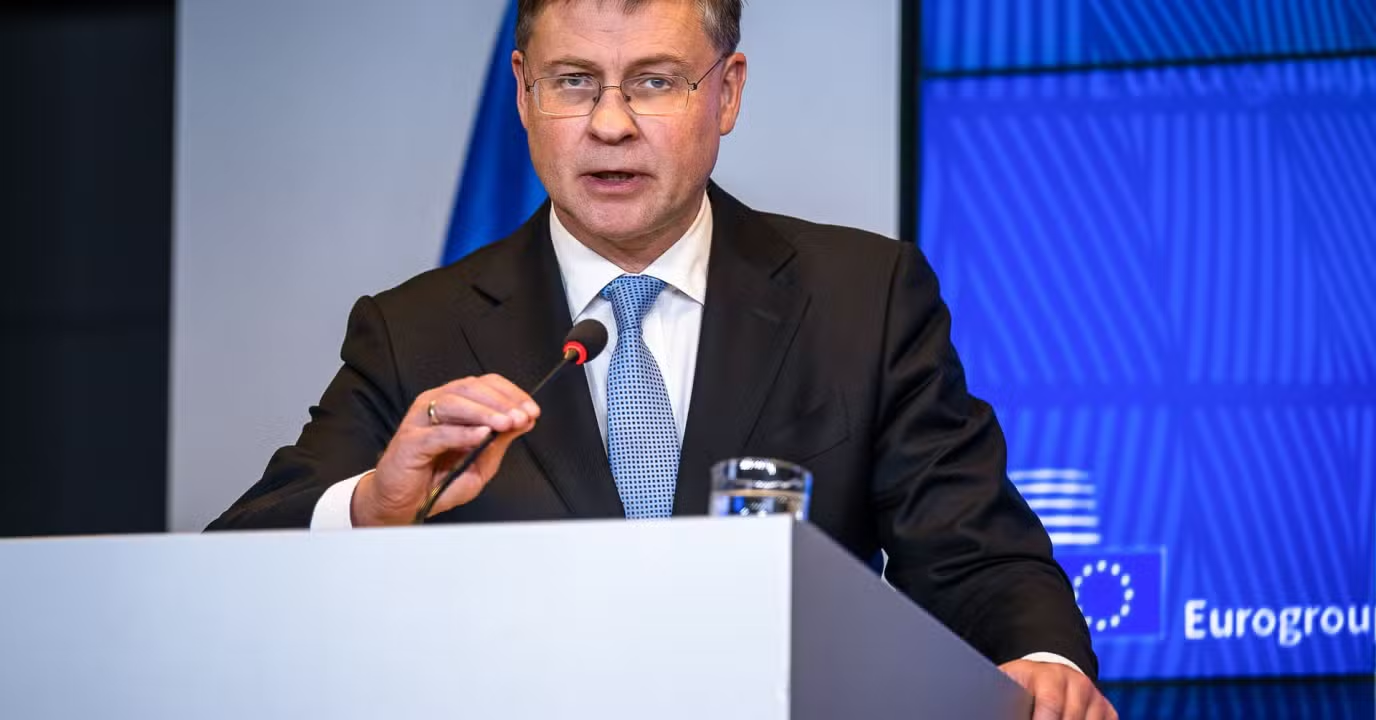
Dombrovskis urges quick EU decisions on 45 billion euro loan for Ukraine
Interview: Move fast to secure Kyiv's future, Brussels economy chief tells Ukraine, EU countries
kyivindependent.com· 2d
European Commission approves proposal to provide additional $49.5 billion to Ukraine
Exclusive: EU proposes additional 45 billion euros for Ukraine, seeks to incentivize allies to step up
Press point by the President on an Instrument for Coordinated Support to Ukraine
europa.eu
EU plans to send a new 45 billion euros to Kyiv in 2027
Ukraine faces a projected budget shortfall of 70 billion euros in 2027, and the European Union plans a new 45 billion euro loan for that year to help fill it. EU Economy and Trade Commissioner Valdis Dombrovskis announced the plan on 9 November 2026, ahead of a meeting of EU economy ministers, and it would come on top of the 45 billion euros Ukraine is set to receive in 2027 under a 90 billion euro loan put together in April 2026. Even with the new loan, Kyiv would still face a shortfall of roughly 25 billion euros, which external partners such as Norway, the United Kingdom, and Canada have pledged toward.
The loan faces hurdles among member states. Czechia, Hungary, and Slovakia opted out of the 90 billion euro loan and are expected to opt out again, and Bulgaria may follow, its government now led by the more pro-Russian Prime Minister Rumen Radev. Diplomats also question how to cover the loan's interest payments while member states raise defense spending.
On 17 November 2026 the European Commission proposed an Instrument for Coordinated Support to Ukraine, under which Ukraine would repay the loan only once Russia pays for the damage it has caused. The 45 billion euros would be financed by borrowing on capital markets and guaranteed by the EU budget, split into 25 billion euros for defense industry capacity and 20 billion euros for budget support, the latter conditional on reforms including in the rule of law and anti-corruption. Companion proposals would amend the Ukraine Facility to let highly rated third countries guarantee the loan and support a second round of loans repaid from windfall profits of immobilized Russian assets.
The Commission approved the legislative proposals on 18 November 2026, and they still require approval by EU member states. EU leaders discussed the plan informally at a meeting of the Coalition of the Willing in Berlin on 19 November, with their first formal discussion set for a European Council meeting in Brussels on 26-27 November and hopes high for agreement by the final EU leaders' meeting of the year on 17-18 December.
Ukraine faces a projected budget shortfall of 70 billion euros in 2027.
EU Economy and Trade Commissioner Valdis Dombrovskis announced on 9 November 2026, ahead of a meeting of EU economy ministers, that the European Union plans a new 45 billion euro loan for Ukraine in 2027, with EU and national diplomats confirming the plan.
The new loan would come on top of the 45 billion euros the EU is set to provide Ukraine in 2027 under a 90 billion euro loan put together in April 2026.
Even if the new loan is agreed, Kyiv would still face a shortfall of roughly 25 billion euros in 2027.
Norway, the United Kingdom, and Canada have announced pledges toward Ukraine's budget for 2027.
For the loan to be approved, the European Commission must first circulate the plan and EU countries must then agree on its terms.
Diplomats see two main issues with the loan's terms: whether all countries participate, and how to cover its interest payments while member states raise defense spending and settle contributions to the next EU budget.
Czechia, Hungary, and Slovakia opted out of the 90 billion euro loan and are not contributing to its interest payments, and diplomats expect them to opt out of the new loan as well.
Diplomats also expect Bulgaria to seek an opt-out, as its government has changed since the 90 billion euro loan was approved and is now led by the more pro-Russian Prime Minister Rumen Radev.
The European Union expects third countries to step up to cover the remaining roughly 25 billion euros of Kyiv's 2027 shortfall.
The European Commission proposed an Instrument for Coordinated Support to Ukraine on 17 November 2026.
Under the proposed instrument, Ukraine would need to repay the loan only once Russia pays for the damage it has caused in Ukraine.
The loan under the instrument has two parts: 20 billion euros for budget support and 25 billion euros for military needs.
Another third of Ukraine's 2027 funding gap is to be covered by external partners.
European Commission President Ursula von der Leyen said the instrument will provide 45 billion euros in 2027 and cover two thirds of Ukraine's 70 billion euro funding gap.
Von der Leyen said the instrument is the best way to give Ukraine a strong hand at the negotiation table.
Von der Leyen said the budget support will keep essential civilian services running, including schools and hospitals, and the military support will give Ukraine the means to defend itself.
Von der Leyen said the loan will ensure Ukraine stays the course on reforms, contribute to further integration of the Ukrainian and European defence industries, and give Ukraine the predictability it needs.
Von der Leyen said the EU will continue to ask external partners to step up their efforts, that she will present the proposal at the next European Council in the week after 17 November 2026, and that the EU will discuss it with partners in the Coalition of the Willing in Berlin on 18 November 2026.
The European Commission's draft proposal, set to be presented on 18 November 2026, would generate 45 billion euros in loans guaranteed by the EU budget's headroom, with the EU paying down the loan's costs the same way as for the approved 90 billion euro loan.
The draft divides the 45 billion euros into three funding pipelines: 25 billion euros for defense industry capacity in Ukraine and 20 billion euros split equally between Macro-Financial Assistance and the Ukraine Facility, which pay Ukraine for implementing EU and IMF reforms.
The 25 billion euros for defense capacity would be handed out in return for Ukraine submitting product schedules, and EU and Ukrainian manufacturers would be prioritized, with an agile approval mechanism retained for third-country purchases when needed.
The draft proposes amending the Ukraine Facility so that third countries of high credit quality provide irrevocable, unconditional, on-demand financial guarantees to the EU, and so that guaranteeing countries help pay the loan's interest with an appropriate contribution.
A second amendment would support G7 members in providing new loans to Ukraine, called second generation ERA loans, repaid from future flows of extraordinary revenues from immobilized Russian sovereign assets once the initially supported loans have been paid.
The document does not predict how much new money the second generation of ERA loans would unlock, though the guarantees could unlock an additional 5 billion euros for the Ukraine Facility, supplementing the 10 billion euros already proposed by the EU.
The draft acknowledges that mobilizing additional significant resources by member states would be an important economic challenge, and says an innovative solution is needed that is not expected to place a financial burden on either Ukraine or its member states.
EU leaders' first chance to discuss the proposal and long-term financing for Ukraine will be at a European Council meeting in Brussels scheduled for 26-27 November 2026.
Hopes are high that agreement on funding Ukraine for 2027 and on the next EU budget can be reached in time for the final EU leaders' meeting of the year, scheduled for 17-18 December 2026.
The European Commission approved a set of legislative proposals on 18 November 2026 to provide up to 45 billion euros in additional financial support to Ukraine in 2027, which still require approval by EU member states.
The package establishes the Instrument for Coordinated Support to Ukraine, a new loan of up to 45 billion euros to be financed by borrowing on capital markets.
A companion proposal would amend the Multiannual Financial Framework Regulation to enable the EU budget to guarantee the new loan.
Further proposals would amend the existing Ukraine Facility and the Ukraine Loan Cooperation Mechanism to incentivize international partners to provide additional financial support to Ukraine.
The budget support would be conditional on Ukraine pursuing reforms, including in the rule of law and anti-corruption, relevant to the interim benchmarks under the Fundamentals Cluster.
Ursula von der Leyen said Ukraine's needs for 2026 are covered and the Commission is proposing a further 45 billion euros for 2027.
The 70 billion euro gap in Ukraine's 2027 budget was identified by President Volodymyr Zelensky in October 2026.
It has already been agreed that defense funding to Ukraine earmarked for 2027 will be frontloaded to earlier in the year.
The European Commission proposal includes a legal tweak to make possible a second round of loans supported by windfall profits from immobilized Russian assets.
EU leaders will have an informal chance to discuss the proposal at a meeting of the Coalition of the Willing in Berlin on 19 November 2026.
Valdis Dombrovskis said EU countries and Ukraine need to respond quickly and decisively to the financing proposal, saying, "We need conceptual decisions rather soon, by December."
Dombrovskis said the proposal as it stands assumes all EU countries will participate, with the loan covered by all 27 member states, which he called the logical way forward as a mechanism of solidarity for Ukraine and for the EU's own security.
Dombrovskis said he hopes the money can be delivered to Kyiv as early in the year as possible once the proposal is approved, and that reform-conditional funds could also be disbursed sooner depending on Kyiv, which would need to frontload certain reforms.
Dombrovskis named laws relating to a simplified tax regime and to combating tax evasion as the reforms Ukraine should prioritize.
Dombrovskis said discussions with the Ukrainian government on the loan's payment schedule are ongoing.
Dombrovskis emphasized that, as with the 90 billion euro loan, the EU reserves the right to use immobilized Russian sovereign assets to repay the loans, and that Kyiv makes no repayments so long as Russia is at war and not paying reparations.
Dombrovskis said any discussion of the fate of Russia's assets would come up "in the context of the peace process" and would depend on what Moscow pays Ukraine in reparations.
Ursula von der Leyen, asked on 18 November 2026 whether the time is right to reopen discussion on directly using Russia's assets, mentioned only the existing use case of supporting Ukraine with the windfall profits that the invested assets generate.

