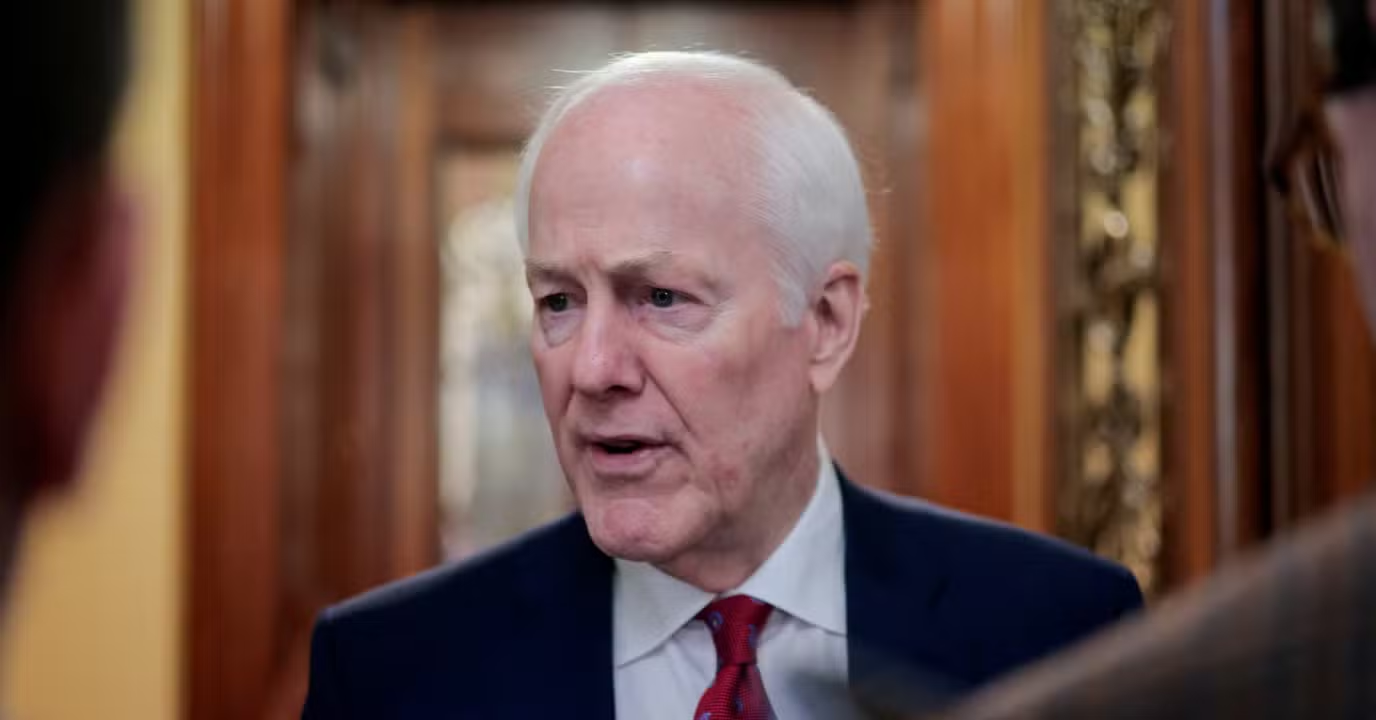
Trump moves to replace Texas judicial nominee blocked by Senator Cornyn
Trump moves to replace Texas judicial nominee opposed by Senator Cornyn
reuters.com· 25h
Trump Judicial Nominee at Center of GOP Drama Signed Off on Deadly Boat Strikes
truthout.org· 43h
Demoralized GOP ditches work, ABANDONS TRUMP after midterm drubbing
youtube.com· 2d
Mitch McConnell could deal Trump one last blow on his way out
rawstory.com· 3d
McConnell may block his conservative critic’s year-end ambassadorial confirmation
semafor.com· 3d
Trump faces a ticking clock on his growing vacancy backlog
politico.com· 5d
Trump arming his 'most toxically partisan' lackey with power to 'blind Congress': analyst
A Republican Senator Just Tanked 2 Of Trump's Most Contentious Nominees
huffpost.com· 6d
A Trump Nominee’s Deep Corporate Lobbying History - The American Prospect
prospect.org· 6d
Trump PANICS as Nominees CRASH AND BURN!
Tillis to block Trump’s comptroller general pick from confirmation in year-end package
Exiting GOP senators become liability for Trump
thehill.com· 7d
GOP Rams Through Trump FCC Nominee Opposed by Free Speech Groups
Senate Democrat destroys Trump’s weak nominees with basic questions
dailykos.com· 7d
Trump’s Picks for Top Jobs Keep Running Into Trouble in Senate
wsj.com· 7d
'Pathetic' and 'disqualified': Trump picks flunk senator's simple test in stunning hearing
'Embarrassing' Trump judicial nominee ridiculed after 'train wreck' hearing meltdown
Durbin, Tillis spar over judicial nominees’ role in Comey prosecution
Republican senator cancels vote on Trump pick to lead science foundation
Senate panel vote on National Science Foundation nominee is abruptly pulled
washingtonpost.com· 8d
Cassidy rejects Trump’s pick to lead NSF, saying he failed to ‘stand up for science’
statnews.com· 8d
Trump Is Sneaking One of His Cronies Into a Critical Post
newrepublic.com· 9d
Should you take GLP-1s during pregnancy? What some doctors say.
Trump RUSHES To CONFIRM Judge Facing BOMBSHELL MISCONDUCT Allegation!!
Senate Republicans pushed to confirm as many of President Donald Trump's nominees as possible before Democrats take control of the Senate in 2027, but several stalled in the lame-duck session. The Senate health committee rejected Jim O'Neill's nomination to lead the National Science Foundation on November 18, with Chairman Bill Cassidy canceling the vote because O'Neill lacked the support to advance. Senator Thom Tillis put a hold on Michael LoSapio, Trump's nominee to lead the Cybersecurity and Infrastructure Security Agency, after LoSapio told his confirmation hearing that the Capitol was not attacked on January 6, 2021. Tillis also placed a presumptive hold on Eric Ueland, Trump's pick to lead the Government Accountability Office. A senior Republican aide said Majority Leader John Thune will leave both out of the December nominations bloc. Nearly 100 of roughly 300 Senate-confirmed leadership positions sit vacant, according to the Partnership for Public Service.
Senator John Cornyn of Texas blocked a Senate Judiciary Committee vote on November 18 to advance T. Elliot Gaiser, Trump's nominee for a Dallas-based federal judgeship. Cornyn had withheld his blue slip from Gaiser, saying he is not from Texas and does not have trial experience. Senator Ted Cruz accused Cornyn of handing an open judicial seat to Democrats, and Cornyn remained under pressure to allow a vote before the lame-duck session ends in December. On November 26, Trump moved to replace Gaiser with former prosecutor Steve Fahey, who is backed by Cornyn, and committee chairman Chuck Grassley said the panel has received partial nomination paperwork for Fahey.
President Donald Trump nominated Gen. Chris LaNeve as the Army's chief of staff on November 17, 2026.
LaNeve has served as the Army's acting chief of staff since April 2026, after Defense Secretary Pete Hegseth fired Gen. Randy George without cause.
There were doubts that LaNeve had enough support in the Republican-led Senate to be confirmed, with the Army having gone five months without a confirmed chief of staff.
US officials said in August 2026 that Senator Joni Ernst, an Army veteran, opposed confirming LaNeve.
LaNeve drew Trump's attention by calling to congratulate him when his second term began in January 2025, became Hegseth's top military assistant, and was elevated to the Army's No. 2 role in February 2026.
Pentagon spokesman Sean Parnell said in August 2026 that officials were 'actively coordinating with our Senate partners to lock in the optimal moment to formally submit his nomination.'
Dan Lamothe forecast that LaNeve's nomination may face a confirmation battle before Democrats take control of Congress in January 2027.
President Trump nominated Eric Ueland, a top Office of Management and Budget official, as comptroller general to head the Government Accountability Office, announcing the nomination on Monday, November 16.
Ueland's term as comptroller general would run 15 years.
Senator John Curtis said Ueland is very qualified but that he has concerns Ueland is the partisan pick for a very bipartisan office, with strong partisan leanings.
Senator Rand Paul said it is important to find someone who is honest and objective, sticking with what he said the year before.
Senator Susan Collins said she does not know whether Ueland is a bipartisan pick.
Bobby Kogan of the Center for American Progress wrote on X that Ueland is the most toxically partisan person he ever worked with on the Hill and would be a disaster for the agency.
The Senate health committee rejected Jim O'Neill's nomination to lead the National Science Foundation on November 18, 2026, when Chairman Bill Cassidy canceled the confirmation vote, saying O'Neill lacked the support to advance.
O'Neill would have led the National Science Foundation for six years if confirmed.
Bill Cassidy said O'Neill did not do enough to 'stand up for science and against irresponsible decisions and statements' from Health Secretary Robert F. Kennedy Jr. while serving in high-ranking posts at the Health and Human Services Department and the Centers for Disease Control and Prevention, and expressed doubts about his willingness to stand up for scientific integrity.
O'Neill would have been the first National Science Foundation director without a scientific or engineering background, drawing opposition from Democrats and science advocacy groups.
Cassidy cited O'Neill's stint as acting director of the Centers for Disease Control and Prevention from August 2025 to February 2026 and his role in firing CDC director Dr. Susan Monarez, who had failed to support Kennedy's vaccine policies.
The Senate health committee had declined to hold a confirmation hearing for O'Neill, prompting Democratic senators to push to delay the vote.
Senators Maria Cantwell and Tammy Baldwin sent Cassidy a letter on November 17 arguing the Senate should have the chance to hear directly from O'Neill about how he would lead the foundation.
The nonprofit Stand Up for Science facilitated more than 1,000 calls and emails to Cassidy opposing the nomination in the two days before the vote was canceled.
Stand Up for Science said 'people power works' in a Bluesky post celebrating the canceled vote.
Gretchen Goldman, president of the Union of Concerned Scientists, said the foundation needs to be led by someone who can champion science for the public good and that O'Neill is not that person.
Bill Cassidy said he likes O'Neill personally but that this time requires leadership and fortitude and standing up for what is right.
At a Senate Judiciary Committee hearing on November 18, Senator Dick Durbin questioned two Trump judicial nominees, Philip Aubart and Brian Meyers, over their roles in the prosecution of former FBI Director James Comey.
FBI records filed in court show Aubart was deeply involved in the Comey investigation and appears to have remained supervisor of the prosecution after the lead prosecutor stepped off the case earlier in 2026.
US Magistrate Judge Brian Meyers approved and signed a May 2026 search warrant for email records from Comey and his wife.
Senator Thom Tillis asserted that Aubart and Meyers had no connection to the Comey case, asking whether he would have brought them before the committee in his 12 years if he thought they were associated with it.
Dick Durbin said that instead of losing their jobs, some of the people involved in the Comey prosecution appear to be considered for lifetime appointments.
At his confirmation hearing on November 18, Texas Supreme Court Justice James P. Sullivan, nominated for a lifetime federal judgeship, struggled to recall the 22nd Amendment when Senator Chris Coons asked him to explain it.
Sullivan declined to say whether Trump could run again in 2028, citing judicial ethics rules against weighing in on political controversies.
Senator John Kennedy challenged Sullivan's interpretation of the Eighth Amendment's prohibition of cruel and unusual punishment and told him 'You're talking in circles, judge' as Sullivan struggled to explain his originalist philosophy with Supreme Court precedent.
Chris Coons called Sullivan's answer 'very disappointing' and described the 22nd Amendment's language as 'bracingly clear'.
Anti-disinformation activist Jim Stewartson called Sullivan's hearing performance 'one of the most embarrassing things I've ever seen'.
Education expert Rose Benson wrote that 'the only qualification Trump used for appointing judges is whether they let him run again'.
Journalist Aaron Rupar wrote that Sullivan 'reveals he doesn't know what the 22nd amendment says' and, after Coons explained it, refused to say it would be illegal for Trump to serve an illegal third term.
At a Senate Homeland Security and Governmental Affairs Committee hearing, Senator Richard Blumenthal questioned 10 Trump nominees, most of whom would not say who won the 2020 popular vote or whether the Capitol was attacked on January 6, 2021.
Cybersecurity and Infrastructure Security Agency nominee Michael LoSapio, a Palantir security chief, refused to say who won the 2020 popular vote and said 'I don't believe it was an attack' on the Capitol.
Office of Government Ethics nominee Michael Chamberlain answered only that 'Joe Biden was the president for four years,' and none of the four District of Columbia Superior Court judicial nominees would say the Capitol was attacked on January 6.
Education Department inspector general nominee Mark Priebe said 'Joe Biden won the popular vote in 2020,' while General Services Administration nominee Maria D'Avanzo said she did not know who got the most votes.
Richard Blumenthal told LoSapio 'You are disqualified from the position that you've been nominated to fill' and called Chamberlain's answers 'really pathetic'.
Blumenthal called his questions 'a test of independence,' complained that the nominees were being heard 'en masse,' calling the process 'really a sham,' and said he hoped it would change 'when the majority changes in January.'
Republicans on the Senate Commerce Committee voted on November 18 to advance Trump's nomination of Danielle Thumann Severs to the Federal Communications Commission over a Democratic boycott of the hearing.
Democrats had sought an additional hearing after internal records suggested Severs helped FCC Chairman Brendan Carr pressure cable news outlets to change their content on Trump's behalf.
Severs told the committee she had not worked with Carr on any of those media-related issues.
In a November 17 letter, Senator Ben Ray Luján asked Senator Ted Cruz to hold the vote because Severs appeared to have 'misled the committee and offered false testimony'.
Commissioner Anna Gomez's term expired in June 2026, and Cruz and the Republican majority did not include her renomination alongside Severs's nomination.
In a November 16 letter, the committee's Democratic senators quoted Cruz's own 2014 writing that controversial nominees 'should not be confirmed in the lame duck session of Congress by senators who just lost their seats and are no longer accountable to the voters.'
The 13 Democratic senators on the committee said in a collective statement that they had concerns about the nominee and asked that she be pulled from the markup until a Democratic nominee is put forward, blaming the White House for ignoring Anna Gomez's renomination.
Senator Bernie Moreno called the Democratic members 'sons of bitches' and said their boycott was a 'total disgrace'.
Public Knowledge president Chris Lewis said Severs's November 10 testimony failed to assure lawmakers that she would remain independent from Brendan Carr and protect free speech.
Free Press co-CEO Jessica J. González said Cruz sent Severs to a Senate floor vote even as thousands of Americans called the Senate in the preceding 24 hours to oppose her confirmation.
Senator John Cornyn withheld his blue slip from T. Elliot Gaiser, Trump's nominee for a district judgeship in Texas, saying Gaiser is not from Texas and does not have trial experience.
Cornyn's office said he had recommended another nominee to the administration months earlier.
Retiring Senator Thom Tillis placed a hold on CISA nominee Michael LoSapio after LoSapio said in his confirmation hearing that the Capitol was not attacked on January 6, 2021.
John Cornyn said, 'I just refuse to be jammed by a non-Texan who has no trial experience, who hasn't been vetted,' adding that the White House had been given an alternative and he did not want the seat vacant.
Heritage Foundation President Kevin Roberts wrote, 'John Cornyn is going out as the Republican Texas Senator who helped get radical leftist James Talarico's agenda started early. What a legacy.'
Cornyn replied to Roberts, 'Kevin, your sycophancy has destroyed the credibility of a once great institution, and in so doing you have made yourself irrelevant.'
Senator Thom Tillis issued a presumptive hold on Eric Ueland's nomination to head the Government Accountability Office and planned to block his inclusion in a catchall nomination package Senate Republicans planned to approve in December 2026.
The Senate Homeland Security and Governmental Affairs Committee held a confirmation hearing on Ueland on the morning of November 19.
Committee Chairman Rand Paul said his committee was likely to vote to approve the nomination when senators return to Washington after Thanksgiving.
Thom Tillis said Ueland is an honorable guy but that the Government Accountability Office needs somebody more independent than Ueland for the office to have credibility.
Tillis predicted it would be difficult for Ueland to resist giving in to directives from Trump administration officials, including White House budget director Russ Vought.
Rand Paul said he has no intention of opposing Ueland's nomination, though he has not publicly endorsed it.
Scott MacFarlane said voters made it clear in the midterms that they do not like election denialism and that Trump's judicial nominees continue to espouse it when face to face with senators.
Eric Ueland's nomination did not go through the prescribed process for selecting Government Accountability Office leadership, which is supposed to consist of a bipartisan 10-member panel providing recommendations.
Several Republicans expressed discomfort with the rushed confirmation process and with the conflicts of interest in having a Trump ally lead the agency that would investigate the administration.
Ueland said at his confirmation hearing that he is 'not here as a plant, a stooge, a lackey for anybody.'
Ueland said he would investigate the White House, where he works, if confirmed to lead the Government Accountability Office.
Senator Thom Tillis placed holds on Eric Ueland's nomination to lead the Government Accountability Office and Michael LoSapio's nomination to lead the Cybersecurity and Infrastructure Security Agency.
Senator Ron Wyden also placed a hold on LoSapio's nomination.
A senior GOP aide said Senate Majority Leader John Thune will not include Ueland or LoSapio in the final bloc of nominations voted on in December.
Ron Wyden said it was obvious why LoSapio was the wrong pick to lead the Cybersecurity and Infrastructure Security Agency: 'You can't have an insurrectionist Palantir executive in charge of our nation's cybersecurity and election security.'
A senior GOP aide said Thune has honored all previous holds and objections in previous blocs and would expect the same here.
Rand Paul spokesman Drew Carmichael said the committee was 'currently looking at sometime in early December' for its last hearing of the year to advance remaining nominees.
The Government Accountability Office has found at least 11 cases of the Trump administration illegally withholding funds Congress ordered spent in Trump's second term alone.
Catherine Rampell wrote in The Bulwark that confirming Ueland would 'constitutionally castrate the entire legislative branch' and that he would oversee probes into illegal funding freezes his own office likely helped carry out.
Russell Vought responded 'yawn' on X to Rampell's piece about incoming Democratic majorities' plans to hold him and the Office of Management and Budget accountable, nine days before Trump nominated Ueland.
Former Homeland Security inspector general John Roth said, 'They are trying to blind Congress to what's going on. This is Congress's eyes and ears into the operations of government.'
Republican senators pushed to confirm as many of Trump's nominees as possible before Democrats take control of the Senate in 2027.
According to the Partnership for Public Service, nearly 100 of roughly 300 Senate-confirmed leadership positions across 15 Cabinet departments are vacant, with only 29 of those vacancies having a pending nominee.
Trump has not named a permanent head of the Internal Revenue Service since the acting head's term expired in March 2026.
The Food and Drug Administration is without a confirmed leader after Trump's latest pick, Heidi Overton, was pulled just before the article's publication.
A wave of Justice Department departures means just three of its 11 top spots would have permanent Senate-confirmed leaders if the announced exits proceed.
The Senate Armed Services Committee held a confirmation hearing for Navy secretary nominee Hung Cao, and neither Cao nor Army chief of staff nominee Chris LaNeve has a clear path to confirmation.
Before leaving for its September 2026 recess, the Senate cleared a 74-person bloc of Trump's civilian nominees, the fifth round of group confirmations.
Justice Department nominee Arthur Kleinschmidt is expected to get a vote in early December 2026, while a hearing for fellow nominee Adam Gustafson has not been held because his paperwork is incomplete.
Trump posted on Truth Social that it is 'very important' for the Senate to confirm all 'pending 161 Nominations, including 25 Federal Judges.'
Senator Bill Cassidy said he has heard 'nothing at all' from the White House about how to help confirm nominees and that agencies 'should be able to find somebody who's acceptable to Democrats and acceptable to Republicans.'
Senator Rand Paul said he has not had 'any conversation' with the White House about the nominations issue.
Senate Majority Leader John Thune said 'there is no substitute for Senate confirmation' and that 'Democrats would stand in the way of George Washington himself if President Trump nominated him to serve in his administration.'
Senator Cynthia Lummis said Democrats will 'shut off nominees' when they take control in January 2027 and called it 'just irresponsible to leave agencies rudderless for two years.'
Senator Roger Wicker said he hopes to fill all the Pentagon posts before the end of 2026 but that 'there is a lot of work to be done on that still' and lawmakers face 'a time crunch.'
Health Secretary Robert F. Kennedy Jr. said at a MAHA Action event, 'The Senate no longer has any leverage over me, and that's a big deal.'
Senator Richard Blumenthal said 'an incompetent or corrupt permanent appointee is more dangerous than an acting nominee.'
Attorney General Todd Blanche said the Justice Department's latest departures are unremarkable because 'this happens in every administration' after midterm elections.
Mitch McConnell has not signed off on adding Nate Morris, Trump's nominee to be ambassador to Colombia, to the Senate's year-end nominations package, and may knock the nomination out of the package, according to two people familiar with the discussions.
Morris's nomination advanced to the Senate floor earlier in November 2026.
Under the process for the year-end package, any single Republican senator can object to a nominee's inclusion, giving McConnell significant sway over Morris's confirmation.
McConnell spokesperson David Popp said 'Senator McConnell will evaluate the en bloc package when it is presented to the conference.'
A third person familiar with the confirmation discussions expressed confidence that any issues 'will ultimately be worked out and he will be confirmed as part of the bloc' at the end of 2026.
The Senate Foreign Relations Committee approved Nate Morris's nomination 13-8 in the week before November 23.
Morris was reported to have repeatedly criticized McConnell during his Kentucky Senate campaign and to have vowed to 'trash' McConnell's legacy.
At his confirmation hearing, after Senator John Curtis gave him a chance to smooth things over with McConnell, Morris said he was 'proud of the campaign we ran.'
On November 18, Senator John Cornyn blocked a Senate Judiciary Committee vote to advance T. Elliot Gaiser's nomination to a lifetime federal judgeship in the Northern District of Texas.
Senator Ted Cruz accused Cornyn of handing an open judicial seat to Democrats, and Cornyn remained under pressure from Cruz and other conservatives to allow a vote before the GOP's lame-duck session ends in December.
Gaiser, who leads the Justice Department's Office of Legal Counsel as assistant attorney general, played a role in producing the legal opinion that greenlit the US military's deadly airstrikes on civilian boats in the Caribbean and Pacific Ocean.
Cornyn said in a November 21 social media post describing a heated exchange with Cruz, 'Everyone knows that I am a notorious cusser and screamer and that Ted is a fragile thing.'
Legal Accountability Center co-founder Michael Teter said Gaiser may have recognized he would never get a judgeship through a Senate controlled by the Democratic Party and that this was the last one available.
Trump is moving to replace T. Elliot Gaiser with former prosecutor Steve Fahey, who is backed by Cornyn, for the Dallas-based federal judgeship.
Senate Judiciary Committee Chairman Chuck Grassley said his panel received partial nomination paperwork for Fahey.
Cornyn said the White House 'was trying to jam him down our throat without adequate vetting for a lifetime job.'

