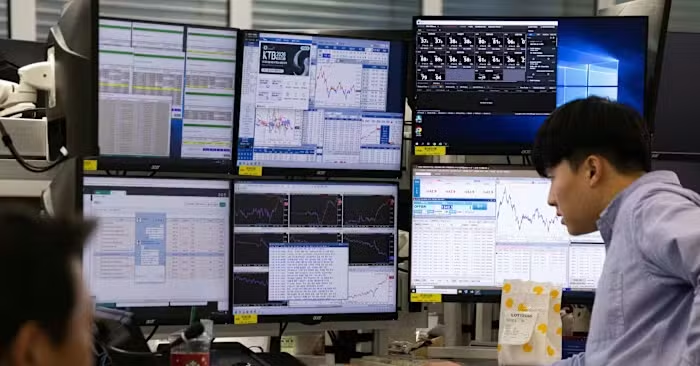
Asian stocks rebound as AI sell-off eases after chip rout on US tariff threats
Stocks advance in Asia after volatile US trading over AI risks
ft.com· 37m
SoftBank Stock Drops Another 15% as Slump from AI Eclipses Covid
wsj.com· 14h
Aasian pörssit syöksyvät
yle.fi· 23h
Stocks retreat as AI rebound stumbles, tariff threats loom
reuters.com· 23h
Asian markets lose ground as AI fears return
SoftBank drops over 11% as Wall Street AI sell-off ripples across Asian tech names
cnbc.com· 24h
Asian technology stocks tumbled on 25 November 2026, led by a rout in Japanese semiconductor shares as renewed concerns over the AI trade followed an overnight sell-off on Wall Street. Chip testing supplier Advantest plunged 12.26% and chipmaking equipment supplier Tokyo Electron slumped 10.9%. SoftBank Group shares dropped a further 14.8%, extending a slump that has left the stock down 68% from its all-time high in early June 2026 and wiped out more than $200 billion in market value.
The selling spread across the region: Samsung Electronics and SK Hynix, key suppliers of high-bandwidth memory for AI accelerators, both fell more than 7%, and MSCI's broadest index of Asia-Pacific shares outside Japan lost 3.2%, with South Korea's Kospi closing down 4.8% and Japan's Nikkei 225 down 3.1%. Copper prices fell 4.66% in Shanghai as the fizzling AI rally weighed on industrial metals.
Three people with knowledge of the matter said the US Trade Representative's office is preparing to release the findings of a probe that could pave the way for new tariffs, focused on alleged excess industrial capacity among 16 major US trading partners including China and the EU. Nvidia fell 5.9%, and Anthropic dropped 6.5% to below its IPO price.
Asian stocks advanced on 26 November after volatile US trading driven by worries over artificial intelligence risks.
Asian technology stocks tumbled on 25 November 2026, led by a rout in Japanese semiconductor shares, as renewed concerns over the AI trade followed an overnight sell-off on Wall Street.
Nvidia chip testing supplier Advantest plunged 12.26% and Tokyo Electron, which supplies chipmaking equipment to TSMC, slumped 10.9%.
SoftBank Group shares shed 10% on 25 November.
Japanese chip stocks Lasertec, Disco Corporation and Renesas Electronics lost 10.15%, 9.41% and 10% respectively.
Samsung Electronics and SK Hynix, key suppliers of high-bandwidth memory for AI accelerators, both fell more than 7%.
LG Innotek shed 6.15% and LG Display declined 4.09%.
MSCI's broadest index of Asia-Pacific shares outside Japan fell 3.2% on 25 November, led by a drop of as much as 6.4% in South Korean shares and an 8.6% decline at the worst point in Taiwan.
Japan's Nikkei 225 fell as much as 3.7% and S&P 500 e-mini futures were 0.6% lower.
Three people with knowledge of the matter said the US Trade Representative's office is preparing to release the findings of a probe that could pave the way for new tariffs, focused on alleged excess industrial capacity among 16 major US trading partners including China and the EU.
Nvidia surrendered gains from Jensen Huang's return as CEO earlier that week, falling 5.9%.
Anthropic fell 6.5% to below its IPO price.
Copper prices fell 4.66% in Shanghai as the fizzling AI rally weighed on industrial metals.
Hua Nan Securities analyst Kevin Su said Asian markets were being sold off mainly because of the tariff issue, and that expectations of rate hikes were also suppressing risk appetite.
Pepperstone Group head of research Chris Weston said the re-emergence of tariffs from the USTR had been met with a collective sigh from investors, and that traders appeared reluctant to commit significant capital on the headlines alone.
Capital.com senior market analyst Kyle Rodda said Wall Street pared its Monday advance as sobriety returned to the market and a focus returned to fundamentals.
Japan's Nikkei 225 closed down 3.1% at 56,802.90 points on 25 November.
South Korea's Kospi closed down 4.8% at 4,764.70 points on 25 November.
SoftBank shares dropped a further 14.8% on 25 November, extending a slump that has eclipsed the company's Covid-era plunge.
SoftBank's stock is down 68% from its all-time high in early June 2026, wiping out over $200 billion in market value.
Asian stocks advanced on 26 November after volatile US trading driven by worries over artificial intelligence risks.

