Appeals court says federal law requiring accommodations for pregnant workers is unconstitutional
A federal appeals court has struck down the Pregnant Workers Fairness Act, a 2022 law requiring workplaces to accommodate pregnant women, ruling it unconstitutional because most House members were not physically present when it passed under COVID-era proxy voting rules. The New Orleans-based 5th Circuit issued its 9-8 decision on 20 November 2026, holding that members of Congress must be present for quorum purposes and that proxy presence does not count. The law, which passed with bipartisan support, strengthened rights to accommodations such as time off for medical appointments and exemptions from heavy lifting. Eight dissenting judges noted no member of Congress objected that a quorum was lacking when the funding bill was passed, and advocates including A Better Balance say the ruling invalidates the law in Texas, Louisiana and Mississippi, could imperil it elsewhere, and will likely be appealed to the U.S. Supreme Court.

Appeals court says federal law requiring accommodations for pregnant workers is unconstitutional
The New Orleans-based 5th Circuit Court of Appeals has struck down the Pregnant Workers Fairness Act, a federal law requiring workplaces to accommodate pregnant women, ruling 9-8 that Congress violated the Constitution when it passed the law in 2022. The court says a majority of House members were not physically present when the law was approved as part of a spending package under COVID-era rules allowing proxy voting, and that proxy presence does not count for quorum. The ruling came in a lawsuit by Texas Attorney General Ken Paxton, and the eight dissenting judges note that no member of Congress objected to the quorum at the time and that Texas accepted most of the funds from the same bill. Advocates say the decision invalidates the law in Texas, Louisiana and Mississippi, and the group A Better Balance says the ruling is likely to be appealed to the U.S. Supreme Court.
Federal Court Halts Pregnant Workers’ Protection Law
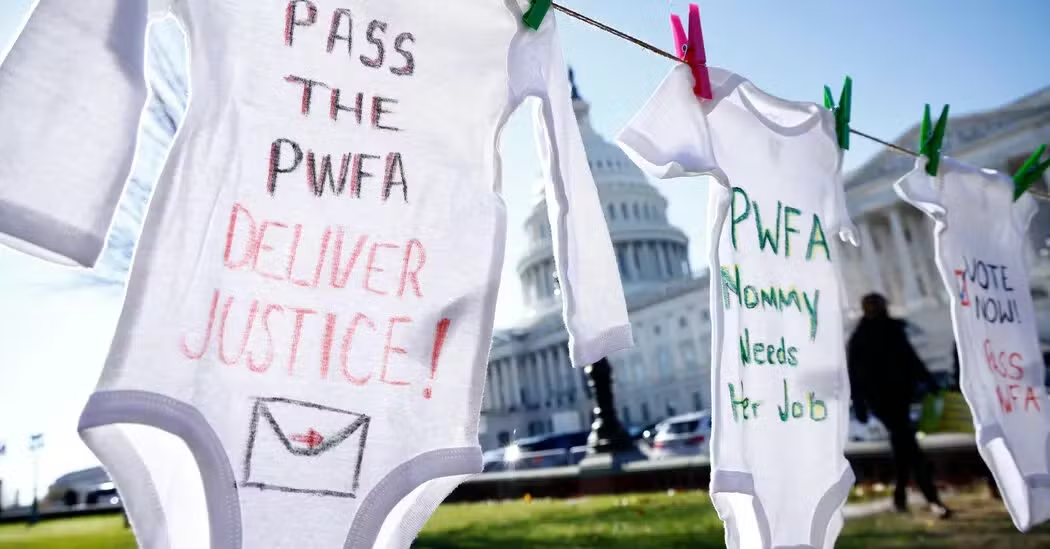
A New York Times news report says a divided Fifth Circuit Court of Appeals ruled 9 to 8 that the Pregnant Workers Fairness Act was passed in violation of the Constitution's quorum clause, because Congress lacked a legal quorum when it passed the law. The law protects accommodations for pregnant workers such as bathroom and water breaks, relief from heavy lifting, and time off for prenatal appointments, and it was passed as part of a $1.7 trillion spending bill at the peak of the Covid-19 pandemic, when lawmakers authorized remote and proxy votes as a safety precaution. The court said the proxy system was at odds with the standards of the Constitution's framers, writing that the Quorum Clause does not allow proxies to be included when establishing a quorum. Legal experts say the decision would effectively invalidate the law in Texas, Louisiana, and Mississippi, home to about 20 million women, and would likely have ripple effects nationally, and the decision is expected to be appealed to the Supreme Court.
https://www.ca5.uscourts.gov/opinions/pub/24/24-10386-CV1.pdf
A divided en banc Fifth Circuit affirms a ruling that the House of Representatives violated the Constitution's Quorum Clause when it passed the Consolidated Appropriations Act of 2023, and upholds an injunction barring enforcement of the Act's Pregnant Workers Fairness Act against Texas. Writing for the court, Judge Cory T. Wilson holds that the Quorum Clause requires the physical, personal presence of a majority of Members, so the House's COVID-era rule letting Members record presence by proxy cannot count toward a quorum. The point is undisputed that the House reached a quorum for the December 2022 vote only by including proxies, with 226 of the 427 recorded votes cast by proxy, so less than a majority was physically present. The court rejects the Government's enrolled-bill rule defense, reasoning that because the parties agree on the facts of passage, Texas's challenge raises only a legal question the enrolled-bill doctrine does not bar. Judge James E. Graves, Jr., joined by six other judges, dissents, arguing that the text, the Supreme Court's Ballin precedent, and practices like unanimous consent going back to the first Congress show the Clause does not require physical presence, and that the majority shoehorns a new requirement into the Constitution. The relief is limited: the court's judgment extends only to affirming the injunction against enforcing the Pregnant Workers Fairness Act against Texas, not to the rest of the multi-trillion dollar Act.

