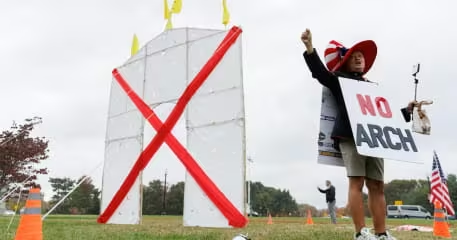
Judge blocks Trump's triumphal arch in written opinion; Justice Department plans appeal
Courts Block Trump Arch x 2
youtube.com· 42h
New Dem Star Exposes Trump’s Brazen Thirst for Flattery
thedailybeast.com· 2d
What happens to Trump’s triumphal arch after two judges block construction
newsweek.com· 3d
What happens next after second judge blocks Trump's arch plans
No Stupid Arch
substack.com· 5d
- gov.uscourts.vaed.607913.30.0.pdf
courtlistener.com· 5d
Second judge blocks construction of Trump's massive 'triumphal arch'
euronews.com· 6d
Federal Judge Orders an Indefinite STOP to Trump's Vanity Arch Project!
Second federal judge blocks construction of Trump's memorial arch
pbs.org· 6d
Second federal judge blocks Trump building triumphal arch
usatoday.com· 6d
Another judge blocks Trump’s arch construction in second blow to project
washingtonpost.com· 6d
A 2nd federal judge blocks construction of Trump's memorial arch in DC
apnews.com· 6d
Second judge blocks Trump’s triumphal arch, saying it lacks congressional approval | CNN Politics
cnn.com· 6d
A second judge blocks Trump's arch, saying it's unlikely to succeed in court
npr.org· 6d
'Very angry' judge's 'frustration' poured out in new Trump project smackdown: MS NOW
rawstory.com· 6d
2nd federal judge blocks Trump’s triumphal arch
politico.com· 6d
Second judge blocks Trump's triumphal arch, calling it a 'rushed job'
reuters.com· 6d
- gov.uscourts.dcd.289572.127.0.pdf
President Donald Trump first proposed a 250-foot triumphal arch at Memorial Circle on Columbia Island to celebrate the nation's 250th birthday, though he later said it would be a military complex to store ammunition. On 5 November 2026, the National Capital Planning Commission approved final plans by an 8-4 vote, and the National Park Service and Interior Department gave their final approvals.
Arlington County, Virginia sued the National Park Service and Interior Secretary Doug Burgum on 8 October 2026, saying construction could force closing the Arlington Memorial Bridge, which emergency services for Reagan National Airport and Arlington National Cemetery need. US District Judge Tanya Chutkan temporarily blocked groundbreaking on 5 November and extended her order on 18 November until 3 December.
On 20 November 2026, US District Judge Leonie Brinkema in Alexandria, Virginia granted Arlington County a preliminary injunction in a written opinion, barring the Park Service from beginning construction while the county's challenge plays out. She held the arch is a commemorative work requiring specific congressional approval never obtained, that it far exceeds the two 166-foot columns Congress approved in a 1925 Act, and that its effects on road traffic and Ronald Reagan Washington National Airport, about three miles south, were never adequately considered. She called the project a rushed job that lacked a legal basis.
On 22 November, Chutkan issued a 33-page opinion of her own finding local governments likely face immediate harm from the project's traffic disruption and questioning the administration's shifting explanations. The Justice Department plans to appeal to the U.S. Court of Appeals for the Fourth Circuit, which could stay the injunction and allow work to resume.
President Donald Trump first publicly proposed building an arch at Memorial Circle on Columbia Island more than a year before 16 November 2026.
The Federal Aviation Administration found the proposed arch would not be a hazard to air navigation, and the Commission of Fine Arts approved its architectural design.
On 5 November 2026, the National Capital Planning Commission approved the final site and building plans, the National Park Service issued its final decision approving the Triumphal Arch at Memorial Circle, and the Interior Department authorized construction.
In February 2026 the Lemmon Plaintiffs sued over the arch on ultra vires and Take Care Clause claims, and agreed to a consent order requiring fourteen days' notice before construction.
On 31 October 2026, District of Columbia and Virginia Plaintiffs filed suit, consolidated with the Lemmon case, and moved for a temporary restraining order.
On 5 November 2026, the court granted the temporary restraining order, deferring ruling on a stay of agency action.
On 10 November 2026, the District of Columbia and Virginia Plaintiffs amended their complaint, and new preliminary injunction motions were filed in both consolidated cases.
The revised environmental assessment plans six to eight months of below-grade excavation first, above-ground construction no earlier than May 2027, and 33 to 39 months of total construction.
The United States argued the plaintiffs lack Article III standing, that states cannot sue as parens patriae against the federal government, and that aesthetic offense cannot manufacture standing.
The United States argued the arch fulfills a century-old congressional authorization for 166-foot columns at Memorial Circle and needs no Commemorative Works Act procedures.
The United States argued the National Park Service complied with every relevant statute and that the plaintiffs' disagreement with its decision does not establish illegality or irreparable harm.
The United States argued 40 U.S.C. § 8106 requires only some form of congressional authorization, with design approval entrusted to the federal review commissions.
The United States argued the National Historic Preservation Act requires only consultation with preservation agencies, citing the D.C. Circuit's CTIA-Wireless Ass'n v. FCC decision.
In declarations, Secretary of War Pete Hegseth and Homeland Security Secretary Markwayne Mullin said the arch could help counter unmanned aircraft threats without requiring structural modifications.
Ricky Buria and Steven Willoughby said in declarations that planning to integrate those uses into the arch was ongoing and no final decisions had been made.
National Park Service Regional Director Jennifer Nersedian said in a declaration that initial construction would involve fencing off grassy areas, connecting utilities, and mobilizing equipment.
On 20 November 2026, US District Judge Leonie Brinkema in Alexandria, Virginia said she would issue an injunction indefinitely blocking the proposed 250-foot arch while she hears Arlington County's legal challenge.
Brinkema called the arch project a rushed job that lacked a legal basis.
Brinkema found multiple defects in the government's economic and environmental analysis, including an inadequate explanation of the arch's effects on Reagan Washington National Airport.
Brinkema said the government's argument that a 1925 statute authorized the arch made no sense and hurt its credibility, because the project lacks congressional approval.
White House spokesman Davis Ingle said the judiciary should not be abused to politicize a structure designed to unite the nation.
White House spokesman Davis Ingle said the administration would continue making the case for the 'beautiful and fitting' monument and is confident it will be fully vindicated as the litigation proceeds.
Democracy Forward lawyer Kate Talmor said the court recognized the irreparable harm the arch would cause people who live and work in Arlington and stopped the 'massive vanity project' while the case is heard.
Brinkema found no evidence that federal officials had adequately considered the arch's serious impacts on road traffic and on Ronald Reagan Washington National Airport, about three miles south of the site.
The arch project was already on hold under another federal judge's temporary restraining order set to expire on 3 December 2026.
Brinkema ruled that Arlington County's concerns about road traffic gave it standing to sue, noting the site sits on a major artery through northern Virginia.
Brinkema noted construction cranes could rise to 320 feet and expressed particular concern about planes and helicopters near the site.
Brinkema said in court, 'It seems like a rush job. I don't see any way where the defense could be successful on the merits in this case. You don't have Congressional approval for this project.'
Brinkema said the 1925 law 'was written before National Airport even existed'.
Brinkema said, 'Once one of the major roadways is closed, it clogs up everything.'
Brinkema questioned how tourists would be mingling with snipers and drones on the proposed arch.
President Donald Trump has suggested in recent months that the arch would also house military components that could take advantage of its high vantage point over the capital.
Fallon Gallagher reported that Brinkema was very angry and not buying the government's argument about the columns, and that her frustration toward the administration was on clear display in the courtroom.
Brinkema said at the hearing she would grant the request of Arlington County, Virginia, which sued over the arch in October 2026.
Brinkema's ruling goes further than Judge Chutkan's restraining order, preventing construction while Arlington County's legal challenge plays out.
Brinkema issued her injunction from the bench in a lawsuit brought by the Arlington County Board, two days after a different federal judge in Washington extended a previous temporary block on breaking ground.
Democracy Forward said Brinkema's injunction would extend until the Virginia-based case is over.
White House spokesperson Davis Ingle called the ruling the product of 'another activist district court'.
President Donald Trump originally unveiled the arch to celebrate the nation's 250th birthday but has since said it would be a military complex to store ammunition.
Lawyers for the Department of Justice defended the arch in a 44-page court response filed on 13 November 2026, saying the National Park Service complied with legal requirements.
Department of Justice Public Affairs Specialist Matthew Nies said the department plans to 'immediately' appeal the court's decisions.
Justice Department lawyers wrote in the 13 November filing that a preliminary injunction 'improperly intrudes upon the province of the Executive Branch without conveying any benefit to the public.'
U.S. District Judge Tanya Chutkan agreed on 18 November 2026 to extend her temporary restraining order keeping the arch project on hold until 3 December 2026.
The National Capital Planning Commission's final approval of the arch on 5 November 2026 was by an 8-4 vote.
The planned arch would stand twice the height of the Lincoln Memorial.
The Arlington County Board's suit alleges construction would likely necessitate closing the Arlington Memorial Bridge, which emergency services for Reagan National Airport and Arlington National Cemetery need.
Commentator Glenn Kirschner called the arch a vanity project and said the ruling fits a wider pattern of courts, including some Trump appointed, ruling against the administration.
The planned 250-foot arch is modelled on Paris' Arc de Triomphe.
Arlington County sued the National Park Service, Interior Secretary Doug Burgum, and Acting Park Service Director Jessica Bowron on 8 October 2026, amending the complaint on 6 November.
In a memorandum opinion entered 20 November 2026, Judge Leonie Brinkema granted Arlington County's motion for a preliminary injunction barring the National Park Service from beginning construction of the 250-foot arch.
Brinkema held the arch is a commemorative work under the Commemorative Works Act, which requires specific congressional approval the defendants never obtained.
Brinkema held the 250-foot arch far exceeds the two 166-foot columns Congress approved in the 1925 Act and would impair the protected view of the Lincoln Memorial.
Brinkema held the arch would violate the National Park Service Organic Act's conservation mandate, requiring explicit congressional authorization before the project could proceed.
Brinkema held the county has standing and faces irreparable harm because traffic impacts would disrupt emergency routes and force it to divert finite resources.
Brinkema rejected the defendants' venue argument and held all four preliminary injunction factors favor the county.
Brinkema found the national security rationale for prompt construction lacked credibility because it was first raised after litigation began and the Park Service never considered it during its review.
The federal defendants conceded they complied with no Commemorative Works Act procedures, arguing the Act does not apply because the arch is intended to perpetuate American greatness rather than commemorate something.
Joyce Vance called the arch one of Trump's delusions of grandeur and said the right thing is for the administration to let the plan go.
Joyce Vance forecast that the administration will appeal Brinkema's ruling.
Joyce Vance said the administration hastily manufactured its national security rationale for the arch.
In a 33-page opinion, Judge Tanya Chutkan found local governments showed likely immediate harm from the project's traffic disruption and questioned the administration's shifting explanations, including a national security rationale.
If the Justice Department appeals, the case would go to the U.S. Court of Appeals for the Fourth Circuit, which could stay Brinkema's injunction pending appeal and allow work to resume.