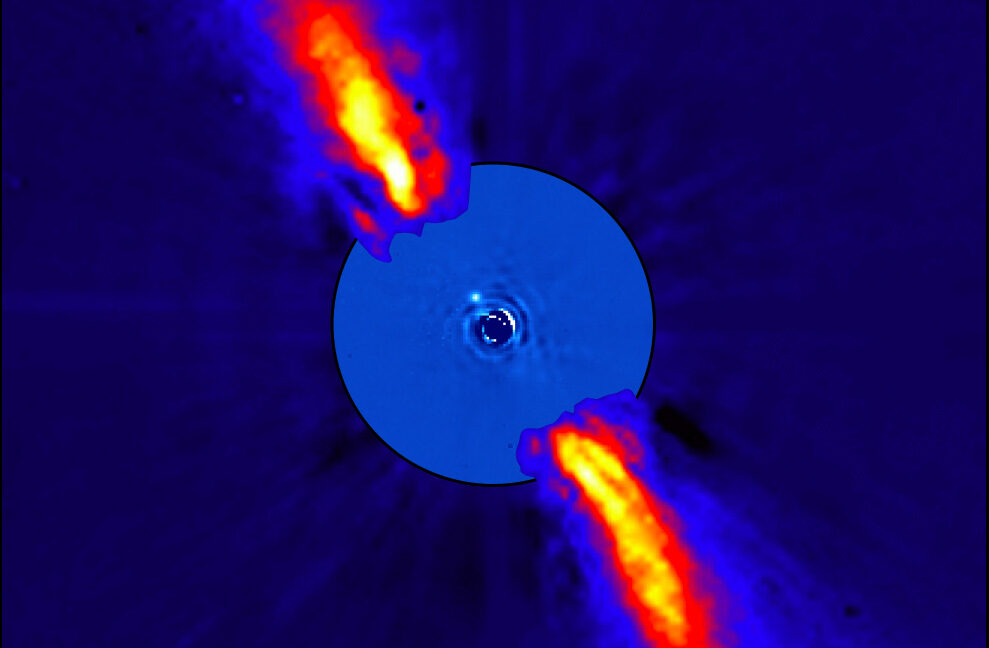
James Webb telescope finds water and carbon dioxide ice in disk around Beta Pictoris
Summary
- A team led by Sarah Betti of the Space Telescope Science Institute used the James Webb Space Telescope to find water and carbon dioxide ice in the disk around Beta Pictoris.
- Beta Pictoris is a young star about 20 million years old, some 64 light-years from Earth, with a debris disk where three planets are known to be forming.
- The ice is glassy rather than crystalline, mixed thoroughly with carbon dioxide, and makes up about 11 percent of it.
- The researchers concluded the ice most likely formed in interstellar space before the star's planets began to take shape.
- The findings suggest the raw materials for water-rich, potentially habitable worlds may be common around young stars.
Reactions
- Commentary described the edge-on disk around Beta Pictoris as a natural laboratory for studying how planetary systems grow.
Timeline newest first
Sources newest first
- James Webb telescope finds ice older than the star it orbits
arstechnica.com· 9h
Using the James Webb Space Telescope, Sarah Betti's team found water and carbon dioxide ice in the debris disk around the young star Beta Pictoris—ice that likely formed in interstellar space before the star's planets took shape. The findings suggest the raw materials for water-rich, potentially habitable worlds may be common around young stars.
