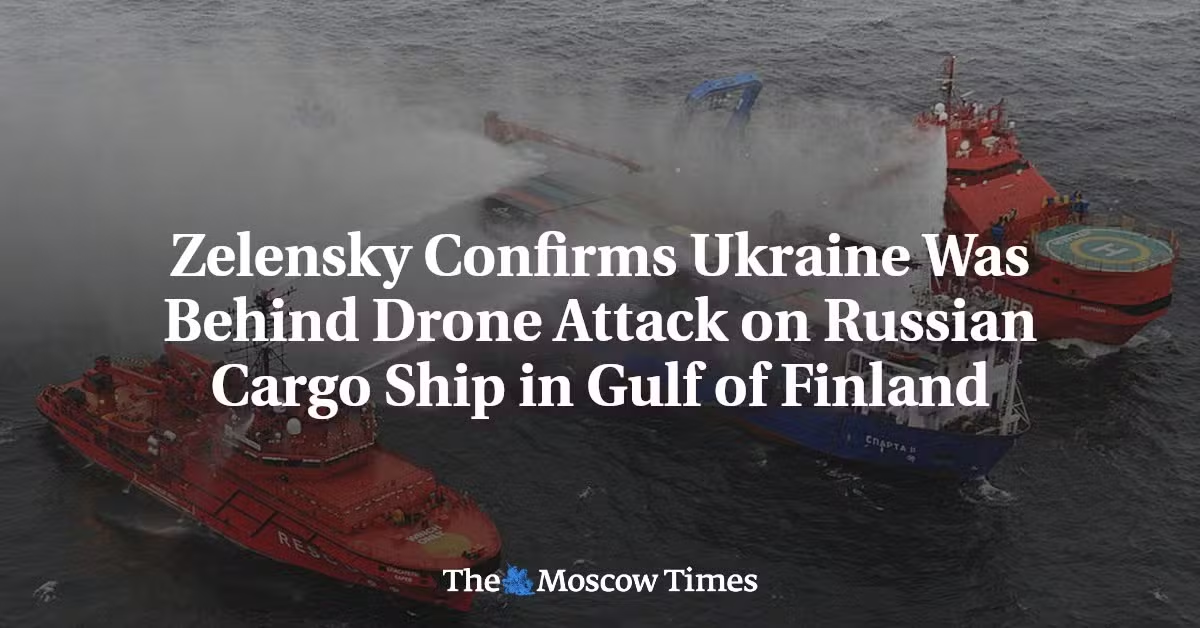
Zelensky confirms Ukraine's drone strike on Russian cargo ship Sparta II
Zelensky Confirms Ukraine Was Behind Drone Attack on Russian Cargo Ship in Gulf of Finland - The Moscow Times
themoscowtimes.com· 2d
Zelensky confirms Ukrainian attack on Russian ship in Gulf of Finland
kyivindependent.com· 2d
Russian cargo ship under tow after being hit by drones arrives in St Petersburg
reuters.com· 3d
Asiantuntijat odottavat lisää drooni-iskuja Suomenlahdelle – meriliikenne on silti turvallista
yle.fi· 3d
EN DIRECT, guerre en Ukraine : un cargo russe pris pour cible dans le golfe de Finlande, le Kremlin dénonce l’« expansion de l’activité terroriste » en mer Baltique
lemonde.fr· 3d
Europe Is ‘Somewhere Between Peace And War’ With Russia, Former Finnish Defense Chief Says
rferl.org· 4d
Russian cargo ship set ablaze in Baltic Sea drifts into Gulf of Finland
newsnationnow.com· 4d
Russia is towing drone-hit cargo ship after Baltic Sea attack
euronews.com· 4d
Russia starts towing ship hit by drones in Baltic, Finland says
channelnewsasia.com· 4d
Russia Starts Towing Ship Hit by Drones in Baltic, Finland Says - The Moscow Times
Guerre Russie-Ukraine : la «zone grise» rétrécit pour les pays de l’Otan
liberation.fr· 4d
Sanctioned Russian vessel ablaze in Finnish waters after drone attack
ft.com· 4d
Russian cargo ship still on fire off Finland after drone attack
aljazeera.com· 4d
Russian cargo ship still on fire off Finland after attack
En direct : la Finlande dénonce une attaque de drone ukrainien contre un cargo russe en mer Baltique
france24.com· 5d
EN DIRECT, guerre en Ukraine : un cargo russe attaqué en mer Baltique ; des drones ukrainiens produits au Royaume-Uni… Les dernières informations
Russian cargo ship burns in Baltic Sea after drone strike
abc.net.au· 5d
Finland warns Ukraine war ‘spilling over’ after Baltic Sea drone strike on Russian cargo ship | CNN
cnn.com· 5d
Crimea Descends Into Chaos As Ukraine Expand War To The Baltic
youtube.com· 5d
Russian cargo ship hit by drones in Baltic, Finland tightens security
Russisches Frachtschiff nach Drohnenangriff vor Finnland in Brand
spiegel.de· 5d
Russian cargo ship hit by drones in Baltic, Finland tightens security
cnbc.com· 5d
EN DIRECT, guerre en Ukraine : le point sur l’attaque par drone d’un cargo russe en mer Baltique, la Finlande soupçonne un hélicoptère russe d’avoir violé son espace aérien
Russia-bound ship attacked in Gulf of Finland
bbc.com· 5d
Russian military-linked cargo ship catches fire after reported drone strike in Gulf of Finland
Cargo russe ciblé et survol d'hélicoptère: la Finlande signale une série d'incidents
rfi.fr· 5d
Russian cargo ship struck by drone in Baltic: Finnish authorities
Cargo ship bound for Russia hit by drones, Finland tightens security
usatoday.com· 5d
Palavan venäläisaluksen miehistö on evakuoitu
EN DIRECT, guerre en Ukraine : la Finlande soupçonne un hélicoptère russe d’être entré dans son espace aérien, quelques heures après une attaque de drone sur un cargo russe en mer Baltique
What to know as Russian cargo ship ‘attacked by drones’ in the Baltic Sea
inews.co.uk· 5d
Russian cargo ship struck by drones in Gulf of Finland
Une "attaque de drone" contre un cargo russe détectée dans le golfe de Finlande
«La guerre s’étend jusqu’à nos portes» : un drone ukrainien frappe un cargo russe dans le golfe de Finlande
Rescue efforts under way as drones hit Russian ship off Finland coast
Russian cargo ship ablaze in Baltic Sea after drone strike, crew evacuates
Russia Says Cargo Vessel Struck by Drones in Gulf of Finland - The Moscow Times
Russian cargo ship catches fire in Gulf of Finland, Moscow claims drone hit
err.ee· 5d
A Russian cargo ship caught fire in the Gulf of Finland on the morning of November 21, 2026, after a drone attack, and President Volodymyr Zelensky confirmed three days later that Ukraine carried out the strike. The Sparta II, a 121-metre Russian-flagged vessel owned by Oboronlogistika, a shipping company that provides logistics for the Russian Defence Ministry and is sanctioned by the US Treasury, was hit while in an international shipping lane 11 nautical miles north of Estonia's Vaindloo Island.
Leningrad Oblast Governor Alexander Drozdenko said the ship, bound for Kaliningrad from St. Petersburg, was attacked by two unmanned aerial vehicles, and that 80 drones were shot down over the Leningrad region. The 16-member crew evacuated onto lifeboats and then a nearby Russian ship, with one crew member slightly injured, according to Finnish authorities. The burning ship drifted into Finnish territorial waters and anchored about twenty kilometres off Loviisa, where Finland's Border Guard led the rescue, backed by Estonian vessels, and raised readiness for a possible oil spill. Finland said a Russian helicopter penetrated up to 4.1 kilometres into its airspace off Loviisa hours after the strike.
Ukraine did not claim responsibility at first, but Finnish Border Guard officer Petteri Blomvall confirmed on November 22 that the fire was a Ukrainian drone attack. The blaze burned through the night despite water cannons from seven vessels, and Finnish authorities warned the cargo could not be assessed for explosion risk. A Russian rescue vessel began towing the Sparta II out of Finnish waters on November 22, and it arrived in St. Petersburg under tow on November 23, its crew uninjured according to Drozdenko.
Zelensky confirmed in an interview published on November 24 that Ukraine struck the Sparta II, a vessel sanctioned by the United States and Ukraine, with a drone. Finnish authorities cautioned that further explosions were possible and the vessel could sink if the blaze continued.
A fire broke out aboard the Russian cargo ship Sparta II in the Gulf of Finland on the morning of November 21, 2026, and Estonian rescuers received word of the fire and preliminary reports of onboard explosions at 9:35 a.m.
When the incident began, the Sparta II was in an international shipping lane 11 nautical miles north of Estonia's Vaindloo Island, and it drifted out of Estonia's exclusive economic zone at around 10 a.m.
Leningrad Oblast Governor Alexander Drozdenko said the Sparta II, bound for Kaliningrad after leaving St. Petersburg, was attacked by two unmanned aerial vehicles and its crew was being evacuated.
Estonian authorities said they were monitoring the situation in cooperation with Finnish counterparts and would respond if Russia requested international assistance.
Finland's Defence Forces said the Sparta II was damaged west of Russia's Gogland island, caught fire, and later drifted into Finnish territorial waters, corroborating the Russian account.
Finland's defence ministry reintroduced temporary aviation and maritime restrictions in the eastern Gulf of Finland as a precaution and said Finland had informed its allies of the incident.
Drozdenko said 80 drones were shot down over the Leningrad region.
Kaliningrad Governor Alexei Besprozvannykh said the incident posed no threat to supplies to the Kaliningrad region.
Finnish Prime Minister Petteri Orpo said the war is spilling over into neighboring areas, where a drone strike has hit a Russian merchant vessel, and that "Ukraine has the right to fight against the aggressor."
Swedish Prime Minister Ulf Kristersson said Sweden was monitoring the situation and had offered help to Finland.
The Finnish Border Guard said the situation posed no danger to other maritime traffic and that preparations for potential rescue operations were being made with other authorities in Finland and internationally.
The Sparta II's 16-member crew evacuated onto lifeboats and then onto a nearby Russian ship and was on its way back to Russia, according to Finnish Border Guard Commander Ilja Iljin.
The blaze was still burning late on November 21 while Finland led the rescue operation and the ship sat at anchor in Finnish waters.
The Sparta II is a 121-metre Russian-flagged vessel owned by Oboronlogistika, a shipping company that provides logistics services for the Russian Defence Ministry, and is listed as sanctioned by the US Treasury Department.
Finland said a Russian helicopter was suspected of briefly violating Finnish airspace during the rescue operation.
Estonia sent a navy vessel to assist in the rescue operation, including firefighting and pollution response.
Finnish authorities said Russian vessels may eventually tow the wreckage of the Sparta II home.
Finnish armed forces spokesperson Aki-Mauri Huhtinen said it is likely Ukraine was behind the attack and that it was not clear why the vessel was targeted.
Ilja Iljin said there is no confirmed information about what cargo is on board but it cannot be ruled out that there is military materiel on board.
Estonian Prime Minister Kristen Michal said the consequences of fighting Russia's aggression have reached the Baltic Sea, called it another signal for the aggressor to stop, and said nothing will stop Estonia from supporting Ukraine.
Swedish Defence Minister Pal Jonson said Swedish combat aircraft operating under Finnish command took part in safeguarding Finland's and NATO's territorial integrity after the incident.
Finland's Ministry of Defence said its forces detected the drone attack on the Russian vessel in international waters and dispatched Border Guard units to the scene.
Finland said a Russian helicopter penetrated up to 4.1 kilometres into Finnish territory off Loviisa hours after the strike.
Finnish Defence Minister Antti Häkkänen said the suspected airspace violation could be linked to rescue or surveillance operations carried out after the cargo ship was damaged in the Gulf of Finland.
The Finnish Border Guard said it was leading maritime rescue and environmental damage control operations on the Sparta II south of Loviisa and had contacted Russian maritime rescue authorities.
The ship was still on fire on November 22 as Finnish units carried out firefighting and cooling efforts.
The burning Sparta II anchored inside Finland's territorial waters about twenty kilometres off Loviisa, where firefighting got underway.
Finnish rescue authorities ordered raised readiness for a possible oil spill response, with patrol boats from Kotka and Porvoo, a surveillance aircraft, a helicopter, a guard ship, and two tugs deployed or alerted.
Two Russian rescue ships were arriving at the site, and the ship was to be towed to Russia once the rescue work was done.
The Sparta II's command bridge at the bow and the area between the bridge and its containers had suffered damage.
Ilja Iljin said rescue services were preparing for the ship's cargo possibly being dangerous, explosive, or harmful gases.
Aki-Mauri Huhtinen said Ukraine seeks out Russia's economic and military targets to strike, as it has done before.
Leningrad region Governor Aleksandr Drozdenko said that according to the crew no evacuation was necessary, the situation on board was under control, and the crew intended to resume their course.
Ukraine had not claimed responsibility for the strike on the Sparta II.
Ukrainian President Volodymyr Zelensky's sanctions policy adviser Vladyslav Vlasiuk wrote, "Yes, quite a coincidence, isn't it? It seems that vessels sanctioned by Ukraine for systematically supporting Russia's military-industrial complex have a rather unfortunate tendency to catch fire."
Finnish Defence Minister Antti Häkkänen said the Finnish Border Guard was responsible for the investigation into the attack and was cooperating with other relevant authorities.
Finnish border guards counted no injuries among the Sparta II's sixteen crew members.
A security perimeter was established around the burning ship, whose cargo Finnish authorities said they could not assess for the risk of explosion.
It was reported, and could not be verified, that the Sparta II was carrying paints and coatings.
Finnish Border Guard commander Ilja Iljin said the Sparta II, attacked in international waters of the Gulf of Finland, was hit by Ukrainian drones.
Commentator Jay in Kyiv said the strike appeared to be the first time a Russian merchant vessel was hit in the Gulf of Finland and opened a new area of operations for Ukraine in the Baltic Sea.
Jay in Kyiv said two sanctioned Russian cargo vessels were traveling together, one burning in the Gulf of Finland and the other fleeing into Finnish waters, and speculated Finnish authorities would likely board the latter.
Finnish Border Guard officer Petteri Blomvall confirmed that the strike on the Sparta II was a Ukrainian drone attack.
The fire on board the Sparta II continued to burn through the night despite several vessels spraying the ship with water cannons, as shown in pictures and video released by Finland's coast guard.
Estonian Navy Commander Ivo Vark said the risk of further attacks in the Gulf of Finland cannot be ruled out.
Moscow described the incidents, the drone strike on the cargo ship and the Russian helicopter incursion into Finnish airspace, as co-belligerence.
A Russian rescue vessel began towing the Sparta II out of Finnish waters on November 22 after two days of firefighting, with Finland's coast guard saying the vessel was stable enough for towing to begin.
One of the Sparta II's 16 crew members was slightly injured, and of the seven vessels fighting the fire, two were Russian, two were Estonian, and the rest were Finnish.
Finland's coast guard said responsibility for the rescue would transfer to Russia once the ship left Finnish waters.
Jukka-Pekka Lumilahti of the Finnish Border Guard said, "Smoke is still coming from the vessel, and there is clearly still heat on board."
Finnish President Alexander Stubb said the Sparta II, which had posed a serious threat, had left Finnish waters, and that "the consequences of Russia's war of aggression are also being felt in our neighbouring regions."
Former Finnish Defence Chief Jarmo Lindberg said Europe is not at war with Russia but is no longer at peace either, operating in a gray zone between the two.
Lindberg judged that the Russian helicopter incursion near Loviisa was primarily a reaction to the damaged Sparta II rather than a planned provocation.
Lindberg said the Sparta II was the second vessel Ukraine has struck far from Ukraine in the Baltic area, after a missile corvette hit near Finland earlier.
Lindberg said it is extremely important for Europe and Finland to have a ceasefire and a permanent peace, and forecast that at least some Russian formations will eventually return to bases east of Finland.
Kremlin spokesman Dmitry Peskov said the strike shows a very dangerous tendency towards the expansion of terrorist activity in the Baltic zone, which leads to an escalation of tensions in the region.
Finnish Border Guard official Mikko Hirvi said the service's powers and procedures are in order for responding to such strikes and forecast that drone strikes like the weekend's will be seen more in the future.
Experts forecast that the weekend's events in the Gulf of Finland will not be the last of their kind.
The Sparta II arrived in St. Petersburg under tow on November 23, and Leningrad Region Governor Alexander Drozdenko said the ship and its 16-member crew arrived without injuries.
President Volodymyr Zelensky confirmed in an interview published on November 24 that Ukraine struck the Sparta II, a vessel sanctioned by the United States and Ukraine, with a drone in the Gulf of Finland on November 21.
Finnish authorities warned that further explosions aboard the Sparta II were possible and that the vessel could sink if the blaze continued.
Zelensky said the Sparta II was a legitimate target for Ukrainian self-defense because it was carrying weapons.
Zelensky acknowledged that the strike on the Sparta II may have raised concerns among Ukraine's allies.
Finland's defense minister said, "We have told the Ukrainians this time, and a little earlier too, how sensitive this narrow stretch of the Gulf of Finland, right between us and Estonia, is in terms of environmental safety and the safety of civilian shipping."
Zelensky said of the strike, "We did everything right."
Zelensky said every vessel with a Russian flag carrying weapons or any sanctioned cargo is a legitimate target for Ukraine in Russian territorial or neutral waters.
Zelensky said the attack on the Sparta II occurred in Russian territorial waters: "We had all the rights for that and then some drift happened, and surely there are questions."
Zelensky acknowledged that some European allies are "worried when something is happening in the Baltic Sea."
Zelensky said he instructed his ministers and the military to "communicate more with partners so that they have enough details and there are no surprises."
Norway's Defence Minister Tore O. Sandvik said Ukrainian attacks on Russian targets in the Baltic Sea region "must respect our need for stability in our near areas," and that Norway and Ukraine have a good dialogue on stability in the region.

