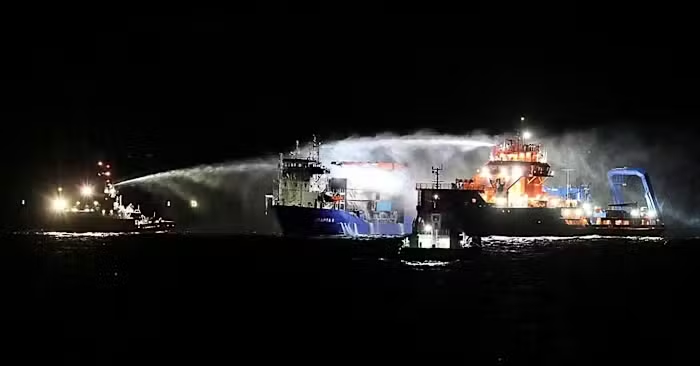
Finland confirms Ukrainian drone strike on Russian cargo ship Sparta II
Sanctioned Russian vessel ablaze in Finnish waters after drone attack
ft.com· 29m
Russian cargo ship still on fire off Finland after drone attack
aljazeera.com· 2h
Russian cargo ship still on fire off Finland after attack
reuters.com· 4h
En direct : la Finlande dénonce une attaque de drone ukrainien contre un cargo russe en mer Baltique
france24.com· 6h
EN DIRECT, guerre en Ukraine : un cargo russe attaqué en mer Baltique ; des drones ukrainiens produits au Royaume-Uni… Les dernières informations
lemonde.fr· 7h
Russian cargo ship burns in Baltic Sea after drone strike
abc.net.au· 15h
Finland warns Ukraine war ‘spilling over’ after Baltic Sea drone strike on Russian cargo ship | CNN
cnn.com· 15h
Crimea Descends Into Chaos As Ukraine Expand War To The Baltic
youtube.com· 15h
Russisches Frachtschiff nach Drohnenangriff vor Finnland in Brand
spiegel.de· 17h
Russian cargo ship hit by drones in Baltic, Finland tightens security
cnbc.com· 17h
EN DIRECT, guerre en Ukraine : le point sur l’attaque par drone d’un cargo russe en mer Baltique, la Finlande soupçonne un hélicoptère russe d’avoir violé son espace aérien
Russia-bound ship attacked in Gulf of Finland
bbc.com· 18h
Russian military-linked cargo ship catches fire after reported drone strike in Gulf of Finland
kyivindependent.com· 19h
Russian cargo ship struck by drone in Baltic: Finnish authorities
Cargo ship bound for Russia hit by drones, Finland tightens security
usatoday.com· 21h
Palavan venäläisaluksen miehistö on evakuoitu
yle.fi· 22h
EN DIRECT, guerre en Ukraine : la Finlande soupçonne un hélicoptère russe d’être entré dans son espace aérien, quelques heures après une attaque de drone sur un cargo russe en mer Baltique
Une "attaque de drone" contre un cargo russe détectée dans le golfe de Finlande
Rescue efforts under way as drones hit Russian ship off Finland coast
Russian cargo ship ablaze in Baltic Sea after drone strike, crew evacuates
Russian cargo ship catches fire in Gulf of Finland, Moscow claims drone hit
err.ee· 26h
A fire broke out aboard the Russian cargo ship Sparta II in the Gulf of Finland on the morning of 21 November 2026, with preliminary reports of onboard explosions reported around 9:35 a.m. The 121-metre Russian-flagged vessel, which had left St. Petersburg the day before bound for Kaliningrad, was in an international shipping lane 11 nautical miles north of Estonia's Vaindloo Island when the fire began, and it later drifted into Finnish waters about twenty kilometres off the coastal town of Loviisa, where it anchored.
Russian officials said the ship was struck by two drones, an account Finland's Defence Forces corroborated, saying it was damaged in international waters west of Russia's Gogland island. The ship is owned by Oboronlogistika, a US-sanctioned shipping company that provides logistics for the Russian Defence Ministry, and appears on American and Ukrainian sanctions lists for carrying military freight. Unverified Russian agency reporting said it was carrying paints and coatings, and Helsinki said it could not assess the risk of explosion because precise information on the cargo was lacking.
The 16-member crew was evacuated onto lifeboats and then onto the sanctioned Russian ship Kapitain Zakharov, with no injuries counted. Finland led the rescue operation, dispatching Border Guard units and raising rescue departments' readiness for a possible oil spill, while Estonia sent a navy vessel and Swedish combat aircraft under Finnish command helped safeguard Finnish and NATO territory. Finland also introduced temporary aviation and maritime restrictions in the eastern Gulf of Finland, informed its NATO allies of the attack, and suspected a Russian helicopter of penetrating 4.1 kilometres into Finnish airspace during the rescue. Ukraine did not claim responsibility.
On 22 November 2026, a Finnish Border Guard officer, Petteri Blomvall, confirmed the strike was a Ukrainian drone attack, adding that the ship remained at anchor and firefighting operations were continuing.
A fire broke out aboard the Russian cargo ship Sparta II in the Gulf of Finland on the morning of 21 November 2026, with Estonia's rescue center receiving word of the fire and preliminary reports of onboard explosions at 9:35 a.m.
The ship, which had left St. Petersburg bound for Kaliningrad, was in an international shipping lane 11 nautical miles north of Estonia's Vaindloo Island when the fire began, and it drifted out of Estonia's exclusive economic zone at around 10 a.m.
Russian officials said the Sparta II was struck by two drones.
No marine pollution had been reported following the fire.
Leningrad Oblast Governor Alexander Drozdenko wrote on Telegram that a cargo ship en route to Kaliningrad was attacked by two unmanned aerial vehicles in neutral waters three nautical miles from the Russian border, saying the crew was being evacuated and the consequences were being clarified.
Estonian border guard duty officer Andres Tiik said Estonian authorities were monitoring the situation in cooperation with Finnish counterparts and would respond if Russia requested international assistance.
Finland's Defence Forces said the Sparta II was damaged in international waters west of Russia's Gogland island, corroborating the Russian account, and the burning vessel later drifted into Finnish waters.
The ship's 16-member crew evacuated onto lifeboats and then onto a nearby Russian ship and was on its way back to Russia.
The 121-metre Russian-flagged Sparta II is owned by Oboronlogistika, a shipping company listed by the US Treasury as sanctioned and providing logistics services for the Russian Defence Ministry, and it left St. Petersburg on 20 November 2026.
The blaze was still burning late on 21 November while Finland led the rescue operation with the ship at anchor in Finnish waters, and Finnish authorities said Russian vessels may eventually tow the wreckage home.
Finland introduced temporary aviation and maritime restrictions in the eastern Gulf of Finland to protect civilians and allow authorities to intercept drones if needed.
Finland suspected a Russian helicopter of briefly violating Finnish airspace during the rescue operation.
Estonia sent a navy vessel to assist with firefighting and pollution response, and Swedish Defence Minister Pal Jonson said Swedish combat aircraft operating under Finnish command took part in safeguarding Finland's and NATO's territorial integrity.
Finnish armed forces spokesperson Aki-Mauri Huhtinen said at a press conference that it is likely Ukraine is behind the attack, though it is not clear why the vessel was targeted.
Finnish Prime Minister Petteri Orpo wrote on X that Finnish authorities are handling the situation in the Gulf of Finland, where a drone strike has hit a Russian merchant vessel, that the war is spilling over into neighboring areas, and that Ukraine has the right to fight against the aggressor.
Estonian Prime Minister Kristen Michal wrote that the consequences of fighting Russia's aggression have reached the Baltic Sea, calling it another signal for the aggressor to stop, and said nothing will stop Estonia from supporting Ukraine.
Finnish Border Guard Commander Ilja Iljin said there is no confirmed information about the cargo on board but it cannot be ruled out that there is military materiel on board.
Kaliningrad Governor Alexei Besprozvannykh said the incident posed no threat to supplies to the Kaliningrad region.
Finland's Ministry of Defence said its forces detected the drone attack on the Russian vessel in international waters and dispatched Border Guard units to the scene.
A Finnish Border Guard patrol plane photographed flames and thick smoke coming from the rear of the Sparta II off Finland's southern coast.
Finland's Border Guard said the crew had not been forced to abandon ship and no environmental damage had been detected, with the vessel in the open sea off the coastal town of Loviisa.
Finnish authorities said the Border Guard was preparing to evacuate people from the Sparta II and assist in firefighting operations.
Finland's Defence Ministry said Finland immediately informed its NATO allies of the drone attack.
Finland's border guards said the situation posed no danger to other maritime traffic in the Gulf of Finland.
No Finnish authority provided any information establishing where the drone that struck the ship came from.
Finland's defence ministry said a Russian helicopter was suspected of penetrating 4.1 kilometres into Finnish territory off the coast of Loviisa a few hours after the drone attack.
Finnish Defence Minister Antti Häkkänen said the suspected airspace violation could be linked to rescue or surveillance operations carried out following the damage to the cargo ship in the Gulf of Finland.
The burning Sparta II anchored inside Finland's territorial waters about twenty kilometres off the coast of Loviisa, and firefighting got underway.
Gulf of Finland maritime district commander Mikko Simola said the ship's command bridge at the bow and the area between the bridge and the containers had suffered damage.
Finland's rescue authority ordered the Helsinki rescue department to lead a raising of rescue departments' operational readiness for a possible oil spill response, with patrol boats from Kotka and Porvoo, a surveillance aircraft, a helicopter, the guard ship Uisko and two tugs deployed.
Two Russian rescue ships were arriving at the site during the evening, and the crew was to be evacuated onto the Russian ship Kapitain Zakharov, which is also under sanctions.
Finnish Border Guard commander Ilja Iljin said the crew had been evacuated onto a nearby Russian cargo ship heading to Russia, that firefighting was underway off Loviisa, and that rescue services were preparing for the cargo possibly being dangerous, explosive, or giving off harmful gases.
Iljin also said the Sparta II was to be towed to Russia with a rescue ship's assistance.
Finnish Defence Forces communications chief Aki-Mauri Huhtinen said it is likely Ukraine is behind the strike, that Ukraine seeks out Russia's economic and military targets, and that there can be no exact information on why the Sparta II in particular was struck.
Mikko Simola said the Helsinki and St. Petersburg maritime rescue centres were in constant contact and that most of the discussion with Russia concerned what equipment Russia could send to the site.
Helsinki rescue department fire chief Juha Murtonen said the rescue operation had raised its readiness for anticipatory oil spill response together with the rescue departments of the Gulf of Finland area.
Swedish Prime Minister Ulf Kristersson said on X that Sweden was monitoring the situation and had offered help to Finland, without giving details.
Finnish coast guard officer Ilja Iljin said the Sparta II's crew had not abandoned the vessel and was carrying out its standard firefighting procedures, with a first Finnish patrol vessel at the site ready to evacuate if needed, though it was unknown whether there were any casualties.
Leningrad region Governor Aleksandr Drozdenko wrote on the Russian messaging platform Max that according to the crew no evacuation was necessary, the situation was under control, and the crew intended to resume their course.
Finnish Prime Minister Petteri Orpo suggested the drone strike had to do with the war Russia started with its 2022 invasion of Ukraine.
Ukraine did not claim responsibility for the strike on the Sparta II.
Ukrainian President Volodymyr Zelensky's sanctions policy adviser Vladyslav Vlasiuk wrote on X, "Yes, quite a coincidence, isn't it? It seems that vessels sanctioned by Ukraine for systematically supporting Russia's military-industrial complex have a rather unfortunate tendency to catch fire."
Finnish Defence Minister Antti Häkkänen said the Finnish Border Guard was responsible for the investigation into the attack on the Sparta II and was cooperating with other relevant authorities.
Kaliningrad Governor Alexei Besprozvannykh wrote on Telegram that a Russian rescue vessel had approached the Sparta II, that the crew said they did not need to be evacuated, that two drones were used in the attack according to preliminary information, and that there was no threat to Kaliningrad's supplies, adding the crew was carrying out the necessary work and planned to continue on its way.
Finnish border guards said no injuries were counted among the Sparta II's sixteen crew members, while several Finnish media reported in the afternoon that the crew was evacuated by ferries and lifeboats as the fire had not been brought under control.
A security perimeter was established around the burning ship, and Helsinki said it could not assess the risk of explosion because precise information on the cargo was lacking.
The Sparta II appears on the American and Ukrainian sanctions lists for having carried military freight and for its links with Oboronlogistika LLC, the sole official carrier of the Russian defence ministry, and unverified Russian agency reporting said it was carrying paints and coatings.
Finnish Border Guard commander Ilja Iljin told the Finnish public broadcaster that the Sparta II, attacked in international waters of the Gulf of Finland, was hit by Ukrainian drones, an information Ukraine did not confirm.
Leningrad Oblast Governor Alexander Drozdenko said the situation on board was under control and announced the ship would resume its route toward Kaliningrad.
Estonia's Police and Border Guard Administration said the Sparta II, which was in a channel open to international navigation, remained in the area of responsibility of the maritime rescue center of Saint Petersburg.
Commentator Jay in Kyiv said the strike on the ship reported to be the Sparta 2 appeared to be the first time a Russian merchant vessel was struck in the Gulf of Finland, that the burning ship looked like a total loss, and that it was likely carrying weapons on its way to Kaliningrad.
Jay in Kyiv also claimed that two sanctioned Russian cargo vessels were traveling together, one burning in the middle of the Gulf of Finland and the other fleeing into Finland's NATO waters, and that Finnish authorities were likely already boarding the vessel that entered their waters.
A Finnish Border Guard officer, Petteri Blomvall, confirmed that the strike on the Sparta II was a Ukrainian drone attack, adding that the crew was evacuated, the ship was at anchor, and firefighting operations were continuing.

