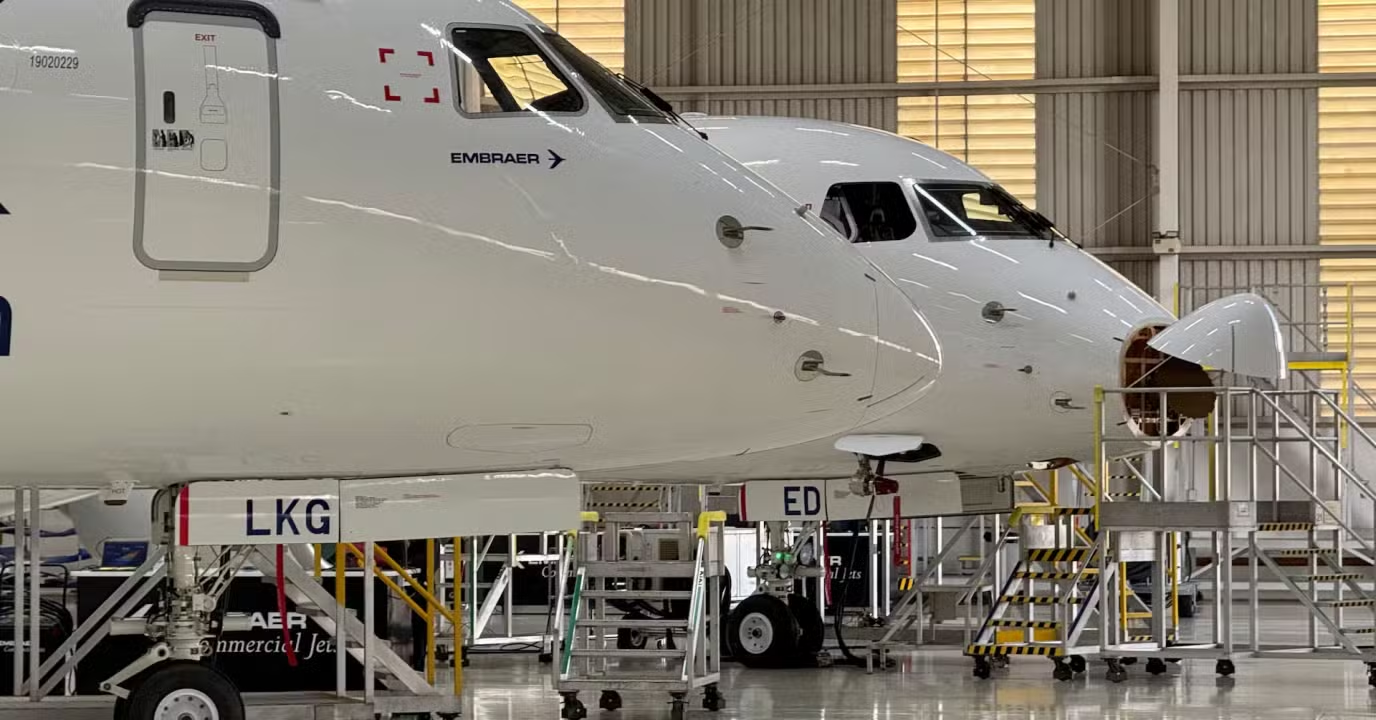
Brazil and Embraer seek to reverse proposed 10% US tariff on Brazilian aircraft
Brazil's Embraer criticizes new US tariffs, warns of air travel inflation
reuters.com· 20h
Brazil blasts ‘unacceptable’ new US tariff proposals
aljazeera.com· 29h
Trump tariff threat ‘unacceptable’, says Brazil, as China denounces levies as baseless
theguardian.com· 30h
Brazil Lashes Out at New US Tariffs, Saying It Will ‘Not Yield’
bloomberg.com· 33h
US airlines face higher costs from proposed Embraer duty
Embraer Shares Sink as US Threatens Brazil Aircraft Tariff
US proposes surprise new tariffs on Brazil imports, including 10% duty on aircraft
The United States has proposed a 10% tariff on finished Brazilian aircraft, ending an exemption and revising tariffs first imposed in July, alongside a new rate on out-of-quota Brazilian sugar. Embraer shares dropped about 5% on the news.
The plane maker has much at stake: its backlog held roughly 160 E175 jets for American Airlines, SkyWest and Republic Airways at the end of the third quarter, and it says it holds $3.5 billion in assets and employs more than 2,500 people in the United States. Its exact exposure is unclear, since the tariff codes listed do not distinguish completed from green aircraft, and questions remain over the Praetor business jet, which is shipped to Florida at an advanced stage and completed there. Embraer says it still lacks clarity on what the duty would cover.
The proposal covers 14 major trading partners, but Brazil was singled out after trade talks with Washington stalled. The duties rest on a law letting the president target unreasonable or discriminatory trade practices, and the administration says they fit deals reached in 2025. The US Trade Representative will hold a hearing on January 14, with reports differing on whether final duties start as early as January 2027 or not before February or March.
Embraer shares fell as much as 9.6% on 25 November and were up 1.3% on 26 November, when CEO Francisco Gomes Neto met Vice President Geraldo Alckmin, who leads Brazil's trade negotiations with Washington.
The United States proposed new tariffs on Brazilian goods on 25 November 2026, including a 10% duty on finished aircraft that were previously exempt, revising tariffs imposed in July.
Washington also proposed a new tariff rate on out-of-quota raw and refined Brazilian sugar entering the United States.
Embraer shares dropped about 5% after the proposal.
The US Trade Representative will hold a hearing on the duties on January 14 before they can take effect.
US Trade Representative Jamieson Greer said Brazil had made 'no meaningful progress' toward addressing practices Washington sees as harmful, and that the proposed changes would provide 'greater leverage to obtain the elimination of Brazil's unreasonable acts, policies, and practices'.
Greer said the additional sugar tariff and the 10% aircraft tariff were intended to help bring Brazil to the table, and that Washington remains open to negotiations.
Brazil's Foreign Ministry said the government would assess the impacts and repercussions of the proposed tariffs.
Embraer's firm order backlog included about 160 E175 jets combined for American Airlines, SkyWest Airlines and Republic Airways at the end of the third quarter.
Embraer says it holds $3.5 billion in assets and employs more than 2,500 people across the United States.
The USTR press release referred to 'finished aircraft', but the listed tariff codes do not distinguish completed from green aircraft.
Analysts and executives forecast the 10% duty would raise costs for US airlines, which have no US-made alternatives to Embraer jets, and said the tariffs could take effect as early as January.
Richard Aboulafia said 'There is no US competitor to Embraer jetliners' and forecast the threats would not be carried out, saying 'This is every bit as big a threat to Embraer jets as tariff threats were to Bombardier jets. In other words, it will not happen.'
Airlines for America called for maintaining zero tariffs on aircraft and parts, saying 'now is not the time to increase costs on aircraft', and noted aviation exports provide a $93 billion US trade surplus.
Embraer said it strongly defends the zero-tariff regime for global aerospace.
JPMorgan said it did not expect the tariffs to affect Embraer's Praetor executive jet and described the 5% drop in Embraer shares as 'overdone'.
UBS analysts said they expected the tariffs to apply to the Praetor.
Brazil's government vowed it would 'not yield to this kind of threat'.
The proposed tariffs cover 14 major trading partners: Bangladesh, Cambodia, China, the European Union, India, Indonesia, Japan, Malaysia, Singapore, South Korea, Switzerland, Taiwan, Thailand, and Vietnam.
Brazil was singled out in the announcement after trade talks with Washington stalled.
The tariffs are imposed under a law that allows the president to target countries found to engage in unreasonable or discriminatory trade practices, and the administration says they are consistent with trade deals the US reached in 2025.
The administration will seek feedback from affected industries and hold a hearing reported for either 14 or 25 January.
The final duties would not take effect until February or March, and Trump could veto any legislation seeking to overturn them.
Brazil's government said the unilateral decision 'constitutes an unacceptable action within the framework of the ongoing bilateral negotiating process' and that it will keep negotiating 'without ruling out the possibility of adopting retaliatory measures in response to the illegal and unjust imposition of tariffs on Brazilian products'.
A spokesperson for China's embassy in Washington said 'the so-called issue of industrial overcapacity does not really exist and should not be used as a pretext for political manipulation' and urged the two sides to deliver on agreements secured between Donald Trump and Xi Jinping.
China's foreign ministry spokesperson Guo Jiakun said 'a tariff war or a trade war serves no party's interests' and called for the US to resolve the issue through dialogue.
Japan's top government spokesman Minoru Kihara said it was 'regrettable that a proposed measure targeting Japan has been announced'.
Taiwan's government said it is confident it will keep its existing 15% tariff rate.
India's government denied it had any structural excess capacity and said it remains committed to an early conclusion of a trade deal with the United States.
Vietnam's trade ministry said it is 'preparing and submitting rebuttal comments on the preliminary findings' and working with the US to complete its trade deal as soon as possible.
US Senator Ron Wyden said 'this is another blatant attempt by Donald Trump to reconstruct his illegal global tariffs' and that he will 'use every tool at my disposal to end Trump's tariffs chaos'.
American Enterprise Institute senior fellow Derek Scissors said the proposal 'barely raises existing tariffs on China and will make no difference to the country's trade behaviour'.
Some US analysts criticised the duties as too weak to change China's trade practices.
Reports differ on when the duties would begin, with the tariffs described as possibly effective as early as January 2027 and as not taking effect before February or March.
Brazilian President Luiz Inacio Lula da Silva voiced outrage over the proposed tariffs on Brazilian aircraft and sugar.
Lula's office said Brazil has been negotiating 'in good faith' with Washington for more than a year and will continue seeking 'a negotiated solution' without ruling out 'reciprocal measures'.
The Office of the US Trade Representative said the new sugar rate would ensure Brazilian sugar could not be shipped through third countries into the United States.
Embraer's Sao Paulo-traded shares fell as much as 9.6% on 25 November 2026 and were up 1.3% on 26 November.
Embraer CEO Francisco Gomes Neto met Vice President Geraldo Alckmin, who leads Brazil's trade negotiations with Washington, on 26 November 2026.
Questions remain over whether the duty covers the Praetor business jet, which is shipped to the United States at an advanced stage of production and completed at Embraer's Florida facilities, and Embraer says it still lacks clarity on exactly what the tariff would cover.
Embraer CEO Francisco Gomes Neto said the company was caught off guard by the proposal, and that a tariff on the E175 would penalize airlines, be reflected in ticket prices and could even contribute to inflation.
Gomes Neto said Embraer will seek support from US industry contacts and policymakers while relying on the Brazilian government to defend its case, and that the tariffs would have no impact on 2026 delivery plans.
Geraldo Alckmin called the proposed tariff 'completely unreasonable', said it is tradition not to have tariffs in a sector as strategic as aerospace, and said Brazil will work to reverse it.
Citi analysts forecast any tariff on the E175 would probably be passed on to customers such as American Airlines and SkyWest rather than absorbed by Embraer, and that the larger E2 family would be the most exposed.

