Signal blocks screenshots on Android and iOS to keep AI agents from reading messages
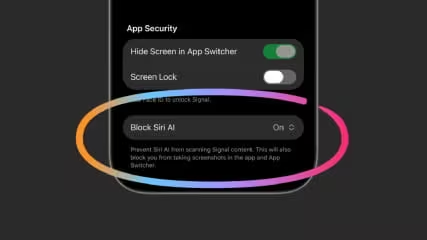
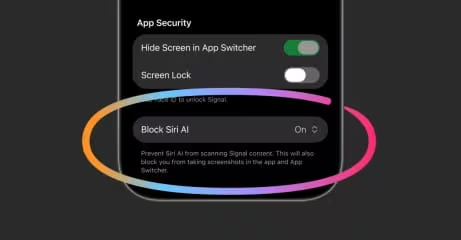
Signal is restricting screenshots in its Android and iOS apps to prevent AI agents from reading users' messages and other data. The block applies on iOS 27 and on Android, and is meant to stop Siri, Gemini, and other Android AI assistants from reading on-screen content. On iPhone a new Block Siri AI setting is on by default, while on Android the protection runs through the app's existing Screen security option.
Users who want the old behavior back can restore screenshot capability in Signal's settings. On both platforms the app also shows a prompt offering to turn the protection off when it detects a screenshot on iOS or an AI assistant reading the screen on Android.
Signal itself says the remedy is incomplete. It does not stop third-party agents from reading notifications or digging through files, and it does not address other routes such as retrieving data via the device filesystem. Blocking screenshots on one's own device also will not help if the other person in a chat has switched the protections off on theirs. Mac users are left with no protections against AI agents at all.
Signal says it is struggling to build a better solution because little is known about how AI agents actually access application data, and it argues more tools are needed to stop agents like Meta's Muse from using deep accessibility settings as a skeleton key. As of the latest word, the mobile restrictions extend a screenshot block Signal already applies by default on its Windows app, and Signal is calling for a standard, system-level way to block AI agents from reading apps' content.
Signal is restricting the ability to take screenshots in its Android and iOS apps to prevent AI agents from reading users' messages and other data.
The block applies on iOS 27 and on Android and is intended to stop Siri, Gemini, and other Android AI assistants from reading on-screen content.
Users can restore screenshot capability in Signal's app settings.
Signal says the remedy is incomplete because it does not address other ways AI agents can access app data, such as retrieving it via the device filesystem.
Signal says it is struggling to develop a better solution because little is known about how AI agents actually access application data.
Signal says more tools are needed to prevent third-party agents like Meta's Muse from using deep accessibility settings as a skeleton key to reach application data.
Signal President Meredith Whittaker said AI agents are hostile to privacy and that their integration into operating systems without remedies is an existential threat to privacy at the application layer.
Whittaker said in a blog post that Google, Apple, Microsoft, and others do not provide ways for developers to restrict AI data access without making drastic compromises to the core user experience.
Whittaker said the lack of such tools is why Signal is unable to implement these protections on macOS.
Whittaker warned that restoring screenshot capabilities will potentially expose users' and their contacts' Signal content to AI agents and break Signal's privacy guarantees.
Whittaker urged operating system providers to make it easier for app developers to control what data AI agents can access.
Signal called on Apple, Google, and Microsoft to provide simple technical tools and accurate documentation to app developers.
Whittaker said Signal is the canary in the coal mine but the problem affects the entire ecosystem and should galvanize anyone who cares about these fundamental rights.
On iPhone, Signal's new Block Siri AI setting is on by default, and on Android the protection runs through the app's existing Screen security option.
On both iOS and Android, Signal shows a prompt offering to turn the protection off when it detects a screenshot on iOS or an AI assistant reading the screen on Android.
Blocking screenshots on one's own device will not stop an AI assistant from reading messages on the other person's device if that person has switched the protections off.
The protection does not prevent third-party agents from reading notifications or digging through files.
Signal is left without any user protections against AI agents on Mac.
Signal says it wants a standard, system-level way to block AI agents from reading apps' content.
Signal said it is talking with Apple and Google and is cautiously optimistic about where those talks are headed.
Signal already blocks screenshots of its Windows app by default, and the new Android and iOS restrictions extend that block to mobile.
In a written statement, Meredith Whittaker said that in service of AI agentic capabilities users' sensitive data is being captured, stored, and made accessible to whatever local database or remote server an OS-level AI agent is using, all outside Signal's control once captured.

