Trump says renewed strikes on Iran would hit Pickaxe Mountain
Trump downplays Russia, China support for Iran during talks with US troops
aljazeera.com· 17h
How Trump's Iran war was betrayed by AI
newsweek.com· 35h
Iran War Updates: Tehran denounces U.S. for using AI in strikes it claims violate international law
cbsnews.com· 2d
Iran says it is prepared to withstand US blockade, seeks to curb price rises
reuters.com· 2d
U.S. Says Military Disabled Another Ship In Hormuz As Trump Continues To Weigh Options On Iran
huffpost.com· 4d
Iran War Updates: Gulf states and tankers under fire as U.S. and Iran ramp back up tit-for-tat strikes
JD Vance Abruptly Changes Tune on Iran War Despite Election Losses
newrepublic.com· 10d
Trump Says He’s Inclined To Resume Strikes On Iran In 2027 If There's No Deal: Fox News
What's Trump's strategy now with Iran? To keep things as they are
npr.org· 14d
Live Updates: Bahrain says it intercepted Iranian attacks after Tehran claims it targeted U.S. assets
Trump says he held off on more Iran strikes at Gulf allies’ request
Trump says "we don't need a deal with Iran," as Tehran sticks to its demands
Trump says escalation ‘unlikely’, Iran demands ‘surrender’
Nine months into the war on Iran, which President Donald Trump declared militarily over, negotiations with Tehran remain frozen and he now says any renewed American strikes would definitely hit Pickaxe Mountain.
On 9 November Trump said three US aircraft carriers were in or heading to the Middle East, locked and loaded to go back into Iran if needed. He said the United States did not need a peace deal, and his administration dismissed Iran's seven conditions for talks, which include an end to hostilities, sanctions relief and lifting the naval blockade. On 13 November he said Saudi Arabia, Qatar and other Gulf countries had asked him to hold off further large-scale attacks, while acknowledging that rising petrol prices from the war contributed to the Republicans' midterm defeat. That day Iran's Revolutionary Guard said six of its drones hit a US air defense radar in Bahrain, which US Central Command denied, saying both drones were shot down.
Trump then said he was inclined to resume strikes in 2027 if there was no deal. On 17 November the US military struck an Islamic Revolutionary Guard Corps missile site on Iran's Qeshm Island, while Iran targeted the Bahrain radar for the third time in a week and air defense systems at Kuwait's Ali Al-Salem Air Base. An ADNOC ship was struck in the Strait of Hormuz, leaving one crew member missing and eleven injured. On 23 November US forces disabled the merchant ship M/V Pacific Archer for running the blockade of Iranian ports, which the United States reimposed in July 2026.
At the UN Security Council, Iran's ambassador Gholamhossein Darzi said US forces used artificial intelligence, including Palantir's Maven and Anthropic's Claude, to deploy more than 2,000 munitions against 2,000 targets within 96 hours. The opening US-Israeli assault of 28 February 2026 struck more than 1,000 targets in 24 hours, including the Shajareh Tayyebeh Elementary School in Minab, where 156 civilians, 120 of them children, were killed, and the Pentagon has yet to release its probe's findings. Admiral Brad Cooper reportedly told the Pentagon and the White House in July that the list of designated targets was mostly exhausted.
On 27 November, after Thanksgiving calls to US service members in the UAE and Saudi Arabia, Trump warned Iran possesses missiles capable of reaching Europe and said the United States is still giving Iran every chance to make a deal. Iran was reported to have stepped up attacks on US targets across the region, including a drone strike in Kuwait that killed two Italian workers, which Iran denies.
Donald Trump said the war on Iran is militarily effectively over and that the United States is keeping the status quo at the behest of Iran's neighbours.
Trump said a third US aircraft carrier is sailing to the Middle East, bringing the number there to three, and that US forces are locked and loaded and ready to go back into Iran if needed.
Trump forecast at a White House news conference that the conflict with Iran has momentum toward its end and will end fairly soon.
Trump promised that Iran will never have a nuclear weapon, calling it a non-negotiable point.
Trump told reporters he believes taking military action against Iran doesn't seem to be a very necessary thing.
Iranian Parliament Speaker Mohammad Bagher Ghalibaf said Israel is 'working overtime to drag the US into an endless war with Iran'.
Qatari Prime Minister Mohammed bin Abdulrahman Al Thani described his discussions with Trump and JD Vance as 'positive'.
Trump said in a Truth Social post that the United States does not need a peace deal with Iran, claiming it holds Tehran's frozen money and control of the Strait of Hormuz.
Iran refuses to enter negotiations unless the United States meets seven conditions, which the Trump administration dismissed as unacceptable.
Iran's conditions, laid out by lawmaker Vahid Ahmadi in late September, cover ending hostilities, sanctions relief, lifting the naval blockade, Hormuz control with Oman, war compensation, released assets and an end to threats.
Hossein Taeb, head of Iran's Basij paramilitary force, said Iran would decide the manner and agenda of any negotiations only after its conditions are fulfilled.
Iran offered to shorten the proposed ceasefire implementation period from seven days to two, calling it a sign of goodwill.
Secretary of State Marco Rubio called Iran's demands unacceptable and said there was little expectation of a near-term diplomatic breakthrough.
Vahid Ahmadi said Iran's conditions only make sense together and some could be met during an initial ceasefire rather than as a prerequisite for one.
Hossein Taeb said it makes no difference to Iran how long the process of ending the war takes.
Trump said Saudi Arabia, Qatar and other Gulf countries asked him to hold off on further large-scale attacks against Iran, and that he would have launched further strikes without those requests.
Trump claimed he could destroy Iran's energy infrastructure, bridges and manufacturing capability within three days.
Trump acknowledged that rising petrol prices caused by the war contributed to the Republicans' midterm defeat, and said he would not hesitate to launch new strikes on Iran.
Iran's Revolutionary Guard said six of its drones targeted the US air defense radar at the Al-Riffa helicopter base in Bahrain on 13 November.
Bahrain's military said it intercepted Iranian airstrikes before they hit their targets.
US Central Command said two Iranian attack drones launched at Bahrain on 13 November were both shot down by US forces, denying Iran's claim of destroying the radar.
Bahrain's interior ministry urged residents to remain calm, proceed to the nearest safe location and follow official channels.
US Central Command said there were no injuries or damage caused by the interception of the Iranian drones over Bahrain.
Nine months into the war, US-Iran negotiations are stuck, with mediator Qatar working to bridge the divide and Trump hosting Qatar's prime minister at the White House.
Secretary of State Marco Rubio said there is no need for military action against Iran at this stage because sanctions are doing the job, saying 'The pain that they're feeling is, eventually you have to eat. Eventually you have to be able to pay your own fighters and your own security forces'.
Trump said he is inclined to resume strikes on Iran in 2027 if there is no deal, and told Reuters he would wait until the new year to discuss restarting strikes.
Trump called Iranian negotiators 'professional tapdancers' in an interview with Trey Yingst.
Vice President JD Vance said there is 'no daylight' between himself and Trump on the Iran war and insisted he has no qualms about how Trump has handled it.
Vance said the United States destroyed Iran's nuclear program and Iran's conventional military in the war.
Vance attributed the war's political cost in higher gas and energy prices to prior administrations that did not invest in American infrastructure, noting no refinery has been built since the 1970s.
Vance predicted Trump will not let the Iran conflict become a forever war, while forecasting that some will demand the war go on indefinitely.
Laura Ingraham recalled that Trump could have ended the Iran war in June, when a joint memorandum with Iran was on the table.
The US military launched precision strikes on an Islamic Revolutionary Guard Corps missile site on Iran's Qeshm Island in the Strait of Hormuz on 17 November, calling the strike self-defense.
Iran said it targeted a US radar installation in Bahrain for the third time in less than a week, hours before the Qeshm strike, and US authorities said all launches were intercepted.
Iran's army said its drones targeted Patriot air defense systems and drone and missile launch platforms at Ali Al-Salem Air Base in Kuwait, and Kuwait's military said its air defenses were responding to hostile drone threats.
ADNOC said a crew member was missing and eleven people injured after one of its ships was struck in the Strait of Hormuz, with search and rescue ongoing.
US Central Command said no American military personnel had been injured in any of the strikes launched that week.
Kuwait's foreign ministry said the continuation of the attacks constitutes a dangerous escalation that threatens the region's security and undermines diplomatic efforts at de-escalation.
The US Embassy in Bahrain issued a security alert warning Americans to exercise heightened vigilance due to the increased threat of attacks by Iranian-supported Houthis and Iranian efforts to target US officials and facilities.
Hormozgan deputy provincial governor Ahmad Nafisi said the US attack on Qeshm Island caused no damage to residential, commercial or infrastructural areas.
US Central Command said a military aircraft fired precision munitions that disabled the Palau-flagged merchant ship M/V Pacific Archer in the Gulf of Oman as it tried to run the US blockade of Iranian ports, leaving the civilian crew unharmed.
The United States reimposed its naval blockade on Iranian ports in July 2026, and earlier in November announced Task Force Iron Gate to restrict weapons and sanctioned materials across Iran's land borders and the Caspian Sea.
Iran's consumer prices in October 2026 were 88.7 percent higher than a year earlier, with food and beverages up 112.6 percent, and annual average inflation accelerated to 76.8 percent.
First Vice President Mohammad Reza Aref said the unloading and clearance of goods through Iran's non-southern borders has increased significantly and strategic goods reserves are strong.
Aref said the government seeks to prevent increases in basic goods prices for at least three months.
Mohammad Reza Aref said, 'The increase in the unloading and clearance of goods through non-southern borders sends the message that we are not concerned about the enemy's naval blockade.'
President Masoud Pezeshkian said the government is seeking to direct more budget resources and energy savings towards improving living standards in poorer communities.
At a UN Security Council meeting, Iranian Ambassador Gholamhossein Darzi said US forces used artificial intelligence to deploy more than 2,000 munitions against 2,000 distinct targets within 96 hours in the war.
Darzi said Palantir's Maven and Anthropic's Claude system were used to analyze intelligence, identify and prioritize targets and provide strike coordinates.
US Central Command chief Admiral Brad Cooper confirmed in March 2026 that American forces used a variety of advanced AI tools to make decisions faster than the enemy could react.
Gholamhossein Darzi said, 'Neither advanced technology nor the involvement of private companies can shield the United States or the Israeli regime from accountability for flagrant violations of their obligations under international law.'
Gholamhossein Darzi said, 'Those responsible for the commission of atrocious crimes against Iranian people, including deliberate attacks against civilians and civilian objects, must face individual criminal accountability.'
Retired Admiral Mark Montgomery said the US military is processing roughly a thousand potential targets a day and striking the majority, with a human still in the loop while AI does work that used to take days of analysis.
Trump gave the order to commence large-scale military operations against Iran in February 2026, and more than 1,000 targets were struck within 24 hours of the joint US-Israeli assault launched on 28 February 2026, including Ayatollah Ali Khamenei, with the help of the Maven Smart System.
The number of targets struck in the war reached 13,000 by the one-month mark.
The United States struck the all-girls Shajareh Tayyebeh Elementary School in Minab in the 28 February 2026 opening bombardment, killing 156 civilians including 120 children, which US officials attributed to outdated intelligence, ignored warnings and over-reliance on AI; the Pentagon has yet to release its internal probe's findings.
Sources cited by Axios reported Admiral Brad Cooper told the Pentagon, the Joint Chiefs of Staff and the White House in July 2026 that the list of designated targets in Iran had been mostly exhausted.
Iran, reportedly led by Ayatollah Ali Khamenei's son, continues to strike at the US military presence in the region and at oil tankers in the effectively blockaded Strait of Hormuz.
Domestic support for the war with Iran continues to plunge.
Steven Feldstein of the Carnegie Endowment said targeting systems are deployed primarily to maximize operational efficiency, that leaders have conflated speed and scale with military victory, and that this has compromised the ability to secure a meaningful victory.
Joseph Chapa of the University of Massachusetts Boston said reports surrounding the Minab school strike demonstrate how users' overreliance on AI-generated outputs can lead to catastrophic outcomes.
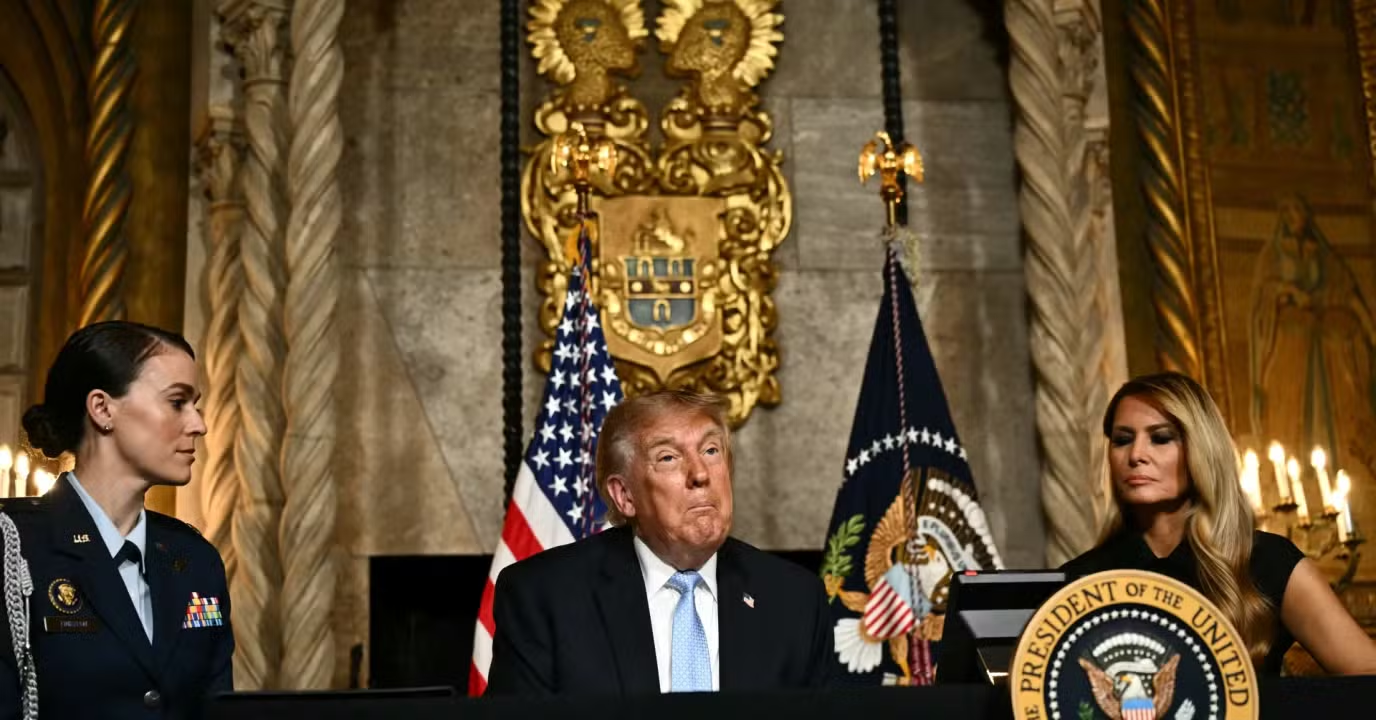
Trump and First Lady Melania Trump called US service members at the al-Dhafra airbase in the UAE and the Prince Sultan airbase in Saudi Arabia on Thanksgiving, 26 November, to praise their role in the war on Iran.
Trump said any renewed strikes on Iran would definitely hit Pickaxe Mountain.
Trump downplayed reports that Russia and China helped Iran target US bases, saying China is barely involved and that the United States also spies on China.
Trump warned that Iran possesses missiles capable of reaching Europe and that without peace in the Middle East it could launch nuclear attacks against Israel and other countries in the region.
Trump said the United States is still giving Iran every chance to make a deal, saying, 'We're trying to be nice. We're giving them every chance to make a deal and save a lot of lives, but I'm not sure if they are gonna take advantage of that.'
Iran was reported to have stepped up attacks on US targets across the region, including a drone strike in Kuwait that killed two Italian workers, which Iran denies.
Trump said he spoke with Israeli Prime Minister Benjamin Netanyahu in the days before the call.

