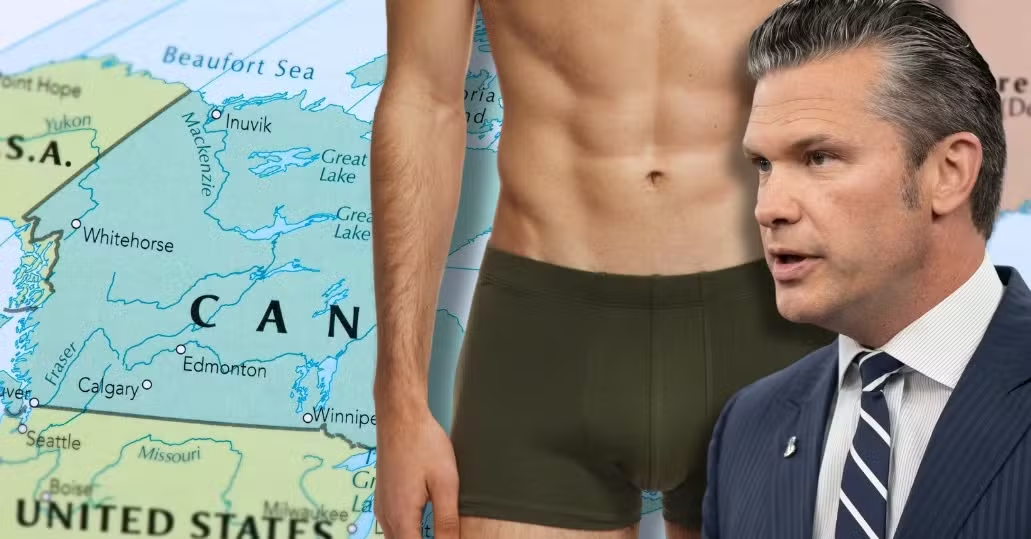
Pentagon memo restricts social contacts between US and Canadian military personnel
Pete Hegseth cancels sharing of top secret ballsack testosterone intel with Canada
thebeaverton.com· 6h
Pentagon Issued Memo Limiting ‘Social Activities’ With Canadian Military
nytimes.com· 9h
Hegseth reportedly moves to restrict defence ties with Canada, but Ottawa sees no change | CBC News
cbc.ca· 10h
Canada defense minister sees no shift in US military ties
reuters.com· 13h
Hegseth's new bout of 'strategic stupidity' spurs outrage: 'How does this make us safer?'
rawstory.com· 15h
'Slap in the face': Secret memo exposes Pete Hegseth turning on close ally
US Defense Secretary Hegseth restricts military ties with Canada, Washington Post reports
In secret memo, Hegseth restricts U.S.-Canada defense relationship
washingtonpost.com· 29h
Defense Secretary Pete Hegseth imposed new restrictions on the US-Canada defense relationship in a classified memo issued the week before November 20, 2026, according to officials familiar with the directive. The restrictions escalate a multifaceted clash between Washington and Ottawa.
Senator Mike Rounds confirmed the memo's existence: it limits general flag officer meetings to those that advance US Department of War objectives, and American defense officials, uniformed and civilian, must seek permission before attending social events or think-tank conferences with Canadian counterparts. It makes no changes to formal military activities but discourages informal and social contact, and there is a desire to secure agreements on military purchases or cooperation before social activities normalize. Rounds said the measures were drafted months earlier but signed only shortly before they were leaked.
Canada's government and military were unaware of any new restrictions, and three Canadian defense officials said they were seeking clarification because there had been no change at the military operational level. Canadian officials made no mention of the directive at the Halifax International Security Forum dinner on November 20. The Pentagon did not respond to a request for comment, the White House referred questions to the Pentagon, and the Canadian Embassy did not respond.
Officials from Five Eyes countries said American officials had shared less information with Canada over the past year on several platforms, though an official from a Five Eyes country said the United States had not formally signaled any change in information sharing. Senators used their briefing on the memo to reassure Canadian officials, who initially feared it might signal a broader retreat from bilateral military cooperation.
Defense Secretary Pete Hegseth imposed new restrictions on the US-Canada defense relationship in a secret memo, according to officials familiar with the directive.
The new restrictions escalate a multifaceted clash between Washington and Ottawa.
The memo imposing the restrictions on US-Canada defense ties was issued in the week before the November 20, 2026 report.
The White House referred questions about the classified memo to the Pentagon, and the Canadian Embassy did not respond.
An official from a Five Eyes country said the United States had not formally signaled any change in information sharing with Canada.
Officials from Five Eyes countries said American officials had shared less information with Canada over the past year on several platforms.
Pentagon spokesman Sean Parnell said the department was prioritizing cooperation that strengthens North American defense and helps Canada meet its NATO commitments.
Parnell said the memo would not change intelligence sharing or work through NATO and NORAD.
Canada's government and military were unaware of any new restrictions from the memo, which had not been seen and whose effect on programs, exercises, and exchanges remained unclear.
Amy McGrath, a retired Marine fighter pilot, asked how restricting military cooperation with Canada makes America safer, writing 'Make it make sense.'
Marc Polymeropoulos, a retired senior CIA operations officer, asked how restricting military cooperation with Canada makes the United States safer.
Brett Bruen, a former US diplomat, called the move 'a staggering degree of strategic stupidity.'
Former Representative Adam Kinzinger of Illinois summed up his reaction to the move as 'Wtaf.'
Artur Wilczynski, a former Canadian diplomat and intelligence official, wrote that the move was both disappointing and not surprising.
The Pentagon did not respond to a request for comment on the reported memo.
Canadian Defense Minister David McGuinty said he had not seen the reported memo and sees no daylight between what Canada and the United States are doing, military to military and otherwise.
McGuinty said the Canadian and American militaries continue to work 'hand in glove' on counter-drug operations in the Caribbean, integrated missile systems, and scrambling fighter jets across North America.
US Senator Mike Rounds, a South Dakota Republican, said defense officials briefed him on the memo and that it did not include any major new measures beyond what American military officials have done for years.
Senator Mike Rounds confirmed the memo's existence and said it limits general flag officer meetings to those that advance US Department of War objectives.
Rounds said US defense officials, both uniformed and civilian, must seek permission before attending social events or think-tank conferences with Canadian counterparts.
Rounds said the measures were drafted months earlier but signed only shortly before they were leaked, and were intended to pressure Canada into increasing its defense spending.
Three Canadian defense officials said they were seeking clarification about the reports because there had been no change at the military operational level.
Canadian officials made no mention of the directive at the Halifax International Security Forum dinner on November 20, according to Canadian sources.
Rounds said it was unfortunate the measures were leaked.
Senator Chris Coons, a Delaware Democrat, said he was irritated by Hegseth's directive and its impact on relations with Canada, and relieved it has no significant operational impact.
Pentagon chief spokesman Sean Parnell said in a statement that the department is taking steps to ensure its engagements with Canada advance tangible US defense objectives and ultimately support a reinvigorated defense relationship.
Rounds said the directive makes no changes to formal military activities but discourages informal and social contact between American and Canadian officers.
Rounds said there is a desire to secure agreements on military purchases or cooperation before moving forward with a normalization of social activities.
Senators used their briefing on the memo to reassure Canadian officials who initially feared the directive might signal a broader retreat from bilateral military cooperation.
Senator Tim Kaine, a Virginia Democrat, said of the memo, 'The tone is bad and it is unnecessary.'
Senator Chris Coons said of the memo, 'This is an own goal.'
The Beaverton, a Canadian satire site, joked that Hegseth had secretly cut military ties with Canada, starting with a fictional most-valuable secret about injecting testosterone into soldiers' testicles.
In the satire, Hegseth attributed the decision to what President Trump told him Putin had said in China, and a fictional Canadian defense chief was relieved she no longer had to pretend his intelligence was worth a damn.

