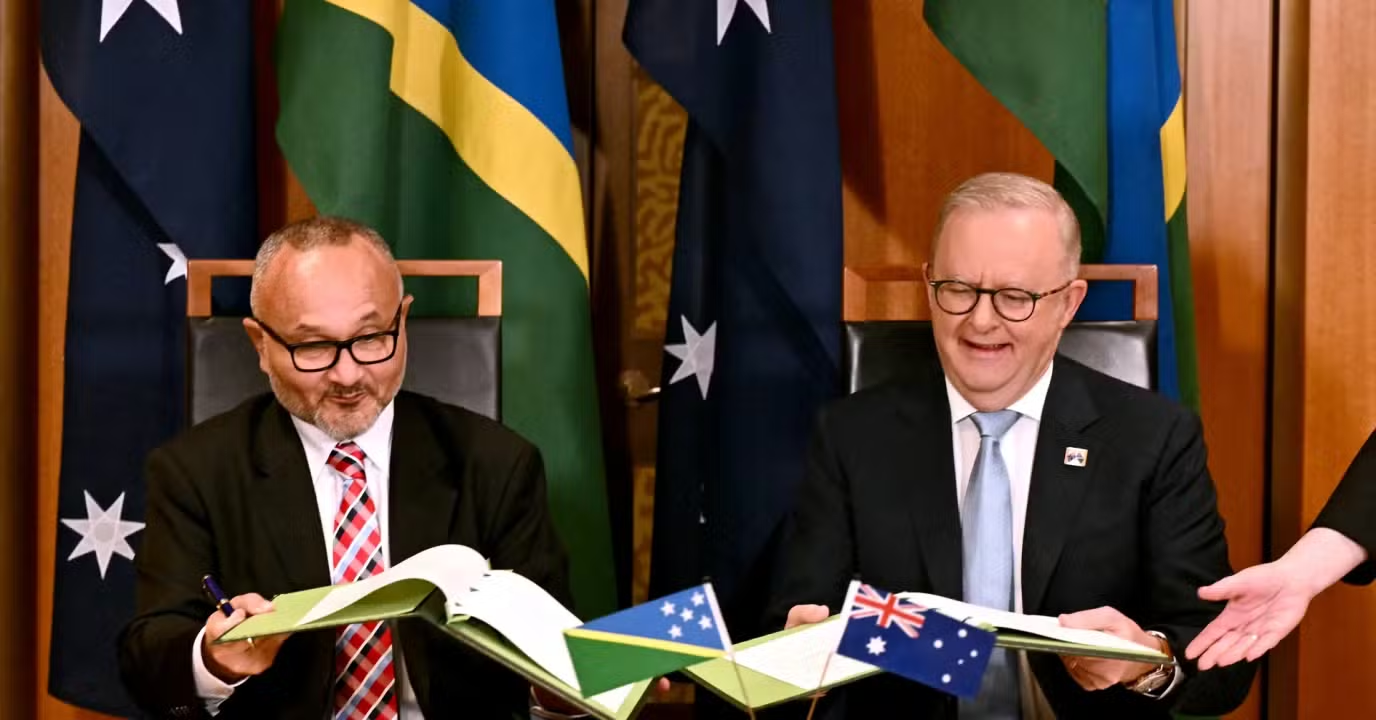
Australia signs security treaty with Solomon Islands barring foreign military bases
Solomon Islands signs security deal with Australia
aljazeera.com· 1h
L’Australie et les Iles Salomon signent un traité freinant les ambitions de la Chine dans le Pacifique
lemonde.fr· 7h
Australia, Solomon Islands sign sweeping pact stymieing China
channelnewsasia.com· 9h
Australia signs treaty with Solomon Islands, a blow for China’s ambitions in the Pacific
politico.com· 12h
Australia and Solomon Islands signed a sweeping security treaty in Canberra on 25 November 2026, announced by Prime Minister Anthony Albanese and his Solomon Islands counterpart Matthew Wale.
The treaty makes Australia Solomon Islands' primary security partner and requires Honiara to consult Australia before any security or critical infrastructure cooperation with countries outside the Pacific Islands Forum, including China. It affirms Solomon Islands' sovereign decision that no foreign military or security base will stand on its soil, and requires that sensitive infrastructure spanning airports, ports, energy and telecommunications stay free from militarisation and unauthorised access, though not retrospectively.
Canberra committed AU$740 million over a decade, AU$670 million in grants and AU$70 million in concessional loans, for education, health, policing, resources and climate resilience. Albanese said the deal also brings increased visa access and funding for schools and community projects.
Wale, in office since May 2026, pursued the treaty despite fierce backlash from pro-China elements in his parliament, including an aborted non-confidence motion in September. He met Albanese five times and said the decision to approve it was taken by his entire cabinet. He travelled to Canberra with 15 ministers and shook hands with Australian Defence Minister Richard Marles in Parliament House.
Wale would not confirm reports that he had told Beijing the 2022 security deal with China would not be renewed, citing a non-disclosure clause. The pact gives Albanese's government, in office since 2022, some form of security agreement with every country of Melanesia.
Australia signed a sweeping security treaty with Solomon Islands, announced by Prime Minister Anthony Albanese and Solomon Islands Prime Minister Matthew Wale in Canberra.
The treaty requires Solomon Islands to consult Australia on any security or critical infrastructure cooperation with countries outside the Pacific Islands Forum, including China.
Wale pursued the deal since taking office in 2026 despite fierce backlash from pro-China elements in his parliament, including an aborted non-confidence motion in September 2026.
Wale met Albanese five times since taking office in May 2026 as the two governments worked through the agreement.
Wale would not confirm reports he had informed Beijing that the 2022 security deal with China would not be renewed, citing a non-disclosure clause.
The agreement gives Albanese's government, in office since 2022, some form of security pact with every country of Melanesia.
Albanese said the agreement will also include increased visa access and Australian funding for education and community projects in Solomon Islands.
At a joint press conference in Canberra, Anthony Albanese thanked Matthew Wale and acknowledged the courage of his leadership.
Albanese said Wale's leadership has taken the relationship between the two nations to a next level, a level which has never been seen before.
Wale said the treaty cements his work to pull Solomon Islands closer to Australia.
Wale said Solomon Islands has been for a number of years a source of uncertainty and doubt in the region, and that those days are gone.
Wale said, "We don't want to be there again, and that comes by being trusted by our neighbors."
Wale declared after taking office in May 2026 that he would sign a treaty with Australia by the end of the year.
Albanese said the treaty will be published in full.
The treaty affirms the sovereign decision of Solomon Islands that there will be no foreign military or security base on its soil.
The treaty cements Australia as Solomon Islands' primary security partner and commits Canberra to AU$740 million over a decade to fund free education and other programmes.
The funding comprises AU$670 million in grants and AU$70 million in concessional loans for education, health, policing, resources and climate resilience.
The treaty requires that Solomon Islands' sensitive infrastructure, spanning airports, ports, energy and telecommunications, remain free from militarisation, foreign interference and unauthorised access, without applying retrospectively.
The treaty also covers road and bridge construction, areas China has dominated in Solomon Islands through its Belt and Road Initiative.
Wale travelled to Canberra with 15 ministers for talks on security, infrastructure, education and health, and shook hands with Australian Defence Minister Richard Marles in Parliament House on 25 November 2026.
Wale said the decision to approve the treaty was taken by his entire cabinet.
Wale told journalists that discussions with China are ongoing.
China's foreign ministry said on 24 November 2026 that its ties with Pacific nations are not matters of geopolitical contests.
Solomon Islands opposition leader Manasseh Sogavare criticized the fast-tracking of the treaty while the status of the China security arrangement remains unclear.
Solomon Islands officials forecast that parliament will return in January 2027 to approve reforms including a pledge for free education, and that the Australian funds will be in place by then.

