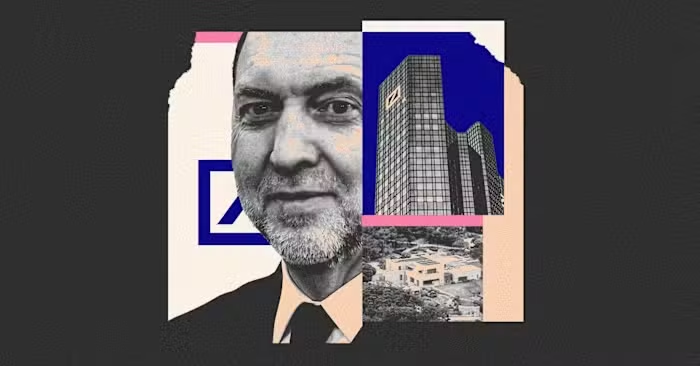
Suspect Money Linked to Russian Oligarch Flowed Through Deutsche Bank via Bristol Address
A Russian oligarch, a Bristol address and the suspect money that flowed through Deutsche Bank
ft.com· 3d
Leaked Files Show Deutsche Bank Kept Sanctioned Russian Oligarchs as Clients Despite Years of Warnings
united24media.com· 4d
Leaked Records Show Deutsche Bank Courting Russian Oligarchs
nytimes.com· 4d
A leak of more than 15 million internal Deutsche Bank records shows the bank kept Russian oligarch clients despite years of warnings from its own risk and anti-financial-crime teams.
The records were analyzed by a consortium of more than 200 journalists and detail the bank's ties to Oleg Deripaska and Viktor Vekselberg.
In 2014 an internal committee ranked Deripaska the riskiest Russian client and recommended ending ties he controlled, but the bank kept him.
In 2017 the bank paid hundreds of millions of dollars to settle allegations it helped Russian investors launder up to 10 billion dollars through mirror trades.
After the 2022 invasion the bank moved many oligarch accounts to Luxembourg and Switzerland and later announced it would wind down its Russian operations.
Deutsche Bank denies helping clients evade sanctions and says it acted lawfully; suspect money linked to an oligarch was reported to have flowed through the bank via a Bristol address.
More than 15 million leaked internal Deutsche Bank records, analyzed by a consortium of over 200 journalists, showed the bank kept Russian oligarch clients despite years of internal warnings.
After Russia's 2022 invasion, Deutsche Bank moved many oligarch accounts to Luxembourg and Switzerland, countries with strict banking-secrecy laws.
Deutsche Bank cited banking-secrecy laws in Switzerland and Luxembourg in withholding some client data that US prosecutors requested about sanctioned Russian clients.
On March 11, 2022, Deutsche Bank announced it would wind down its Russian operations, after initially resisting calls to leave Russia following the invasion.
On March 10, 2022, chief executive Christian Sewing told employees the bank would end some, but not all, of its Russian business.
In April 2021, Deutsche Bank's management board unanimously approved plans for cautious growth in Moscow, citing the relevance and profitability of the Russian market.
Internal spreadsheets from 2021 showed the bank still planning to expand its oligarch clientele, while its anti-financial-crime division in Switzerland wanted to exit accounts linked to Viktor Vekselberg but was told that was not possible.
A November 2020 Russia Strategy Review found 17 Russian clients on the US Treasury Department's Kremlin list and noted Russia's elevated money-laundering and sanctions risks alongside the market's profitability.
In September 2020, outside lawyers hired by the State of New York recommended that Deutsche Bank strongly consider shutting down all operations and services related to Russia.
At a 2019 meeting of Deutsche Bank's supervisory board risk committee, an adviser questioned keeping the oligarchs as clients given the increasing risk.
In 2018, the United States sanctioned seven Russian industrialists close to the Kremlin, and five of them, including Oleg Deripaska and Viktor Vekselberg, were Deutsche Bank clients personally or through business affiliations.
A 2015 internal Deutsche Bank presentation said Russian billionaires contribute heavily to the bank's success and described wealthy Russian clients as the backbone of sustainable growth for its wealth-management business.
In 2014, Deutsche Bank's reputational risk committee ranked Oleg Deripaska its riskiest Russian client and recommended ending relationships he controlled, but the bank maintained the relationship.
Deutsche Bank said it had acted lawfully and never helped clients evade financial sanctions, and that after Russia's invasion of Ukraine it "acted promptly to implement the rapidly evolving sanctions imposed by the relevant authorities".
A Deutsche Bank anti-financial-crime specialist wrote shortly after the invasion that the bank had "a large Russian Oligarchs client population" and asked whether some clients should be advised to withdraw funds "while they still can".
At a 2019 meeting of Deutsche Bank's supervisory board risk committee, an adviser questioned keeping the oligarchs as clients, saying, "If one of the clients turns out to be bad, the loss will be a multiple of the return".
Deutsche Bank chief executive Christian Sewing told employees in March 2022 that withdrawing completely from Russia would go against the bank's values and that it would continue to support clients who could not exit Russia.
Deutsche Bank announced on March 11, 2022 that it was winding down its Russian operations, saying, "There won't be any new business in Russia".
Borislav Ivanov, Deutsche Bank's top executive in Russia, rejected a comparison with departing peers, replying that a competitor remained in Russia and was "5x our size" in several lines of business.
Deutsche Bank said it concentrated its wealth-management clients in Luxembourg and Switzerland following industry practices, not only its Russian ones, and that all its Russian clients were subject to applicable vetting requirements.
Suspect money connected to a Russian oligarch was reported to have flowed through Deutsche Bank via an address in Bristol, England.