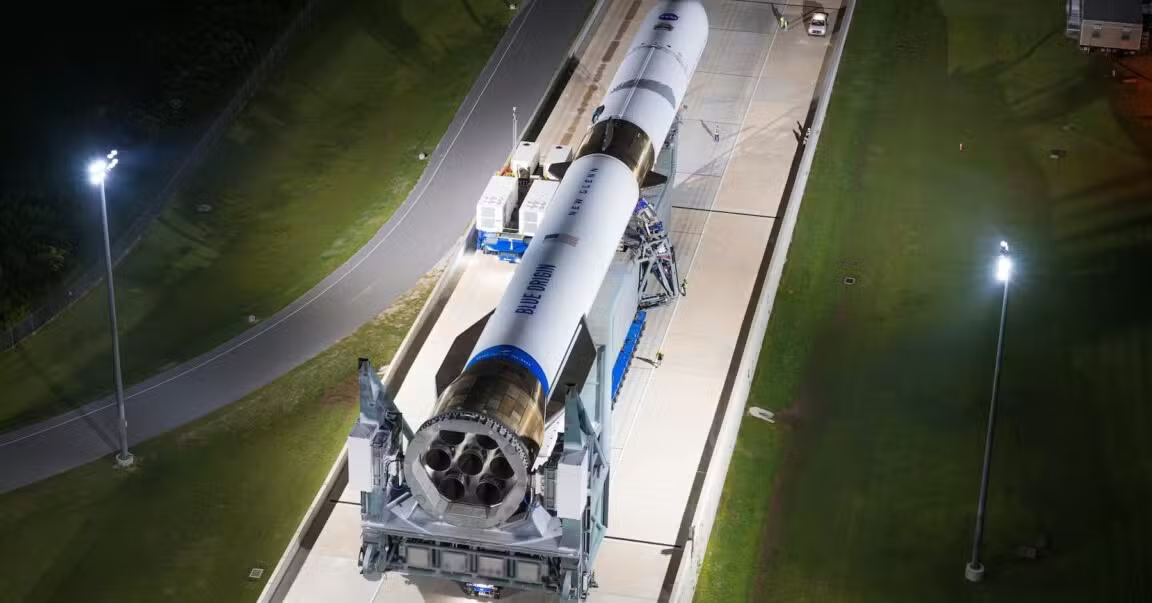
Blue Origin to launch Google's AI satellite data centers on New Glenn in 2029


Google has signed an agreement with Blue Origin to launch satellites for Project Suncatcher, its plan to test AI data centers in space.
The New Glenn mission is set for the first quarter of 2029 and will carry satellites with computing capacity at roughly the scale of a data center rack.
Project Suncatcher satellites are meant to run Google's Tensor Processing Units in sun-synchronous orbit, where they can draw nearly continuous solar energy.
In October 2026 Google launched its first AI server satellite on a SpaceX Falcon 9 rideshare, and its TPUs booted successfully in orbit.
Google has not said who it is contracting with to build the Project Suncatcher satellites.
Google says the New Glenn mission, set for the first quarter of 2029, will be the first dedicated heavy lift launch for Project Suncatcher, carrying satellites with computing capacity at roughly the scale of a data center rack into sun-synchronous orbit.
In October 2026 Google launched its first AI server satellite aboard a SpaceX Falcon 9 rideshare, and the satellite successfully booted its Tensor Processing Units and used the on-board Gemma 4 model to transmit an AI-generated haiku to Earth.
Blue Origin said in a post on X on November 19, 2026 that it and Google had entered into a launch services agreement for Project Suncatcher, Google's research moonshot exploring how a network of solar-powered satellites equipped with Google's Tensor Processing Units could scale machine learning.
Blue Origin and Google announced on November 19, 2026 an agreement under which Blue Origin's New Glenn rocket will launch Project Suncatcher data center satellites for Google in 2029.
The 2029 Google mission will fly on the 7x2 variant of Blue Origin's New Glenn, the smaller version of the rocket, which had launched three times as of the announcement.
Google did not say which company it is contracting with to build the Project Suncatcher satellites.
Google senior director of Project Suncatcher Travis Beals called Project Suncatcher a long-term moonshot to scale AI infrastructure in space by tapping into the abundant solar power in orbit.
Travis Beals said the dedicated launch with Blue Origin represents a crucial milestone on the Project Suncatcher roadmap as Google expands the boundaries of what is possible for the future of compute.
Eric Berber forecasts that the 2029 launch will likely serve to test networking solar-powered satellites equipped with AI chips and demonstrating machine-learning compute in space, making it a technology demonstration, and estimates the satellites may weigh several tons.

