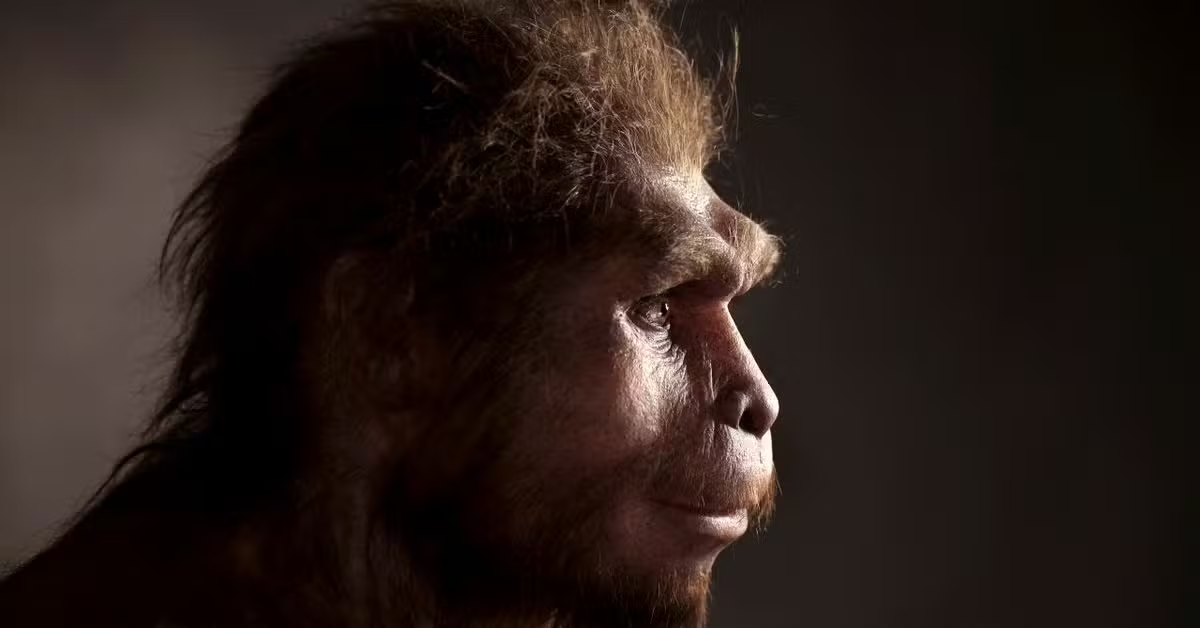
Homo erectus survived in southern China rainforests until 184,000 years ago, studies find
Menschliche Evolution: Homo erectus lebte länger als bisher angenommen
spiegel.de· 2d
Cave discovery in China reveals surprising survival skills of Homo erectus | CNN
cnn.com· 3d
Kings of the jungle? This early human had surprising survival skills that rivalled ours
nature.com· 3d
中国の原人、従来説より10万年以上長く熱帯雨林で生息か 国際研究 - 日本経済新聞
nikkei.com· 3d
Two studies in Nature suggest Homo erectus thrived in rainforests in southern China between 324,000 and 184,000 years ago.
Researchers had assumed the species died out on the Eurasian mainland about 400,000 years ago.
Eight of nine teeth from two caves in Guangxi were identified as Homo erectus by shape and tooth proteins; the ninth might be Denisovan.
Evidence shows the species ate and drank in the rainforest and may have ranged across areas of up to 250 kilometers.
The studies were co-led by geochronologist Kira Westaway and molecular palaeoanthropologist Frido Welker.
The research group says southern China may hold more fossils from the same period.
Reiko Kawano, a Keio University professor who took part in the research, said that if the number of samples increases, researchers may learn where and how Homo erectus and Homo sapiens replaced each other.
The international research group, which included the Chinese Academy of Sciences and Keio University, expects the finding to lead to a more detailed understanding of the course of human evolution.
Kira Westaway and her colleagues identified the two limestone caves in Guangxi while searching for fossils of Gigantopithecus, a three-metre-tall great ape.
The researchers found more than 10,000 animal teeth in the caves, and fossils of muntjac deer, leopards and orangutans point to a rainforest environment.
The researchers say a scavenger such as a porcupine probably accumulated the animal teeth in the caves.
The researchers say the unidentified ninth tooth may belong to Denisovans, though the evidence is circumstantial.
Kira Westaway said the finding is 'a really big deal' because researchers had thought Homo sapiens were the only species with the skill set to survive rainforest environments.
Frido Welker said Denisovans are a possibility for the ninth tooth but that every label put on it is 'a little bit of speculation'.
Two studies on hominin teeth from two southern Chinese caves were published in the journal Nature.
Researchers dated eight Homo erectus teeth from Naxian Cave and Baxian Cave in Guangxi province to between 324,000 and 184,000 years old using five dating techniques.
The findings show Homo erectus lived in southern China at a time the species was thought to have already disappeared from the region and most of the world.
Researchers identified eight of nine teeth as Homo erectus from their shape and recovered dental proteins from four teeth matching Homo erectus.
The studies found Homo erectus lived in dense, canopied rainforests as recently as 184,000 years ago.
Strontium in tooth enamel suggests some Homo erectus individuals ranged across forested karst regions, perhaps traveling up to 250 kilometers.
A ninth tooth from the caves differed in shape from Homo erectus, Homo sapiens and Neanderthals and lacked their molecular signature, so it could not be identified.
Kira Westaway called the discovery fascinating because it confirms Homo erectus was present in a place and at a time researchers had not expected.
Coauthor Patrick Roberts said the research is the first clear, direct evidence of a hominin other than Homo sapiens living in rainforest habitats.
Kira Westaway said the discovery has huge implications for the timeline of Homo erectus as scientists try to understand the causes of its extinction.
Ben Utting said journeys of up to 250 kilometers would have required a sophisticated understanding of terrain and show Homo erectus was far more behaviorally flexible than previously thought.
Ryan McRae, a Smithsonian paleoanthropologist not involved in the studies, said the ninth tooth might be Denisovan or a Denisovan-Homo erectus hybrid.
Chris Stringer of the Natural History Museum in London said recent research suggested interbreeding between the erectus and longi/Denisovan lineages, and the new evidence increases the likelihood this happened.
Kira Westaway says the strontium values in the Baxian Cave teeth do not match local ones and best match areas farther away, such as northern Vietnam.
The researchers found evidence that the Homo erectus individuals ate and drank in the rainforest, a habitat previously unknown for any human species before Homo sapiens.
Kira Westaway said the long-surviving Homo erectus population was evidently flexible, adaptable and mobile, skills normally associated with Homo sapiens rather than early humans.
Frido Welker said that despite the species' achievements, Homo erectus is still associated with an 'unsuccessful' adaptation to changing habitats, namely the emerging rainforest.

