Kim Jong Un calls for building more nuclear weapons during tour of production facilities
North Korea's Kim vows to build more nuclear weapons after ignoring Trump's overture
pbs.org· 12h
North Korea's Kim vows to build more nuclear weapons after ignoring Trump's overture
npr.org· 21h
Nordkorea: Kim Jong Un fordert breiteren Einsatz taktischer Atomwaffen
spiegel.de· 28h
North Korea's Kim calls for nuclear arsenal expansion, says status 'will never change'
cnbc.com· 29h
Kim Jong Un Makes Rare Show of Nuclear Warheads After Snubbing Trump Talks
bloomberg.com· 31h
Kim Jong Un says North Korea should widen deployment of tactical nukes
aljazeera.com· 32h
Despite Trump overture, North Korea’s Kim vows to build more nuclear weapons
politico.com· 32h
North Korea’s Kim Jong Un urges wider tactical nuclear deployment during inspection of weapons facilities | CNN
cnn.com· 35h
North Korea's Kim calls for wider deployment of tactical nuclear weapons
reuters.com· 37h
North Korean leader Kim Jong Un has called for building more nuclear weapons and for the wider deployment of tactical nuclear weapons across multiple domains, during an inspection of nuclear material production and weapons research facilities that state media did not identify or locate.
In remarks reported on November 25, he said North Korea's nuclear material production capacity is being systematically expanded, and that the country's status as a nuclear weapons state is absolutely inviolable and would not change because of outside assertions or what he called denuclearisation rhetoric. He said Pyongyang will never relinquish the weapons, calling them a core guarantee of national sovereignty and security, and warned that any attempt to deny the country's nuclear status would be regarded as an open declaration of war.
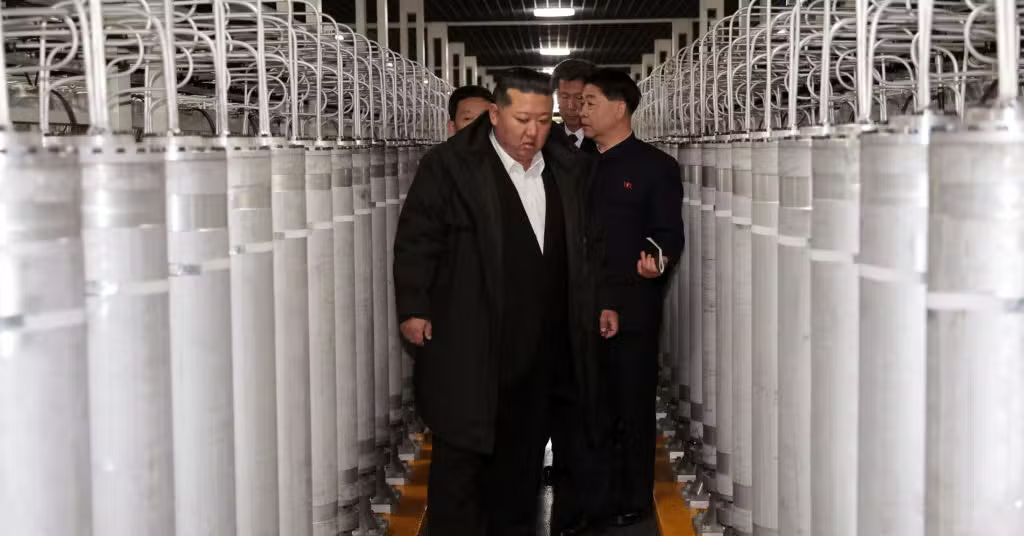
State media photographs released on November 26, taken the day before, showed Kim and senior military officials walking between dense rows of what appeared to be centrifuges for producing weapons-grade uranium, and touring halls displaying what were believed to be warheads, with some images blurred. State media said he inspected two nuclear materials production factories, one newly inaugurated and the other being expanded, and also visited a nuclear-powered equipment production base and a nuclear research institute.
He framed the visit as part of efforts to counter what he called the reckless expansion of adversary states' nuclear forces and military alliances, and variable nuclear threats approaching the Korean Peninsula moment by moment. He accused the United States of inciting its regional allies to possess nuclear-powered submarines and of committing to share its nuclear weapons with them, and singled out South Korea, which he called the most dangerous enemy state, as a threat to North Korea's security and sovereignty.
At the Nuclear Weapons Institute he urged greater attention to operationalizing tactical nuclear weapons for a range of missions, and called for further development of the country's low-yield battlefield nuclear weapons, saying their deployment across multiple domains is crucial given the border with South Korea.
The reports also noted that President Donald Trump had offered to meet Kim during his visit to Asia for the APEC summit in the week before the inspection was reported, and that North Korea gave no public response, so no meeting took place.
North Korean leader Kim Jong Un, during an inspection of nuclear material production and weapons research facilities that state media did not identify or locate, called for wider deployment of tactical nuclear weapons across multiple domains for different missions.
Kim Jong Un said North Korea's nuclear material production capacity is being systematically expanded.
Kim Jong Un said North Korea's status as a nuclear weapons state is absolutely inviolable and would not change because of outside assertions or what he called denuclearisation rhetoric.
Kim Jong Un said any attempt to deny North Korea's nuclear status would be regarded as an open declaration of war.
Kim Jong Un said Pyongyang will never relinquish nuclear weapons, which he called a core guarantee of national sovereignty and security.
Kim Jong Un said in remarks carried by state media, 'Our nuclear capability is now a reality.'
Kim Jong Un said in remarks carried by state media, 'Our possession of nuclear weapons is an absolutely irreversible choice as long as malicious forces exist that use nuclear weapons as a means of achieving hegemony.'
State media released a photograph of Kim Jong Un inspecting the nuclear material production and weapons research facilities at an undisclosed location, taken on November 25 and published on November 26.
President Donald Trump offered to meet Kim Jong Un during his visit to Asia for the APEC summit in the week before the inspection was reported, and North Korea gave no public response, so no meeting took place.
State media reported that Kim Jong Un inspected two nuclear materials production factories, one newly inaugurated and the other being expanded, during a visit on November 25.
Photos released by state media showed Kim Jong Un and senior military officials walking between dense rows of what appeared to be centrifuges for producing weapons-grade uranium and touring halls displaying what were believed to be warheads, with some images blurred.
State media said Kim Jong Un also visited a nuclear-powered equipment production base and a nuclear research institute on November 25.
Kim Jong Un called the inspection part of efforts to strengthen North Korea's defense capabilities in response to variable nuclear threats approaching the Korean Peninsula moment by moment.
Kim Jong Un accused the United States of inciting its regional allies to possess nuclear-powered submarines and of committing to share its nuclear weapons with them.
Kim Jong Un called for the further development of North Korea's low-yield battlefield nuclear weapons, saying their deployment across multiple domains is crucial given the border with South Korea, which he called the most dangerous enemy state.
Kim Jong Un said in a statement carried by state media, 'The validity and substantiality of our possession of nuclear weapons and the trend of bolstering up its nuclear capability in quality and quantity are an irreversible reality.'
Donald Trump dismissed the suggestion that Kim Jong Un rebuffed his outreach, saying in an interview with the New York Post, "No, he didn't ignore it. You know, we had many leaders there … There'll be a time when we meet … It was just not really the right time. It was a very busy two-day period."
Donald Trump claimed he could revive diplomacy with Kim Jong Un at any time by restarting the exchange of letters the two leaders maintained during his first term, while acknowledging they had not corresponded recently.
During a visit to the Nuclear Weapons Institute, Kim Jong Un urged greater attention to operationalizing tactical nuclear weapons for a range of missions.
Kim Jong Un described the visit as part of North Korea's efforts to counter what he called the reckless expansion of adversary states' nuclear forces and military alliances.
Kim Jong Un singled out South Korea as a threat to North Korea's security and sovereignty.
Kim Jong Un said in remarks carried by state media that North Korea's nuclear policy is "a core element of safeguarding the sovereignty of the Republic, enshrined in the supreme law of the state."
Moon Seong Mook of the Seoul-based Korea Research Institute for National Strategy said Kim Jong Un's message was, "Look at how powerful we are. Don't talk about denuclearization if you want to meet us," because the basic US position that North Korea must denuclearize remains unchanged.
Moon Seong Mook said Kim Jong Un's visit to the nuclear facilities was likely meant to check how state objectives on the nuclear program had progressed in 2026 and to set future goals ahead of a year-end Workers' Party conference.
South Korea's Defense Ministry said it takes Kim Jong Un's comments on battlefield nuclear weapons seriously and maintains firm military readiness against Pyongyang's nuclear threats under its alliance with the United States.
South Korea's Joint Chiefs of Staff declined to share an analysis of the North Korean nuclear facilities shown in state media, calling it confidential information for South Korea and the United States.

