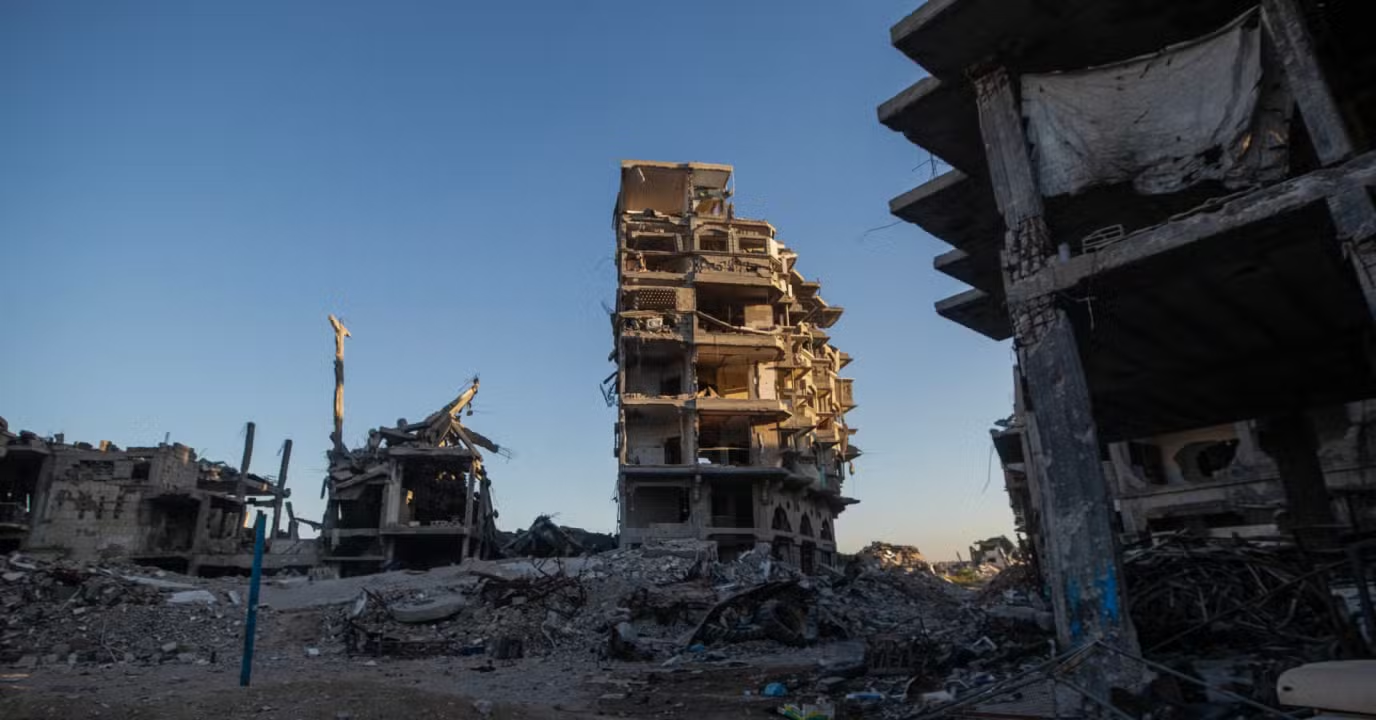
Displaced Palestinians protest near Gaza yellow line as ceasefire death toll reaches 1,661
Displaced Palestinians protest as Israeli air strikes continue in Gaza
aljazeera.com· 1h
Palestinian anti-Hamas groups accused of role in Israel Gaza operation
Palestinians in Gaza face new displacement after Israeli army operation
Palestinians flee and Gaza ceasefire tested as Israeli tanks cross ‘yellow line’
nbcnews.com· 2d
What does Israel’s new ground offensive mean for Palestinians in Gaza?
Israeli military launches rare ground operation in Gaza beyond Yellow Line
bbc.com· 3d
Thousands of Palestinians Flee Israel’s New Assault Past Gaza’s “Yellow Line”
truthout.org· 3d
L'armée israélienne lance une incursion terrestre dans la bande de Gaza
france24.com· 3d
L’armée israélienne annonce le lancement d’une opération dans une zone de la bande de Gaza contrôlée par le Hamas
lemonde.fr· 3d
Israeli tanks roll into central Gaza in first ground operation since ceasefire began
Israeli tanks rolled into central Gaza west of the Yellow Line early on 18 November 2026, the first ground operation since the October 2025 ceasefire, with witnesses seeing them on the main Salahudeen road and positioned east of the Nusseirat refugee camp. The military, working with the Shin Bet security service, said the operation aimed to dismantle a tunnel it called an immediate threat to its troops, and blamed ceasefire violations by Hamas.
Residents were ordered to leave three blocks north of the Nuseirat camp, and about 6,000 Palestinians fled, piling belongings onto bicycles and vehicles. Medical officials said at least three Palestinians were killed in Israeli attacks across central Gaza that day.
A military spokesperson said the operation ended on 19 November, and the army announced it had reopened Salah al-Din Street, though some Palestinians said sporadic gunfire continued. Gaza's Government Media Office later reported that local armed groups had participated in the operation, including pressuring families to evacuate their homes.
Hundreds of displaced Palestinians demonstrated near Deir el-Balah on 21 November against Israel's intensifying air strikes, which killed at least four people that day, including three in a drone strike on a van delivering food aid in Gaza City. Israeli forces, which had been expected to withdraw further from the Yellow Line, kept destroying buildings beyond it and seized more territory. Gaza's Ministry of Health said strikes killed at least nine people in the 48 hours before 22 November, taking the death toll since the ceasefire to 1,661, with 6,062 wounded.
The Israeli military launched its first ground operation since the October 2025 ceasefire early on 18 November 2026, sending tanks into central Gaza west of the Yellow Line, where witnesses saw them roll onto the main Salahudeen road.
The military said the operation targeted Hamas infrastructure outside the areas of the Gaza Strip it controls, and that it had struck a militant in southern Gaza earlier that day.
Dozens of displaced Palestinians fled their tents and shelters after the Israeli military ordered residents to leave, piling belongings on bicycles, wheelchairs, motorcycles and vehicles.
Palestinian medics said an Israeli airstrike near the raid in central Gaza killed one person.
Residents reported hearing tank shells fired in the area of the raid.
Salam Aql said gunfire started as residents were sitting there, that a boy was hit in the leg by a bullet, and that once he was wounded they could not stay any longer, though she had wanted to stay because she was exhausted from repeated displacement.
Hamas said the Israeli raid and the forced displacement of Palestinians marked a ceasefire violation and a dangerous escalation.
The Israeli army said the operation west of the Yellow Line aims to eliminate a threat weighing on its soldiers, mobilizes soldiers and agents of Israel's internal security service, and was carried out in response to ceasefire violations by Hamas.
A journalist in Gaza saw Israeli tanks positioned east of the Nusseirat refugee camp.
Cogat, the Israeli body supervising civilian affairs in the occupied Palestinian territories, called on humanitarian organizations to avoid any movement in the affected sectors near the Al-Boureij and Nusseirat refugee camps and said the Salah Al-Din road would be closed to traffic there.
A security source in the Gaza Strip reported intense Israeli artillery fire north of the Nuseirat camp and the presence of Israeli military vehicles near the neighboring al-Bureij camp.
Cogat urged residents of the Gaza Strip to stay away from the sectors where Israeli forces operate until the official announcement of the end of the operation.
Oum Ahmad Al-Tartouri, a 39-year-old resident of al-Bureij, said her family was terrified by the artillery fire and explosions and gathered their clothes before leaving their house.
Abou Mohammad Abou Shawish, a 48-year-old resident of Nusseirat, said residents had barely had time to regain some stability after long months of displacement before being plunged back into the same fear.
Mahmoud Al-Saafin, a 27-year-old resident of the al-Bureij camp, said he fears the incursion marks the start of a larger-scale operation, as residents have not yet recovered from the war and previous displacements.
Medical officials said at least three Palestinians were killed in Israeli attacks across central Gaza on 18 November 2026.
It was reported that at least two people were wounded by indiscriminate fire near the Nuseirat refugee camp as scores of residents fled the area.
Gaza's Ministry of Social Development warned the assault poses a direct threat to the lives of tens of thousands of displaced people and called the continuation of military operations near populated areas and shelters a grave violation of international humanitarian law.
Israeli Defense Minister Israel Katz said that in the event of further escalation the military is prepared to "maneuver and seize additional territory, while evacuating residents and destroying terrorist infrastructure on the ground," turning such areas into permanent parts of Israel's security zones in the north and south.
The Israel Defense Forces said it had begun a joint operation with the Shin Bet security service to dismantle a terror tunnel west of the Yellow Line that posed an immediate and direct threat to its troops.
An official at al-Awda Hospital said an Israeli attack on al-Mughraqa killed one person and wounded several others.
The Israeli army said it reserves the freedom to act and manoeuvre whenever necessary to eliminate any immediate threat in the Gaza Strip.
Hamas urged mediators to "intervene immediately" over the Israeli ground operation and the forced evacuations northeast of Nuseirat.
The Popular Front for the Liberation of Palestine called the Israeli ground operation a prelude to a wider escalation aimed at forcibly displacing Palestinians.
An Israeli military spokesperson said on 19 November that the operation west of the Yellow Line had ended, though it could not confirm when exactly the offensive came to a close.
The Israel Defense Forces and the Shin Bet security service said a warning had been issued to civilians in the area before the operation.
Andreas Krieg, a senior lecturer at King's College London, said the incursion was a "clear violation of the fundamental premise of the ceasefire" and that Israel cannot invoke security concerns whenever it wants to cross a boundary it agreed to respect.
Rob Geist Pinfold said it is the scale of the violation that matters, with the ground assault and the use of tanks signifying an escalation from Israel.
Amna al-Gasar, 49, said bullets were fired at her family as she fled with her young children and that this was her 14th displacement, asking "Where should we go? We are exhausted. This is not a life."
Muna Abu Shehadeh, 37, said she left central Gaza with relatives carrying nothing but their children, with no bedding, food, or water.
The Board of Peace warned the ceasefire deal was in danger of collapse.
On 18 November 2026 the Israeli military issued forced evacuation orders covering three blocks north of the Nuseirat refugee camp, saying its troops were targeting a suspected Hamas tunnel there.
Gaza's Government Media Office said about 6,000 Palestinians fled the area north of the Nuseirat refugee camp on 18 November 2026.
On 19 November 2026 the Israeli military announced it had completed its operation and reopened Salah al-Din Street, though some Palestinians said sporadic gunfire continued and the road remained unsafe.
Gaza health authorities say more than 1,600 Palestinians have been killed since the ceasefire took effect in October 2025.
Suhail al-Mashharawi, a 50-year-old who has fled 13 times, said the operation ended a year of relative stability and described conditions at the educational centre where his family of eight sheltered as dire, with no humanitarian assistance.
Ismail Younis, who manages a camp for displaced people in the al-Mufti area of Gaza, said bullets penetrated tents during the operation, prompting families to flee without a destination or alternative refuge to save their own lives and their children's lives.
Amna al-Qassas, a 49-year-old who fled with 10 family members leaving everything behind, said displacement had become a recurring nightmare that took her family back to square one and destroyed what little sense of security they had regained.
Late on 17 November 2026, armed men in civilian clothes believed to be members of Israeli-backed local militias surrounded a house sheltering displaced women on ad-Dawa Street on the northern edge of the Nuseirat refugee camp, forced the women into the street, questioned them about a man they were seeking, and fired into the air before withdrawing without detaining anyone.
A Palestinian security source in Gaza said security authorities had documented local armed groups' participation in the Israeli operation that week, including terrorising civilians and pressuring families to evacuate homes and shelters, with the groups benefiting from Israeli fire cover and the closure of Salah al-Din Street.
The Palestinian security source described the groups as gangs financed and armed by Israel to undermine Palestinian internal cohesion by engineering chaos.
Hundreds of displaced Palestinians living near the Yellow Line demonstrated near Deir el-Balah on 21 November 2026 against Israel's intensifying air strikes.
Israeli forces, which had been expected to make further gradual withdrawals from the Yellow Line, instead continued destroying residential buildings beyond it and seized more territory.
Israeli attacks killed at least four Palestinians in Gaza on 21 November 2026, including three who died when an Israeli drone struck a van delivering food aid to displaced people in Gaza City.
Gaza's Ministry of Health said Israeli strikes killed at least nine people in the 48 hours before 22 November 2026, taking the death toll since the October 2025 ceasefire to 1,661, with 55 wounded in that period bringing the total wounded to 6,062.
Mohammed Musleh, mayor of the Maghazi municipality in Deir el-Balah, said more than 500 housing units have been destroyed in less than a month and that the destruction appears to be part of a systematic policy of gradual creeping displacement aimed at forcing residents out of their camp.
Moath al-Kahlout, reporting from Deir el-Balah, said the Yellow Line was much further east when the ceasefire was signed in October 2025.

