US blockade strains Iran's economy as Pezeshkian says government has no money
'We have no money.' Iran’s president admits U.S. economic warfare is far more difficult than destruction caused by missiles | Fortune
fortune.com· 11h
Iran says it is prepared to withstand US blockade, seeks to curb price rises
reuters.com· 4d
Iran says it will use ‘all available means’ to counter US blockade
aljazeera.com· 5d
US targets Iran’s ship-to-ship transfers: Can Tehran break the blockade?
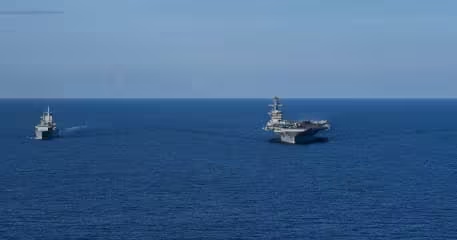
The United States reimposed its naval blockade on Iranian ports in July 2026, preventing oil exports and keeping imports out. Iran said on 23 November it would use all available means to counter the blockade, while Foreign Ministry spokesman Esmaeil Baghaei called reports of Iranian ships loading oil speculation.
In November, the United States announced Task Force Iron Gate to restrict weapons and sanctioned materials moving across Iran’s land borders and the Caspian Sea. By 28 November, the United States had also begun cracking down on trade entering Iran by land. Iran’s Vice President Mohammad Reza Aref said goods clearance through non-southern borders had increased significantly and strategic reserves were strong, without providing figures.
The blockade’s effects were compounded by soaring prices: Iran’s Statistical Centre said October consumer prices were 88.7% higher than a year earlier, while food and beverage prices had risen 112.6%. By 28 November, the government had cut food, fuel and electricity subsidies, state workers and pensioners were unpaid, and the currency had fallen to 2.99 million rials per dollar. Rolling blackouts began, and Tehran cut cheap flour and bread supplies in 7 provinces. Bakers protested flour shortages, while retirees and labor unions protested over living conditions, including with anti-government slogans.
In October, US Central Command chief Adm. Brad Cooper said the blockade had prevented at least $25 billion in Iranian crude oil exports. He said the government had withheld salaries, pensions and benefits from workers in several sectors, including the Islamic Revolutionary Guard Corps. The United States and its partners had also frozen nearly $350 million in Iranian cryptocurrency assets, he said.
Iran stepped up attacks on commercial shipping in the Persian Gulf in the weeks before 28 November, raising insurance and shipping costs. On 26 November, US forces disabled a commercial vessel whose crew tried to run the blockade despite repeated warnings. By 27 November, US Central Command had redirected 158 commercial vessels and disabled 6 attempted blockade runners. Payments for Iran’s final oil deliveries, mainly to China, could continue into December, after which remaining oil revenue was expected to run out.
Iran said it would use all available means to counter the US naval blockade imposed during the US-Israel war.
On 23 November 2026, Iranian Foreign Ministry spokesman Esmaeil Baghaei said reports of Iranian ships loading oil were speculation.
Esmaeil Baghaei said Iran would not tolerate the US actions and would use all available means to counter them.
Esmaeil Baghaei said the US sanctions and naval blockade constituted military aggression and Iran was entitled under Article 51 of the UN Charter to defend itself by any means.
Esmaeil Baghaei said security could be restored to the Strait of Hormuz and the region quickly if the United States fulfilled its commitments.
The United States reimposed its naval blockade on Iranian ports in July 2026.
The United States announced Task Force Iron Gate in November 2026 to restrict weapons and sanctioned materials moving across Iran's land borders and the Caspian Sea.
In October 2026, Iran's consumer prices were 88.7% higher than a year earlier, average inflation was 76.8%, and food and beverage prices had risen 112.6%, according to Iran's Statistical Centre.
Mohammad Reza Aref said goods unloading and clearance through Iran's non-southern borders had increased significantly, and that strategic goods reserves were strong, without providing figures.
Mohammad Reza Aref said, 'The increase in the unloading and clearance of goods through non-southern borders sends the message that we are not concerned about the enemy's naval blockade.'
Mohammad Reza Aref said the government was seeking to prevent increases in basic goods prices for at least 3 months.
President Masoud Pezeshkian said the government was seeking to direct more budget resources and energy savings toward improving living standards in poorer communities.
By 28 November 2026, the US naval blockade had been in place for 137 consecutive days, preventing Iran from exporting oil and keeping imports out.
The United States began cracking down on trade into Iran via land routes.
Iran's government cut subsidies for food, fuel and electricity, while state workers and pensioners went unpaid.
Iran's currency fell to 2.99 million rials per dollar as inflation neared 90%.
Iran's state electricity company began rolling blackouts, and Tehran cut cheap flour and bread supplies in 7 provinces.
Bakers in Zanjan province and other areas staged protests over flour shortages, according to Nour News.
Retirees and labor unions protested, including with anti-government slogans, while Iranian officials allowed protests focused on living conditions.
In October 2026, US Central Command chief Adm. Brad Cooper said the blockade had prevented at least $25 billion in Iranian crude oil exports and that the United States and its partners had frozen nearly $350 million in Iranian cryptocurrency assets.
Brad Cooper said the blockade had led Iran's government to withhold salaries, pensions and benefits from workers in several sectors, including the Islamic Revolutionary Guard Corps, and that some Iran-aligned militias were reportedly withholding soldiers' pay to send funds back to the Guard.
Iran stepped up attacks on commercial shipping in the Persian Gulf in the weeks before 28 November 2026, raising insurance and shipping costs.
On 26 November 2026, US forces disabled a commercial vessel in the Gulf of Oman after its crew tried to run the blockade despite repeated warnings.
By 27 November 2026, US Central Command had redirected 158 commercial vessels and disabled 6 attempted blockade runners.
Payments for Iran's final oil deliveries, mainly to China, could continue into December 2026, after which the remaining oil revenue was expected to run out.
President Masoud Pezeshkian said, 'We have no money' and described Iran's economic conflict as 'far more difficult than one in which missiles are launched and destruction is caused' and 'by no means an easy one.'
Iran's Deputy Interior Minister Ali Zeinivand said inflation had made wages insufficient to cover living expenses and that it was natural for affected groups to make demands.
The head of Iran's Parliament economic commission warned of fuel and heating shortages in the winter of 2026-2027, citing wartime damage to energy infrastructure.
Iran warned that the 'no war, no peace' situation was untenable.
Brad Cooper said the Iranian government was clearly feeling economic pain and the Revolutionary Guard was showing signs of greater desperation.
Some Iranian officials suggested a large convoy of tankers could attempt to break the blockade by transiting the Strait of Hormuz together.