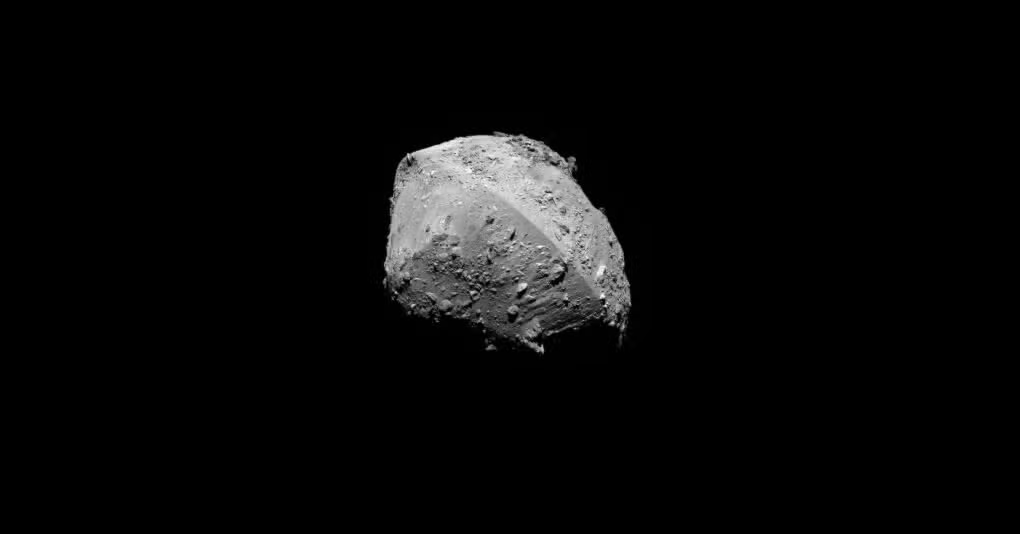
Hera reveals stadium-size crater and boulder swarm at DART impact site on Dimorphos
Europe's Hera mission returns to the chaotic scene of a cosmic smashup
arstechnica.com· 36h
Hera's Images of Smashed Asteroid Moon Dimorphos, Unveiled
skyandtelescope.org· 36h
New photos reveal stadium-sized crater in asteroid knocked off course by NASA
abc.net.au· 37h
NASA's DART mission left a stadium-sized crater in an asteroid, the ESA finds - Engadget
engadget.com· 38h
New images reveal crater on asteroid struck by DART spacecraft
reuters.com· 40h
ESA mission reveals stadium-size crater left by first planetary defense test | CNN
cnn.com· 40h
In 2022, NASA struck an asteroid. Now, we are finally seeing the massive impact up close
scientificamerican.com· 40h
Europe’s Hera Mission Releases Close-Up Images of the Asteroid Hit by a NASA Spacecraft
nytimes.com· 41h
Did it work? Results of first attempt to shift the path of a deadly asteroid
thetimes.com· 41h
Spacecraft crash left asteroid tumbling in orbit with huge crater on one side
ft.com· 41h
Hera spacecraft investigates damage at asteroid "crash scene"
bbc.com· 2d
Revealing Hera's first images of asteroid Dimorphos
youtube.com· 6d
The European Space Agency's Hera spacecraft arrived at the asteroid Dimorphos three weeks before releasing its first images of the scene on November 25, 2026, at the Museum of Natural History in Berlin. The pictures, photographed on November 7 from about 29 kilometers away, show that NASA's 2022 DART impact carved a crater far bigger than most scientists anticipated, almost as large as Dimorphos itself. A rocky object protrudes from the heart of the crater, though scientists are unsure whether it was unearthed from below or fell in from elsewhere.
The crater's shape and size confirm Dimorphos is a loosely bound rubble pile that convulsed like a fluid under the impact. Patrick Michel said DART both carved the crater and reshaped Dimorphos, and the team cannot yet explain how the transition between cratering and global transformation can happen. A decent chunk of Dimorphos is missing, much of the blasted material escaping into space, but the asteroid remains in one piece on its changed post-DART orbit, and its remaining boulder fields and those of Didymos look as they did in DART's 2022 images.
The impact also left hundreds of boulders of differing sizes in motion around the Didymos-Dimorphos system, more than 100 of them between the size of a football and a washing machine, and scientists are scrambling to navigate Hera safely through the swarm. Hera circles the asteroids at a relative velocity of about 12 centimeters per second, so there is no danger of a sudden catastrophic collision. Dimorphos is also tumbling chaotically, making it impossible to predict which face it will show the spacecraft.
Hera is scheduled to approach within about 13 kilometers of Dimorphos in December for the higher-resolution observations needed to calculate its mass, and in January it is due to deploy two CubeSats, with Juventas planned to fly through the boulder field toward a landing attempt where it will measure the asteroid's tenuous gravity field.
The European Space Agency's Hera spacecraft arrived at the asteroid Dimorphos to investigate the damage from NASA's 2022 DART impact, with its first images set for release.
Hera carries two shoebox-sized CubeSats that will study the impact site up close and later land on Dimorphos.
A key task of the Hera mission is to measure the mass of Dimorphos to work out how effective the DART spacecraft's shove was.
Hera had already sent back an image of the asteroid Didymos with Dimorphos in the background.
Patrick Michel, Hera's principal investigator, compared the mission to Inspector Columbo going back to the crash scene to investigate the outcome of the impact.
The Hera mission is forecast to spend the next year studying Dimorphos and also take a look at Didymos.
The DART impact left Dimorphos tumbling in its orbit, with a huge crater covering one side of the asteroid.
The European Space Agency released Hera's first images of the DART impact scene on November 25, 2026, at the Museum of Natural History in Berlin.
Hera's images show the crater DART excavated on Dimorphos is far bigger than most scientists anticipated, almost as large as the asteroid itself.
A rocky object protrudes from the heart of the DART crater, and scientists are unsure whether it was unearthed from below or fell in from elsewhere.
The crater's shape and size confirm Dimorphos is a loosely bound rubble pile that convulsed like a fluid under the impact.
A decent chunk of Dimorphos is missing, but the asteroid remains in one piece on its changed post-DART orbit.
Hundreds of boulders of differing sizes are in motion around the Didymos-Dimorphos system, and scientists are scrambling to navigate Hera safely through the swarm.
Patrick Michel said the DART crash made a mess and that he could not be more excited.
Sabina Raducan said that as Hera made its approach, Dimorphos looked "basically like a blob" that seemed to be missing a piece.
Harrison Agrusa said there are hundreds of boulders all over the place around Dimorphos and that he had lost considerable sleep charting their trajectories to "figure out what the hell is going on."
Margherita Cardi said her team knew it would have to operate in a pretty hostile environment, but the boulder swarm was entirely unexpected, calling it a nightmare and a mix of excitement and panic.
Andy Rivkin said it was kind of emotional for him and a few other people to see the first close-ups of Dimorphos.
Hera arrived at Dimorphos three weeks before the image release and is observing from about 30 kilometers away.
The European Space Agency said the rest of Dimorphos shows no evidence of major changes, with its boulder fields looking as they did in DART's 2022 images.
More than 100 of the boulders encircling the asteroid pair are between the size of a football and a washing machine.
Hera is scheduled to approach within about 13 kilometers of Dimorphos in December for higher-resolution images and observations needed to calculate its mass.
Sabina Raducan said the crater is "a big crater that is almost as large as the body itself, which is really spectacular" and that before the impact Dimorphos moved like a "barrel that you throw down the stairs" after being sent into a chaotic tumble.
Naomi Murdoch said the biggest surprise from Hera's early observations is that hundreds of previously unknown boulders encircle the asteroid pair: "we quickly realized the asteroids were not alone" and "in fact, they had a lot of company."
Murdoch said scientists cannot yet say whether the boulders are debris from the DART impact or came off the primary asteroid, and need more time to determine where they came from and why.
Raducan said the DART mission may have been moving too fast in 2022 to observe the boulders if they were already there.
Margherita Cardi said the boulders present a collision risk for the CubeSats but her team can create an engineering approach to survive them.
Ian Carnelli said in a statement that 66 million years ago an asteroid impact changed the course of life on Earth and that today, for the first time in history, humanity is validating how to prevent such an event from happening again.
The two CubeSats aboard Hera are expected to be released in January, with a plan for them to venture close to and then land on Dimorphos.
The crater images were photographed on November 7, 2026, from a distance of 29 kilometers by a camera aboard Hera.
In January, Hera is due to deploy two CubeSats that will approach even closer and investigate the interior structure of the two asteroids.
Michael Kueppers said the side of Dimorphos hit by DART is completely covered by the crater, giving the visual impression that a piece of the asteroid was cut off by the impact.
Kueppers said scientists knew DART successfully changed Dimorphos's orbit but did not know what happened to the asteroid itself.
Kueppers said investigating what the impact did to Dimorphos is needed to apply the kinetic impactor technique to an asteroid found on a collision course with Earth.
The new Hera images show Didymos unchanged from before the impact, with the same boulder fields and the same central equatorial ridge.
The DART impact blasted a huge amount of material off Dimorphos, much of which escaped into space, while some re-impacted Dimorphos, landed on Didymos, or is likely still in orbit.
The chaotic rotation of Dimorphos makes it impossible to predict which face it will show Hera, complicating the mission's global survey plans.
Hera imaged the hemispheres of Didymos and Dimorphos that the DART spacecraft did not observe.
Naomi Murdoch said the DART mission changed how Dimorphos looks and how it moves and revealed unexpected new companions in the system.
Sabina Raducan said the crater is beautiful and it is hard to describe the excitement of finally seeing what happened.
Raducan said the tumbling of Dimorphos is amazing and actually helps Hera see every side of it regardless of the spacecraft's trajectory.
Raducan said the boulders are visible only in multiple images and long exposures, so the team will probably never know whether DART could have missed them.
Heli Greus said the newly discovered boulders were a big shock because the team had believed the system was just two rocks, and they could be dangerous for Hera and its CubeSats.
Claudia Balossi said the planned CubeSat trajectories pass about 2 and 3 kilometers from the system while the rings of boulders spread out to 7 or 10 kilometers, putting the spacecraft right in the middle of them.
Naomi Murdoch said the Hera team hopes to reach at least one meter per pixel spatial resolution as the mission progresses.
Patrick Michel reported that DART both carved a crater and reshaped Dimorphos, and the team cannot yet explain how the transition between cratering and global transformation can happen.
A composite image from Hera's Hyperscout-H instrument combines 11 long-exposure images acquired on November 6 at about 29.9 kilometers, with the two asteroids digitally subtracted to reveal the boulder trails.
Scientists say the boulders may have been thrown off Dimorphos by the impact or may be relics of the asteroid's ancient formation, and more data is needed to say for sure.
Hera circles the asteroids at a relative velocity of about 12 centimeters per second, so there is no danger of a sudden catastrophic collision with a boulder.
The Juventas CubeSat's planned trajectory takes it through the boulder field toward a landing attempt on Dimorphos, where it will measure the asteroid's tenuous gravity field.
Claudia Balossi said Juventas is right in the middle of the boulder field, where the smallest boulders are probably as big as the CubeSat and the biggest are very big.
Balossi joked that in the worst case a boulder will land on Juventas and the team will activate the CubeSat's gravimeter right away.

