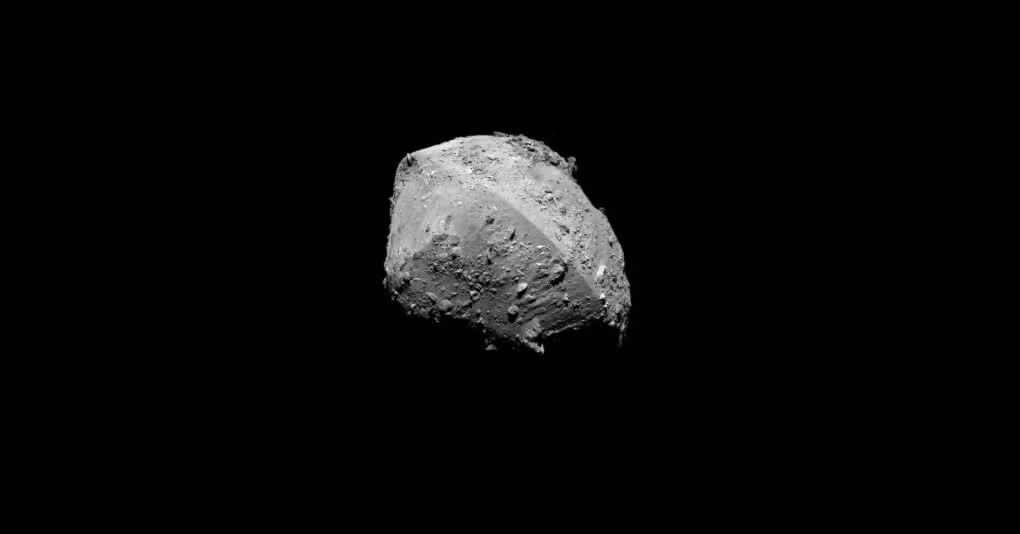
Hera reveals stadium-size crater and boulder swarm at DART impact site on Dimorphos
Europe's Hera mission returns to the chaotic scene of a cosmic smashup
arstechnica.com· 4h
Hera's Images of Smashed Asteroid Moon Dimorphos, Unveiled
skyandtelescope.org· 5h
New photos reveal stadium-sized crater in asteroid knocked off course by NASA
abc.net.au· 6h
New images reveal crater on asteroid struck by DART spacecraft
reuters.com· 8h
ESA mission reveals stadium-size crater left by first planetary defense test | CNN
cnn.com· 9h
Spacecraft crash left asteroid tumbling in orbit with huge crater on one side
ft.com· 9h
Hera spacecraft investigates damage at asteroid "crash scene"
bbc.com· 21h
The European Space Agency's Hera spacecraft has arrived at the asteroid Dimorphos to assess the aftermath of NASA's 2022 DART impact, ending a two-year journey from a launch pad in Florida. ESA released the mission's first images on Wednesday, 25 November, after Hera had spent about three weeks near the asteroid pair, hovering about 30 kilometers (19 miles) from Dimorphos.
The images show a stadium-size crater that flattened one of Dimorphos's previously rounded faces. The asteroid, about 500 feet (151 meters) across, now has a crater nearly as big as itself, and the team is unsure how such a transition can happen. Initial observations also indicate the 2022 impact sent Dimorphos into a chaotic tumble as it orbits Didymos, whereas before it always showed the same face, like Earth's moon. The rest of the asteroid shows no evidence of major changes, and Didymos is spinning just as DART observed on final approach in 2022.
Hera's early observations revealed hundreds of previously unknown boulders encircling the asteroid pair, including more than 100 between the size of a football and a washing machine. These present a collision risk for the mission's two shoebox-sized CubeSats, though Hera itself moves at about 12 centimeters per second relative to the asteroids, too slow for a catastrophic collision.
Hera is to spend the next year studying Dimorphos, flying closer over the six months after arrival. In December it will approach to around 13 kilometers (8 miles) for higher-resolution images and observations to calculate the asteroid's mass, the key to working out how effective DART's shove was. The two instrument-carrying CubeSats are to be released in January, with Juventas planned to fly through the boulder field within a couple of miles of the asteroids toward a landing attempt to measure Dimorphos's tenuous gravity field.
The European Space Agency's Hera spacecraft arrived at the asteroid Dimorphos to assess the aftermath of NASA's 2022 DART impact.
Hera returned a first image of Didymos with Dimorphos in the background, and ESA set the release of the mission's first images for Wednesday, 25 November.
The spacecraft carries instruments and two shoebox-sized satellites that will study the impact site up close and later land on Dimorphos.
A key task of the mission is to measure the mass of Dimorphos to work out how effective the DART spacecraft's shove was.
Hera is to spend the next year studying Dimorphos, with additional observations of Didymos.
Patrick Michel, Hera's principal investigator, said DART exploded inside the asteroid, so there is no information about its final state.
Michel said the impact could have left a crater whose size and depth scientists need to understand, or may have entirely reshaped Dimorphos.
Michel described Hera as a sort of Inspector Columbo going back to the crash scene to investigate the outcome of the impact.
Planetary scientist Simon Green said the mass measurement would let scientists work out what mass of spacecraft at what speed, and how early, would be needed to deflect another asteroid enough that it misses Earth.
ESA released Hera's first images, showing a stadium-size crater that flattened one of Dimorphos's previously rounded faces.
Hera had arrived at Dimorphos about three weeks before the release and is about 30 kilometers (19 miles) from the asteroid.
Initial observations indicate the 2022 DART impact sent Dimorphos into a chaotic tumble as it orbits Didymos, whereas before the impact it always showed the same face, like Earth's moon.
ESA said the rest of Dimorphos shows no evidence of major changes, with boulder fields covering its other regions looking as they did in DART's 2022 images.
Hera's early observations revealed hundreds of previously unknown boulders encircling the asteroid pair, including more than 100 between the size of a football and a washing machine.
The two CubeSats carrying scientific instruments are expected to be released in January, with a plan for them to venture close to and then land on Dimorphos.
Hera is scheduled to approach Dimorphos in December at around 13 kilometers (8 miles) to take higher-resolution images and make observations allowing scientists to calculate its mass.
The boulders encircling the asteroid pair present a collision risk for the mission's CubeSats.
Sabina Raducan said at a news briefing in Berlin that the crater is "a big crater that is almost as large as the body itself, which is really spectacular".
Naomi Murdoch said at the briefing, "we quickly realized the asteroids were not alone" and "in fact, they had a lot of company".
Murdoch said the origin of the boulders is unclear and scientists cannot yet say whether they are debris from the DART impact or have another origin, such as coming off the primary asteroid.
Raducan said DART may have been moving too fast in 2022 to observe the boulders if they were already there.
Margherita Cardi said the discovery of the boulders was a "nightmare" challenge for her team, describing a mix of excitement and panic.
Cardi said her team can take the challenges and create an engineering approach to survive among the boulders.
In a statement, Hera mission manager Ian Carnelli said that 66 million years ago an asteroid impact changed the course of life on Earth and that today, for the first time in history, humanity is validating how to prevent such an event from happening again.
ESA said the briefing's setting in the dinosaur hall of the Museum of Natural History Berlin was a fitting reminder of why the mission mattered.
Hera arrived in the vicinity of Didymos and Dimorphos after a two-year journey from a launch pad in Florida.
Dimorphos, which measures about 500 feet (151 meters) across, has a crater nearly as big as itself, meaning the DART impact both carved a crater and reshaped the asteroid, and the team is unsure how this transition can happen.
Hera found Didymos, the larger of the two asteroids, spinning on its axis just as DART observed on final approach in 2022.
According to ESA's plan, Hera will fly closer to the two asteroids over the six months after its arrival to obtain more detailed observations.
Hera's Juventas CubeSat is planned to fly right through the boulder field, within a couple of miles of the asteroids, toward a landing attempt on Dimorphos to measure its tenuous gravity field.
Hera moves around the asteroids at a relative velocity of about 12 centimeters per second, at which there is no danger of a sudden catastrophic hypervelocity collision with a boulder.
Naomi Murdoch said Hera came to visit two asteroids and found hundreds of companions.
Spacecraft systems engineer Claudia Balossi said Juventas sits right in the middle of the boulder field, where the smallest boulders are probably as big as the CubeSat and the biggest are very big.
Balossi joked that in the worst case a boulder will land on Juventas and the team will activate the CubeSat's gravimeter right away.
Murdoch forecast that Hera will allow scientists to study the boulders in more detail.
Scientists said an obvious explanation for the boulders is that they were thrown off Dimorphos when DART slammed into it, but more information is needed before that can be said with surety.
Scientists forecast they will use Hera's data to reconstruct the dynamics of the 2022 impact and anchor predictive models for how best to deflect all types of asteroids.

