Europe's Hera mission returns to the chaotic scene of a cosmic smashup
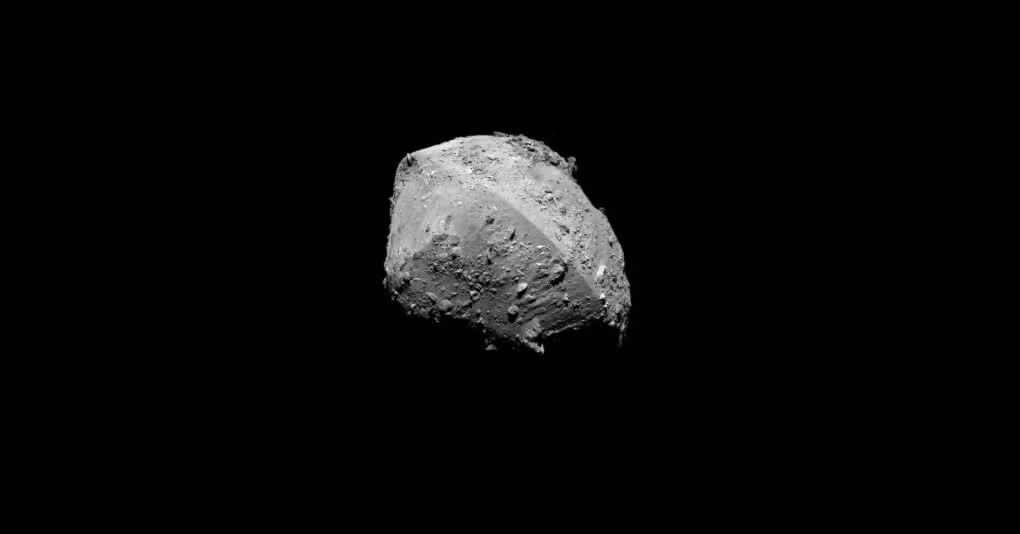
In a report for Ars Technica, Stephen Clark writes that Europe's Hera spacecraft has reached the Didymos asteroids and returned its first views of the scene of NASA's DART experiment, which slammed into the moonlet Dimorphos in 2022 and shortened its 12-hour orbit by about 33 minutes. Hera's images show DART left a crater the size of a stadium, nearly as big as the asteroid itself, and principal investigator Patrick Michel says the impact both carved a crater and reshaped Dimorphos, a transition scientists cannot yet explain. Hera also found hundreds of boulders around the asteroids, ranging from football to washing machine size, which scientists think may be debris thrown off by the impact or relics of Dimorphos's ancient formation, though they need more data to say. According to ESA's plan, Hera will fly closer over six months and release two CubeSats to attempt landings on Dimorphos, with its data meant to help scientists learn how to deflect an asteroid that actually threatens Earth.
Hera's Images of Smashed Asteroid Moon Dimorphos, Unveiled
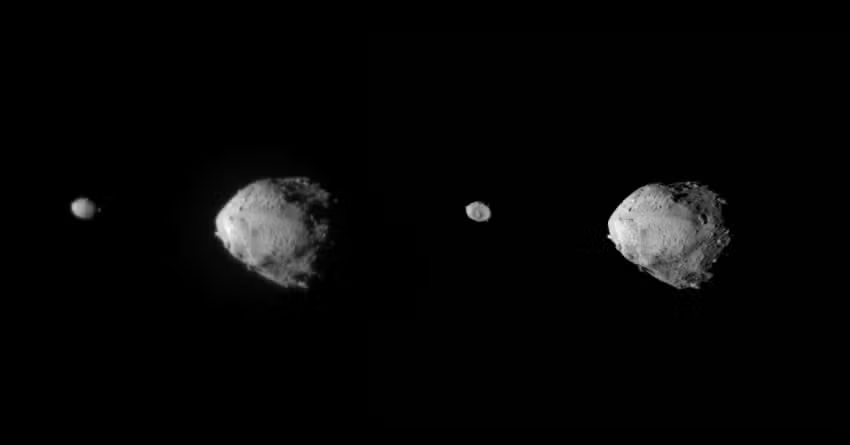
A Sky & Telescope article by Emily Lakdawalla reports that ESA's Hera mission unveiled images on November 25, 2026 showing NASA's DART impact transformed the asteroid moon Dimorphos far more than anyone had expected. The once rounded face of Dimorphos was flattened into a wide crater almost as large as the body itself, and its rotation is no longer synchronized with its orbit, so it now tumbles chaotically around the asteroid Didymos. Hera also discovered more than 100 football-sized to washing-machine-sized boulders orbiting the system, blasted off by the impact or possibly from Didymos, which scientist Heli Greus called a big shock and a danger to Hera and its CubeSats, whose planned trajectories pass through the boulder rings. The mission is orbiting about 30 kilometers from the system, hopes to reach one meter per pixel resolution, and its CubeSat trajectories can be adjusted as it learns more.
New photos reveal stadium-sized crater in asteroid knocked off course by NASA
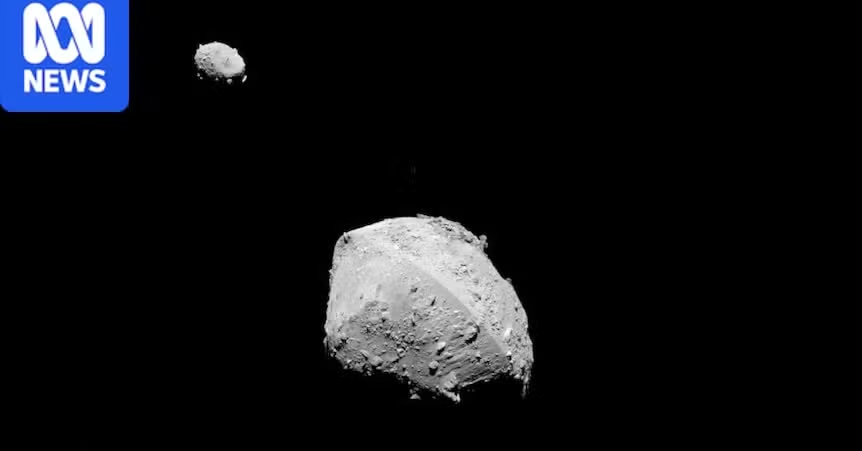
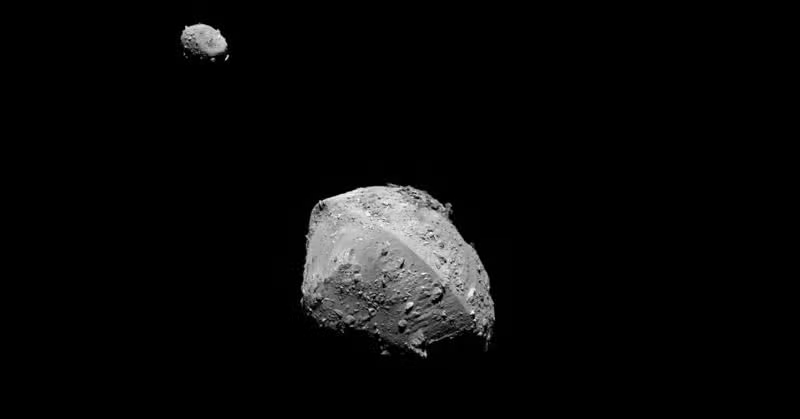
New photos from the European Space Agency's Hera spacecraft show that NASA's 2022 DART mission, a proof-of-principle test of knocking an asteroid off its course, left the asteroid Dimorphos with a stadium-sized crater covering nearly its whole struck side. The oblong asteroid, about 151 metres wide and orbiting its companion Didymos, also remains tumbling in a chaotic way, with hundreds of boulders floating around the pair, though ESA sees no evidence of major changes on the side opposite the impact. Hera mission scientist Michael Küppers calls the combination of the crater and the untouched far side surprising, noting it was known that DART succeeded in changing Dimorphos's orbit but not what happened to the asteroid itself. Hera, now observing from about 25 to 30 km, is to close to within 13 km for higher-resolution images and in January will deploy two CubeSats to study the asteroids' interior structure, work Küppers says is needed to apply the kinetic impactor technique should an asteroid ever be found on a collision course with Earth.
New images reveal crater on asteroid struck by DART spacecraft
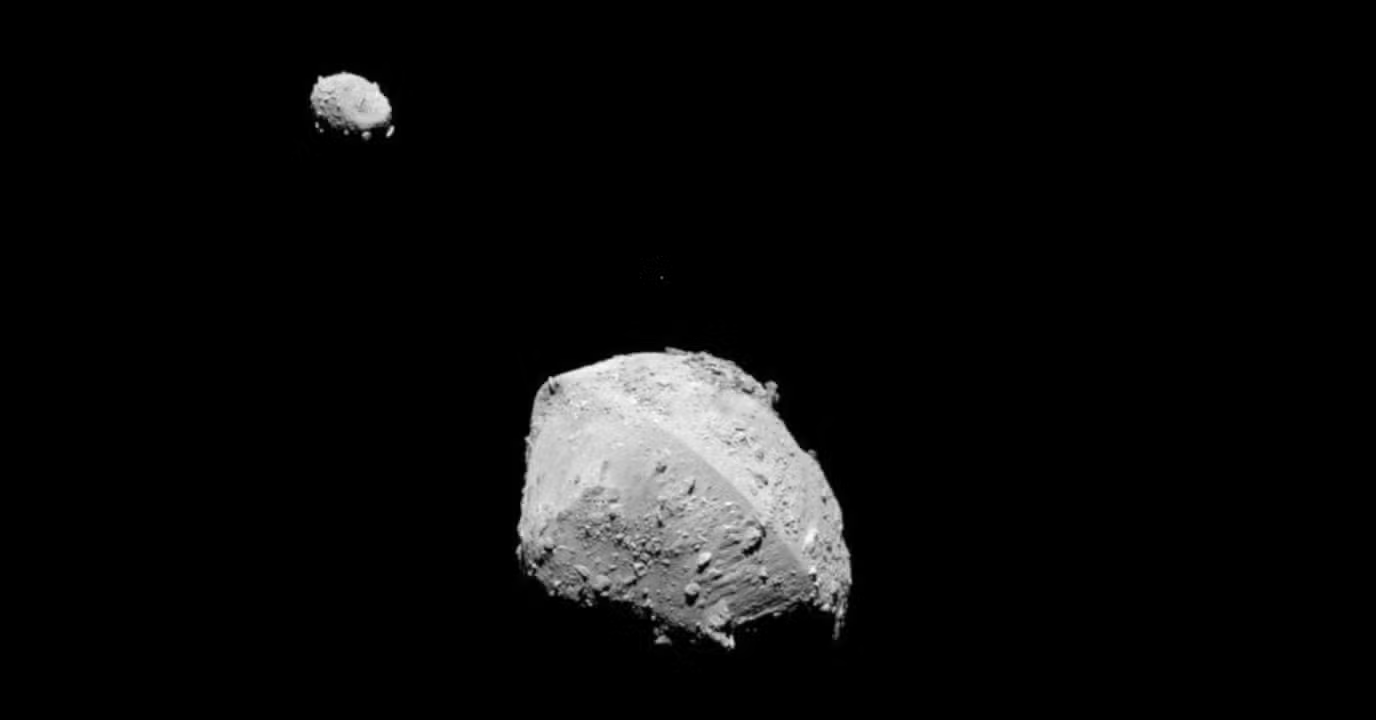
Reuters reports on new images from the European Space Agency's Hera spacecraft showing that Dimorphos, the small asteroid struck by NASA's DART spacecraft in 2022, is left with one side flattened by a stadium-sized crater and tumbling in space. The images, photographed on November 7, 2026, from 29 km away, show the crater covering nearly the whole front side of the oblong, 495-foot-wide asteroid as it orbits its companion asteroid Didymos. Hera mission scientist Michael Kueppers says the impact side is completely covered by a crater, with the visual impression that a piece of the asteroid was cut off, and calls it surprising that the opposite side shows no evidence of major changes. DART was a proof-of-principle test showing a spacecraft could alter the trajectory of an object headed toward Earth, and Kueppers says studying what the impact did to Dimorphos is needed to apply the technique to a real threat. Hera is due to come within 8 miles of the asteroids in the coming month and in January will deploy two CubeSats to study the asteroids' interior structure.
ESA mission reveals stadium-size crater left by first planetary defense test | CNN
ESA's Hera spacecraft has reached the asteroid Dimorphos, and its first released images show a stadium-size crater that flattened one of the asteroid's previously rounded faces, left by NASA's 2022 DART impact, humanity's first planetary defense test, in which a spacecraft hit the space rock at 13,645 miles per hour to test whether an asteroid could be deflected. Hera's early observations also revealed a surprise: hundreds of previously unknown boulders encircle the asteroid pair, and scientists cannot yet say whether they are debris from the DART impact or came from the larger asteroid Didymos, which Dimorphos orbits. Mission team members said the impact sent Dimorphos into a chaotic tumble, and Hera's December close approach, plus CubeSats due to land on the asteroid, should measure its mass and show exactly how well DART worked, refining models for deflecting asteroids that could one day threaten Earth.
Spacecraft crash left asteroid tumbling in orbit with huge crater on one side
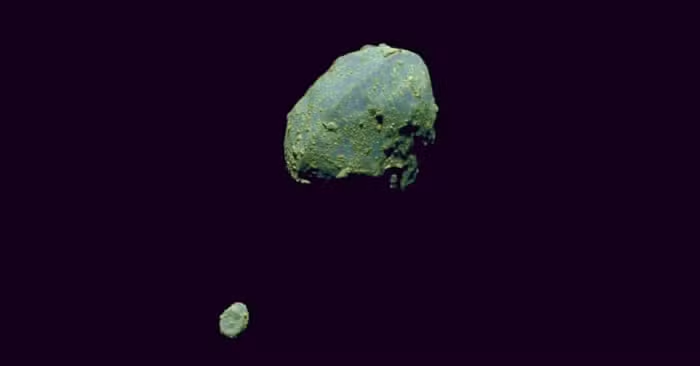
A Financial Times article reports that a spacecraft crash left an asteroid tumbling in orbit, with a huge crater on one side of it.
Hera spacecraft investigates damage at asteroid "crash scene"
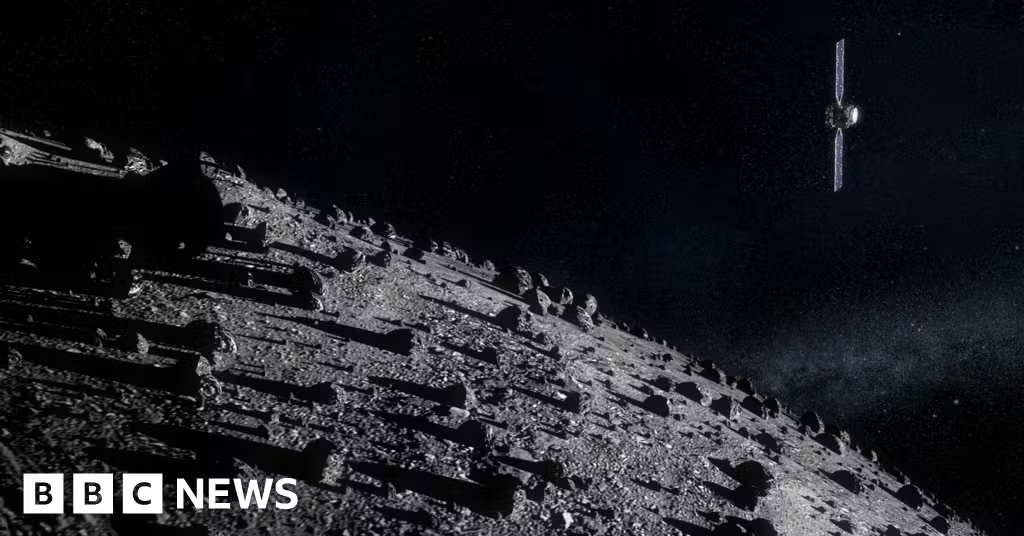
ESA's Hera spacecraft has arrived at the asteroid Dimorphos to investigate the damage left when Nasa's Dart spacecraft deliberately smashed into it in 2022, the first ever test of planetary defences. Dart was obliterated on impact, but the crash changed Dimorphos's orbit around its larger companion Didymos by about 33 minutes, showing an asteroid's path could be altered. Hera, carrying instruments and two shoe-box-sized satellites, will spend the next year scouring the crash scene, and a key task is measuring Dimorphos's mass to work out how effective Dart's shove was. Mission principal investigator Patrick Michel says Hera is like Inspector Columbo going back to the crash scene, and that the impact may have left a crater or entirely reshaped the asteroid.

