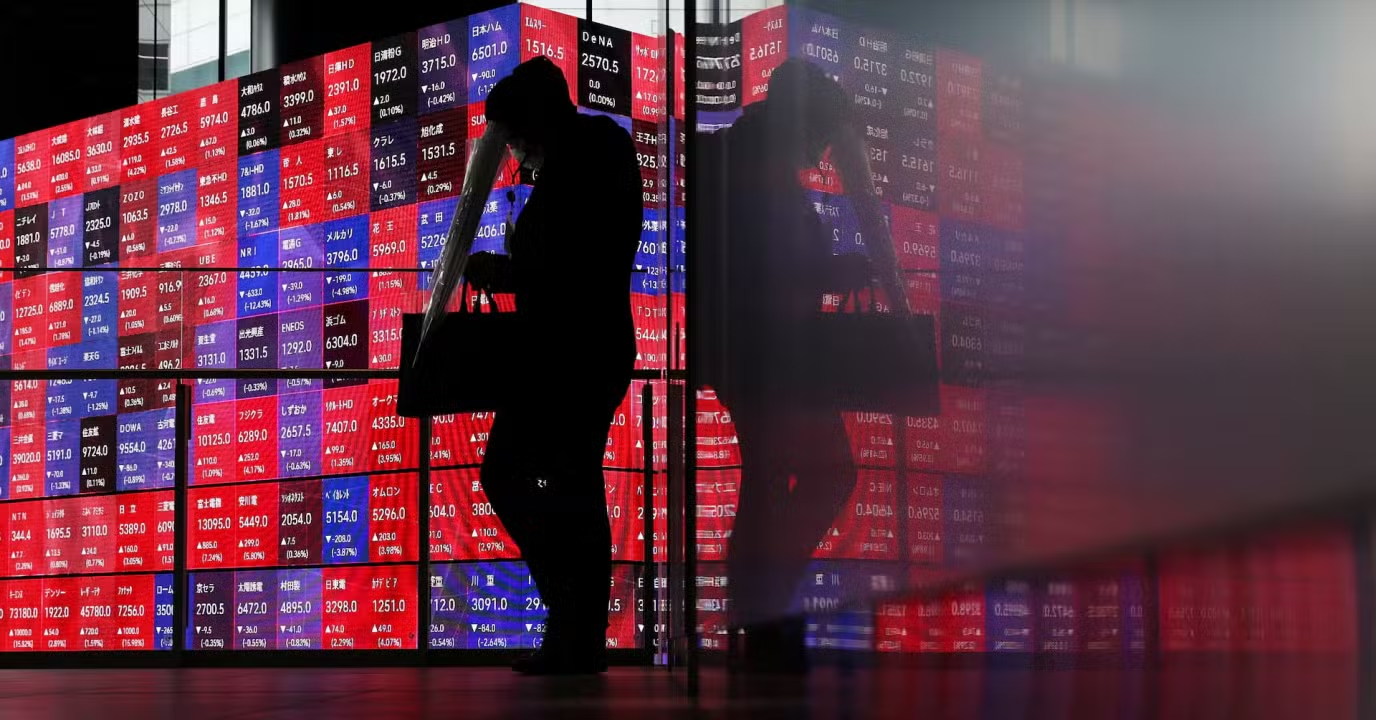
Global stocks rebound after S&P 500 correction as dollar heads for third monthly gain
Shares bounce after bruising month, dollar on course for third monthly gain
reuters.com· 17h
Trump says Wednesday's market had him briefly 'concerned' before stocks recovered
What to watch for as volatility in markets spikes
semafor.com· 30h
Global markets rebound as tech shares recover and tariff fears ease
euronews.com· 38h
Nasdaq 100 Enters Bear Market Territory as AI Angst Fuels Losses
bloomberg.com· 2d
Is your superannuation protected from a Wall Street crash?
abc.net.au· 2d
How major US stock indexes fared Tuesday 11/24/2026
apnews.com· 2d
Morgan Stanley says this is a big buying opportunity: ‘We’re not going to miss it’
cnbc.com· 4d
Wild stock market swings: will I lose money, and is there anything I can do?
theguardian.com· 4d
The stock market faces a worrying scenario: a sell-off with no flight to safety | Fortune
fortune.com· 4d
Citi’s Jane Fraser on the reset for an AI market ‘priced to perfection’
The Stock Market Just Had Its Worst Week in 19 Months. A Sell-Off This Bad Usually Gets Worse, and Here's What Happened to $500,000 After the 8 Weeks That Were Worse
247wallst.com· 4d
Jim Cramer Warns the Market Is "Destroying Savings for the Many"
His 401(k) Hit $900,000 Before the Market Crash, Enough to Retire at 64. A 19.8% Slide in His Nasdaq 100 Fund Erased $178,200 Weeks Before His Last Day
US Stock Futures Rally After AI Rout, Havens Fall: Markets Wrap
Charlie Bilello Flags the Nasdaq 100's First Bear Market Since April 2025
Dip Buyers Hesitate to Step In as Nasdaq 100 Nears a Bear Market
Live: Wall Street crashes to correction territory and ASX set to fall
Goldman Traders See Entry Point in US Stocks But Warn of Risks
Strong Earnings Prove No Match for the Crumbling AI Trade
Correction or deeper reckoning? Investors seek signs US stock selling will abate
The Nasdaq Just Hit a 7-Month Low. Here's What $500,000 in JEPQ, JEPI, SCHD and the Dividend Aristocrats Lost in the Selloff, and the One That Made Money
Stock market correction? Whatever — Wall Street is bullish on 2027, and one chief investment officer sees the S&P 500 soaring 45% to 10,000 | Fortune
Why is the stock market falling — and what happens next?
thetimes.com· 5d
The Nasdaq-100 Is Now Just 49 Points From a Bear Market
The S&P 500 Just Plunged 9% in a Week. Charlie Munger Once Lost 53% in Two Years. Here's His Test for a 66-Year-Old With $2 Million
A 10% drop for the stock market is unnerving, but it's not that unusual
The AI boom had a really bad week — and it's raising loud alarms
npr.org· 6d
S&P 500 correction: Five forces behind the market sell-off
Stocks enter correction territory, driven by a deepening tech rout
cbsnews.com· 6d
U.S. stocks slump into correction territory amid tech and AI worries
washingtonpost.com· 6d
Nasdaq wipes out 2026 gains, S&P 500 fall into correction territory | CBC News
cbc.ca· 7d
US stocks just had their worst week since the April 2025 global sell-off over President Donald Trump's tariffs, as investors grew skittish about AI and technology companies. The S&P 500 fell 9% in the week ending November 21, into its first correction since March 2025, and the Nasdaq 100 entered bear market territory for the first time since April 2025.
Chipmakers led the slide on concerns about slowing data center construction and tighter US chip export policy, with Nvidia ending the week down 23% after a report said its accounting is the focus of a Securities and Exchange Commission probe. Newly public Anthropic, which had run from its $83 IPO price to a peak above $115, fell back below its IPO price on November 24.
Investors said the start of Federal Reserve rate hikes had triggered anxiety about risk assets, as the usual flight to safety into bonds failed to materialize. Some analysts welcomed the decline for taking froth off markets that might otherwise look overheated.
Buyers returned the following week: on November 24 the S&P 500 fell as much as 3.2% before recovering almost all its losses, and most stocks outside tech climbed. Asian stocks rebounded on November 26 as tech trading stabilized, with Japan's Kioxia and SoftBank surging by double figures, and Asian shares steadied again on Friday, November 27, with Nasdaq futures up 2.4% and the Nikkei up 2.1%. The dollar was headed for its third monthly gain, up 1.7% against major peers at 103.8 on rate-hike expectations and safe-haven flows, and futures implied a 99% chance the Federal Reserve will raise rates by 25 basis points in December.
US stocks posted their worst week since the April 2025 global sell-off over President Donald Trump's 'Liberation Day' tariffs, as investors grew skittish about AI and technology companies.
The S&P 500 fell 3.7% and the Dow Jones Industrial Average 1.9% on Friday, November 20, 2026, dropping both indexes more than 10% from their highs into correction territory.
The Nasdaq Composite fell 5.3%, or 1,261 points, to 22,618, its second-worst day of 2026, erasing all its gains for the year.
The S&P 500's seventh consecutive daily loss was its longest losing streak since February 2020.
Chipmakers Advanced Micro Devices and Broadcom led the losses on concerns about slowing data center construction and tighter US chip export policy.
Anthropic's stock fell 9.3% to $88.14 the day after its IPO-week peak, though it stayed above its $83 IPO price.
Nvidia fell 13% in late Friday trading, its ninth down day in 10, leaving it down more than 25% since the sudden downfall of co-founder and former CEO Jensen Huang earlier in November.
Chris Larkin of E*TRADE said the selling was largely confined to AI-related companies and that US economic and business fundamentals remain solid.
Chris Larkin said history shows most such corrections do not turn into bear markets, with only five of the past 15 since 1983 having done so.
Baird strategist Michael Antonelli said the notion that AI can spend unlimited money and support the stock market is ending, but he does not think the bull market that began in October 2022 is over.
The Nasdaq-100 entered bear market territory on an intraday basis on Friday, November 20, 2026.
The Nasdaq posted its worst week since the Covid plunge of March 2020, down 10%.
Anthropic traded from its $83 IPO price to a high above $115 on Thursday before rolling over, and closed the week at $88.91.
Nvidia fell 14% on Friday, ending the week down 23% and nearly 40% for November, after a report said its accounting is the focus of a Securities and Exchange Commission probe.
The S&P 500 broke below its 200-day moving average during the week, a break that turned many on Wall Street into automatic sellers.
Wharton professor Jeremy Siegel said hardly anyone saw the sell-off coming, calling the accumulating market events straws that break the camel's back.
Jeremy Siegel said many trend riders perpetuate the decline by selling as soon as the market goes down.
Jeremy Siegel said people had begun to think 15% to 20% growth would be the norm with AI and that expectations have to be brought down to reality.
Jeremy Siegel said the economy remains in good enough shape for this to be a run-of-the-mill correction, and advised investors to stay with their stocks.
Karan Ramchandani of Post Oak Group said Jensen Huang's departure may have been the catalyst for the sell-off, but the underlying concerns in the technology sector had been building for some time.
Karan Ramchandani said the sell-off is more a reevaluation of the AI sector than a bursting bubble, with investors likely to become far more selective about which companies deliver.
David Trainer of New Constructs said the AI bubble is popping and has much further to go, calling it the early innings of a reckoning with over-investment in AI.
Dan Ives of Yorkville Ives & Co. likened the downturn to the March 2020 and April 2025 corrections, calling the selling panic-driven rather than a red flag moment for tech.
Mark Hackett of Nationwide said a washout led by AI stocks could ultimately prove constructive and serve as the reset needed for a more sustainable rally into year-end.
The S&P 500 fell 9% in the week ending November 21, 2026, its worst week since April 2025, closing 11% below its October 6 record.
The Nasdaq-100 ended that week almost 20% below its record high.
Some analysts welcomed the market decline for taking froth off markets that might otherwise start looking overheated.
Viktor Shvets of Macquarie Capital wrote in a November 20 note that while stampedes can be informative, the day's panic does not feel like an AI bust.
Jamie Cox of Harris Financial Group predicted investors will 'return to rationality' and look instead to consumption-boosting GDP.
Gaurav Mallik of Modera Wealth Management called the slide a 'garden variety correction' with leadership rotating from tech to industrials and financials, and expects a high-single-digit year for stocks in 2027.
Michael Monaghan of Founder ETFs quipped that the market is 'selling first and asking questions later'.
The Nasdaq Composite closed at a seven-month low on November 18, 2026, and the slide kept going.
The Invesco QQQ Trust fell 5.67% on November 20, bringing its decline since October 21 to 16.1%.
The Nasdaq 100 dropped to a 7.25-month low on November 20 in a drop attributed to a liquidation of the artificial intelligence trade, while defensive food stocks gained.
The S&P 500 fell for a seventh straight session on November 20, leaving it down 11.6% from its October 6 all-time high, its first correction since March 2025 and its biggest weekly drop in over a year.
Investors said the start of Federal Reserve interest rate hikes has triggered anxiety about risk assets.
The Cboe volatility index closed at 35.89 on November 20, its highest level since the April 2025 tariff tumult.
Investors said some indicators were close to signaling a market bottom, but stayed wary of calling an end to the declines after the furious selling.
Attention turned to the Federal Reserve's December 8-9 meeting, where markets widely project another quarter-point rate hike, and to Micron Technology's December 17 results as a read on AI investment.
Angelo Kourkafas of Edward Jones said sentiment is very fragile, though the drawdown is becoming big enough to attract some buyers, and he wants to see strength in banks and industrials as a sign of stabilization.
Angelo Kourkafas noted that when the volatility index closes above 30 for the first time in a cycle, the S&P 500 has posted an average total return of 8.1% six months later.
Mark Hackett said the selloff has reset valuations and weakened sentiment to levels that historically have often been signals to buy, but emotional investors can overwhelm opportunistic ones in the short term.
Michael Arone of State Street said he is watching declines from 52-week highs and stock correlations, which are nearing but not at oversold extremes, and that investors fear the Fed is tightening into a slowdown with earnings and AI investment peaking.
Bruce Zaro of Granite Wealth Management said one indicator is signaling a market bottom, a second is close, and the market is getting close to a great dip-buying point.
Michael Reynolds of Glenmede said the volatility index is nearing the 40 level that could indicate peak fear, with fear detached from strong earnings fundamentals.
Tim Ghriskey of Ingalls & Snyder said many valuations are still excessive, the selloff seems like a real correction, and it has further to go.
S&P 500 companies had delivered a second consecutive quarter of profit growth above 30%, but the index slumped in November instead of rallying on the strong results.
Goldman Sachs' trading desk said the selloff has created an attractive opportunity to snap up US stocks.
Goldman Sachs cautioned that overall investor positioning remains elevated and signaled that the broader capitulation needed for a meaningful rally could be missing.
ASX futures pointed to losses of around 0.6% at the open, putting the Australian market on course for a seventh straight losing session, after key commodity prices fell across base and precious metals in a global flight from risk.
The Nasdaq 100 crossed into bear market territory on November 20 for the first time since April 2025, with the Invesco QQQ Trust trading as low as $606.23, 20.2% below its record close.
Charlie Bilello of Creative Planning said the S&P 500's forward price-to-earnings ratio had fallen to 17, its lowest in more than three years.
US equity-index futures rallied as buyers returned, with S&P 500 futures up 2.2% and Nasdaq 100 futures up 3.1%, while Treasury futures fell and the yen weakened as demand for haven assets ebbed.
European shares were set to open higher.
The VIX rose above 28 on November 19, up 52% in a week.
Jim Cramer said on his November 19 Mad Money broadcast that the market has slid into a bear market, saying, 'The market's destroying savings for the many faster than it's creating it for the few.'
Hyperscalers are working hard to keep AI borrowing off their balance sheets, and the bonds of weaker players like neoclouds have plummeted.
Citigroup CEO Jane Fraser said 'getting air out of the tires is not a bad thing', that she is not worried, and that selectivity will bring discipline to how capital is allocated.
Jane Fraser said the Nasdaq's correction does not yet feel fundamental and that the market had been priced to perfection.
Jane Fraser said the selloff week saw an inflation print come in a bit higher, tech outages, and the market absorbing a dramatic shift in US election results, and that the selling was largely hedge funds de-risking over technical things.
The Nasdaq Composite was down about 18% from its October highs as of November 23, with the S&P 500 down more than 11%.
The 10-year Treasury yield hovered near 5% on November 23 with mortgage rates above 7.3%, as the usual flight to safety into bonds failed to materialize.
Foreign purchases of US Treasuries fell 60% in the first eight months of 2026, with Japan cutting its buying by 99% and South Korea and Taiwan net sellers.
Bruce K. Lee of Keebeck Wealth Management said there should be a flight to safety and he does not see one, warning that high bond yields alongside falling equity prices create a problem.
Bruce K. Lee said of the trade war, 'I always say sell, don't yell,' and wondered whether the Fed has lost some of its tools.
Dan Coatsworth said global equity funds and S&P 500 tracker funds both have large exposure to the giants of tech and have fallen in recent days.
Morgan Stanley said the market is offering a big buying opportunity, saying 'We're not going to miss it'.
On November 24, 2026, the S&P 500 fell 0.5% to 7,201.09, its eighth loss in nine days, and the Nasdaq composite fell 1.5% to 23,733.54, while the Dow Jones Industrial Average rose 0.9% to 50,018.70.
Anthropic's stock dropped back below its IPO price on November 24.
Most stocks outside tech climbed on November 24, with the Russell 2000 up 0.6% to 2,684.94.
The Nasdaq 100 briefly entered bear market territory on November 24, plunging as much as 4.7% before finishing 0.6% lower.
The S&P 500 fell as much as 3.2% on November 24 before recovering almost all its losses to close 0.3% lower.
Asian stocks rebounded on Thursday, November 26, as tech trading stabilized and investors took a fresh round of proposed US tariffs in stride, with beaten-down tech firms in Seoul, Tokyo and Taipei leading gains.
Japanese chipmaker Kioxia and SoftBank surged by double figures, and South Korea's SK hynix and Samsung were also comfortably up.
The Nikkei 225, Kospi, Taiex and Hang Seng each climbed more than 1%, and markets in Sydney, Shanghai and Singapore also gained.
US markets finished well off their initial lows after an afternoon dip-buying rally heading into the Thanksgiving holiday on a slightly negative note.
Michael Boutros at Forex.com warned that buyers still need to demonstrate that renewed demand extends beyond short-lived relief rallies.
Michael Boutros said the focus heading into December is on whether semiconductor shares can regain traction and support a broader recovery, or whether the recent deterioration signals further downside.
The Nasdaq fell more than 4% in the first hours of trading on November 25 before recovering most of those losses to end the day down only slightly.
President Donald Trump said on November 26 that he was 'a little concerned' when he saw the big dips early in Wednesday's trading session, but noted stocks were up again by the end of the day.
Asian shares steadied on Friday, November 27, near the end of a bruising month, with Nasdaq futures up 2.4%, S&P 500 futures up 1.7% and European benchmark futures up 0.7%.
Japan's Nikkei jumped 2.1%, gaining 4% for the week after a 7.2% monthly loss, while MSCI's Asia-Pacific index outside Japan rose 1.7% and South Korea's benchmark surged 4%.
China's blue-chip share index gained 3.8% a day after hitting its lowest level since June 2025, and China's cabinet rolled out more support for capital markets.
The dollar was headed for its third monthly gain, up 1.7% against major peers at 103.8, supported by expectations of a Federal Reserve rate hike and safe-haven flows from the equities selloff.
Futures implied a 99% chance the Federal Reserve will raise rates by 25 basis points in December, while speculation of a half-point increase has faded.
AMP chief economist Shane Oliver cited the return of Jensen Huang to Nvidia, the resilient US economy, strong corporate profit growth, and December being a seasonally stronger period for shares.
Shane Oliver said it is quite possible the share rebound could go further, but the risk of a deeper share correction at some point in the next six months remains high.
Software stocks spared in tech rout as AI narrative shifts
ft.com· 38h
Bullish hopes spring as traders bet against a higher VIX: Options Action Live
Wall Street futures rebound after rough week for AI-linked shares
The S&P 500 Just Had Its Worst Week Since the April 2025 Tariff Crash

