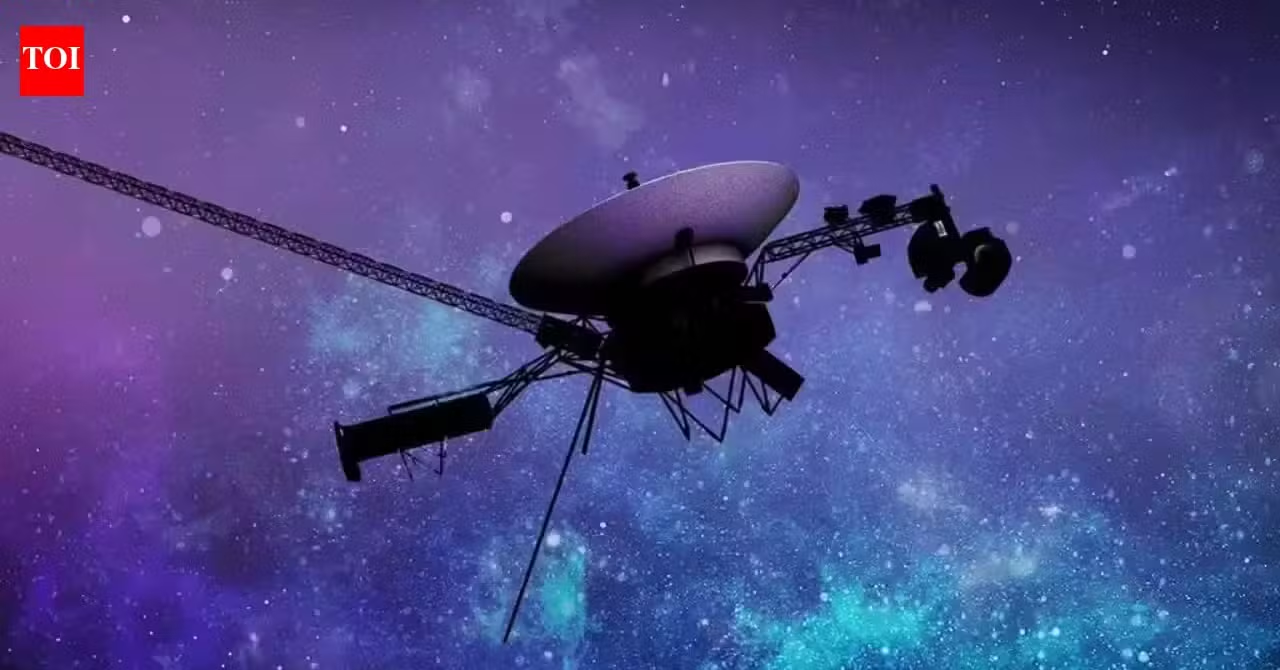
Voyager 1 confirmed one light-day from Earth as NASA probes stopped data flow
Hello, Earth! Nasa's Voyager 1 phones home from beyond 16 billion miles
indiatimes.com· 46h
NASA's Voyager 1 phones home from an awe-inspiring one light-day away
apnews.com· 2d
NASA’s Voyager 1 hits record one light-day distance, 50 years after launch
aljazeera.com· 3d
What we've learned from Voyager 1 as it reaches extraordinary milestone
pbs.org· 3d
Empire State Building Goes Gold for Voyager - NASA
nasa.gov· 3d
A milestone for NASA’s Voyager 1 probe: A distance of one ‘light-day’ from Earth
nbcnews.com· 3d
NASA's Voyager 1 is now a light-day away from Earth. What that means
usatoday.com· 3d
NASA’s Voyager 1 has reached 1 light-day from Earth, the first human-made object in space to reach that distance
theconversation.com· 3d
NASA’s Voyager 1 probe is now one light-day away
theverge.com· 3d
NASA's Voyager 1 space probe is now one light-day away from Earth - Engadget
engadget.com· 3d
Raumsonde »Voyager 1« ist jetzt einen Lichttag von der Erde entfernt: Historische Marke in der Raumfahrt
spiegel.de· 3d
Voyager 1 is now one light-day from Earth | CNN
cnn.com· 3d
Voyager 1 is the first human-made object to reach one light-day from Earth
washingtonpost.com· 3d
Humans Have Crossed a New Threshold in Space
theatlantic.com· 3d
探査機ボイジャー1号,地球から「1光日」に到達へ 人工物で最も遠い259億km
nikkei.com· 4d
NASA’s Voyager 1 Crosses Mind-Melting Milestone 49 Years After Launch
huffpost.com· 5d
The Golden Record: humanity’s most distant message is one light-day away
thetimes.com· 5d
NASA's Voyager 1, launched in 1977 and the farthest human-made object, crossed one light-day from Earth, about 16 billion miles, on 18 November 2026.
A confirming radio signal reached flight controllers at the Jet Propulsion Laboratory on 19 November 2026, a full day after it was sent.
No other human-made object has reached the distance, and radio signals now take 24 hours to travel between Earth and the probe.
NASA celebrated the milestone, and the Empire State Building was lit in gold after the gold-plated records the Voyager spacecraft carry.
As of 19 November, NASA had received no science or engineering data from Voyager 1 since the prior Saturday and was investigating why the flow stopped.
Voyager 1's twin, Voyager 2, is expected to reach one light-day from Earth in 2035.
Ann Druyan, creative director of the Golden Record project, said she thinks there is no greater metric for the vastness of the universe than a spacecraft travelling at about 40,000 miles per hour for almost 50 years and still being a single light-day away.
NASA flight controllers received a signal from Voyager 1 on 19 November 2026, exactly 24 hours after it was sent, confirming the probe had crossed one light-day from Earth.
It was reported on 17 November 2026 that Voyager 1 would reach one light-day from Earth, about 25.92 billion kilometres, at around 7:16 p.m. Japan time on the 18th.
Participants in a celebration of Voyager's Light Day at Caltech in Pasadena, California shone lights toward the probe on 17 November 2026.
Voyager mission manager Kareem Badaruddin said "It's never happened before, and it may never happen again" and called the milestone "that kind of extraordinary".
Voyager 1 was 16.094 billion miles from Earth, so radio signals between the probe and Earth now take a full day to arrive.
Science educator Bill Nye of the Planetary Society said the Voyager missions "changed the way all of us feel about outer space and our home world."
In a Facebook post, astrophysicist Neil deGrasse Tyson cautioned that the nearest stars to the sun are light-years away.
NASA calculated that Voyager 1 crossed the threshold at 5:16 a.m. ET on 18 November 2026, one light-day being the roughly 16 billion miles light travels in 24 hours.
Voyager project manager Suzanne Dodd called reaching one light-day "an astounding feat, one that I never expected to see."
The Empire State Building was illuminated in gold on 17 November 2026 to celebrate Voyager 1, the gold echoing the gold-plated copper phonograph records the Voyager spacecraft carry.
Voyager 1 reached one light-day from Earth on 18 November 2026, about 26 billion kilometres away, nearly 50 years after its launch.
NASA scientist Tiffany Kataria called the one-light-day milestone the best illustration of just how vast space is.
The team at NASA's Jet Propulsion Laboratory in California confirmed the light-day milestone using Voyager 1's carrier signal, which kept coming, along with flight path calculations.
NASA reported no science or engineering data from Voyager 1 since the Saturday before 19 November 2026 and was working to determine why the flow stopped.
NASA wished everyone a "Happy Voyager light-day … day!" on social media the day before the milestone was confirmed.
NASA's heliophysics division director Joe Westlake said traveling a light-day is a singular feat for a spacecraft, but Voyager is so much more than a distant traveler.
Jet Propulsion Laboratory director Dave Gallagher said Voyager 1 crossing the light-day threshold is yet another historic feat on an extraordinary voyage of discovery.

