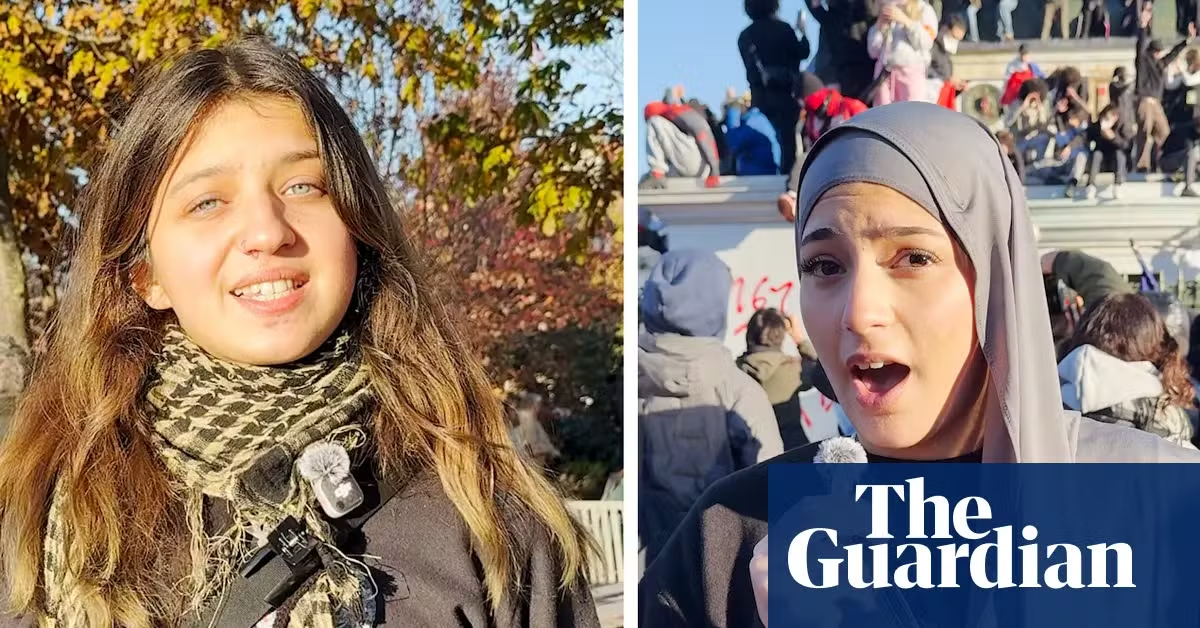
Nearly 10,000 women report miscarriages and bleeding after French police teargas
Thousands of girls and women report bleeding and miscarriages after French police use of teargas
theguardian.com· 5h
«Une mare de sang le long de mon corps»: la létalité des grenades de la police française en question
rfi.fr· 14h
A Paris, des lycéens et étudiants toujours mobilisés qui récusent tout « retour à la normale »
lemonde.fr· 15h
« A l’hôpital, ils ne savaient pas si je passerais la nuit » : les grenades assourdissantes blessent toujours plus gravement les manifestants
17 octobre : le préfet de police défend son dispositif et met en cause des batteries de vélo
mediapart.fr· 38h
On the streets with the French Black Block ultra left protesters
bbc.com· 4d
Manifestations du 17 novembre : entre 146 000, selon le gouvernement, et 500 000 personnes, selon la CGT, ont défilé en France ; revivez la journée de mobilisation
Public agents, private sector employees, high school students and university students demonstrated across France on 17 November for wage increases and against the cost of living. The CGT put participation at more than 500,000 while the interior ministry counted 146,000, and police dispersed unauthorized gatherings in Paris and Marseille.
The movement marked its sixth consecutive weekend of demonstrations against soaring prices, worsening public services and alleged police brutality. More than 1,000 police officers were injured in the unrest.
In Lyon, Jonathan C., 43, was struck in the chest on 24 October by the metal time-delay element of a GM2L stun grenade, which French police use during demonstrations; it lodged two centimeters from his heart before a surgeon extracted it. Dozens of similar injuries have been recorded since the student movement began, and Jonathan filed a complaint with the police watchdog IGPN seeking a ban on the grenades.
French police fired about 22,000 teargas grenades at protesters on 17 October, two every three seconds over more than 10 hours of maintaining order. The feminist collective Lacrymos de Sang has gathered testimonies from more than 9,200 women and girls exposed to teargas during the protests, and 94% reported gynaecological symptoms ranging from severe uterine cramps and unusually heavy bleeding to missed periods. Of 47 pregnant respondents, 15 reported losing their pregnancies, two said they were hospitalised with anaemia after heavy blood loss, and women and girls under 20 appeared particularly affected.
Public agents, private sector employees, high school students and university students demonstrated across France on 17 November 2026 at the call of the public service inter-union, for wage increases and against the cost of living.
The CGT put participation in the 17 November demonstrations at more than 500,000 people, while the interior ministry counted 146,000 and the Paris police prefecture counted 28,000 in Paris.
Police dispersed an unauthorized gathering near the Opéra Bastille and in the Bastille metro station in Paris on the evening of 17 November.
In Marseille, police dispersed a gathering of about 200 high school students and education staff outside the departmental education services, where disciplinary councils for students who took part in blockades were to be held.
Gendarmerie forces blocked the high school and student cortege at the head of the Marseille demonstration when it tried to leave the official route.
About thirty high schools in the Île-de-France region were disrupted on 17 November, a dozen came under firework mortar fire, four had to close, and three students were slightly injured.
Police dislodged blockades set up in about ten high schools in Toulouse on the morning and early afternoon of 17 November.
Some young demonstrators in Lille took tiles and bricks from a building site at the end of the route, though the demonstration ended calmly.
Partial estimates showed 2.59% of state public service agents answered the strike call on 17 November, down from nearly 10% on 5 November.
CGT Haute-Garonne general secretary Cédric Caubère said the Toulouse demonstration showed activists were still mobilized and that everything could go well despite the prefect's reluctance.
A high school student taking part in a Toulouse general assembly said students were fed up with police violence, would keep going, and would launch a new series of actions from 20 November.
A regular of the Lille gatherings forecast that the end of the demonstration was the moment when things could turn, and said union members should stay to calm things down if needed.
Mass social unrest broke out in France after student protests erupted into looting and violence, with protesters marking the sixth consecutive weekend of demonstrations against soaring prices, worsening public services and alleged police brutality.
More than 1,000 police officers were injured in the unrest, and young protesters suffered broken bones, with two protesters losing a hand in altercations with police armed with stun grenades.
The French Insurers Federation estimated damage to shops and private property on 17 October, the day of the biggest riots, at around 207 million euros.
French intelligence, which had drastically underestimated the outpouring of anger, put the number of ultra-left activists in France at 5,000.
Far-right vigilante groups began appearing on the edges of protests in several French cities, saying they aimed to protect French streets.
A man remained in police custody in connection with the fire that damaged Limoges Town Hall, a 19th century building, during the protests.
President Emmanuel Macron publicly blamed the riots on delinquents and ultra-left groups whose aim, he said, was to bring down the French Republic.
A friend of an 18-year-old masked protester who gave the name Nas said that without violence you do not achieve anything, and Nas and his friends insisted they were not politicised or organised by the radical left.
Two masked hard-left student activists downplayed the rioting, said violence reflects badly on their movements, and said the real violence in present-day France is state violence.
Starflix, a 17-year-old Black Block member who gave only a codename, said the Black Block is not a single organisation but a technique, and that some members want government reform while he wants a revolution.
A seasoned Black Block activist said people turn up to a protest, dress in black and do their own thing, that the uniting factor is rage, and he denied that Jean-Luc Mélenchon and France Unbowed were linked to the violence.
An anonymous 39-year-old full-time ultra-left activist said it was their duty to take action, asked whether a policeman must be killed for the state to listen, and said he would take a bullet to protect the youth of France.
Jean-Luc Mélenchon denied any links with the violence.
Michel Klein said there is a will from the radical left and the anarchists to destroy the Republic but that they do not have the means to do it.
The 34-year-old arson suspect in the Limoges Town Hall fire insisted he is innocent.
Paris police prefect Patrice Faure was questioned by the parliamentary inquiry commission on the events of 17 October.
Faure acknowledged that his services underestimated the scale of the 17 October mobilization but denied any lack of anticipation ahead of that day.
Faure revealed for the first time the number of munitions fired by police on 17 October.
A projectile struck Jonathan C., 43, in the chest in Lyon's Guillotière district at around 6 pm on 24 October, breaking two ribs and lodging two centimeters from his heart, and a surgeon extracted it the next day at the Edouard-Herriot hospital.
The same day, Stéphanie, 31, was struck by a similar object that lodged in her thigh as she left a group of protesters a few streets away.
Both victims were hit by metal fragments 2.5 centimeters long whose shape and size match a component of the GM2L stun grenade, used by French police since 2018, though the fragments could also come from the newer EF-SON grenade.
Dozens of similar injuries have been recorded since the start of the high school student movement and the national demonstrations that followed it.
Jonathan C. said of his hospital scan: 'At the scanner they first thought it was a 9 mm bullet; they were afraid it might move and did not know whether I would spend the night.'
Several thousand students and high school students gathered at the Place de la Bastille in Paris on 26 November, called by student organizations to show there was no return to normal in schools and universities.
The higher education ministry estimated that 16% of universities were disrupted on 26 November by blockades or an administrative closure, while the education ministry released no figure for blocked high schools.
The students' demands remained an end to selection, the repeal of Parcoursup and MonMaster, and the creation of 250,000 or even 300,000 university places.
Coppélia Moreau, spokeswoman of the Interfac Ile-de-France, said neither repression nor being thrown crumbs would stop the mobilization, and that the government was isolating itself and increasing the anger of students, parents, and the world of work.
The projectile extracted from Jonathan was the metal time-delay element of a GM2L grenade, a weapon French police use during demonstrations.
Jonathan filed a complaint with the police watchdog IGPN seeking a ban on the grenades, and an investigation is under way.
Jonathan was to testify about his experience before deputies of the National Assembly in the days following the report.
Jonathan's lawyer Pierre Brunisso said the grenades used by French police are not only mutilating but can also kill, and that Jonathan's case is the first evident demonstration of their lethality.
French police fired about 22,000 teargas grenades at protesters on 17 October, the equivalent of two grenades every three seconds over more than 10 hours of maintaining order.
The feminist collective Lacrymos de Sang gathered testimonies from more than 9,200 women and girls, including secondary school students, exposed to teargas during the protests, and 94% reported gynaecological symptoms ranging from severe uterine cramps and unusually heavy bleeding to missed periods.
Of 47 pregnant respondents exposed to teargas, 15 reported losing their pregnancies, 17 described contractions, pain, or bleeding, and two said they sought emergency gynaecological care.
Two respondents said they were hospitalised with anaemia after heavy blood loss, and some reported bleeding despite menopause, hormonal contraception, or testosterone treatment.
Women and girls under 20 appeared particularly affected, reporting more symptoms and a faster onset than older respondents.
Naïma Di Piero said she began bleeding heavily two days after being exposed to teargas on 17 October, suffered ten days of severe bleeding and debilitating cramps, and is losing her hair.
Louisa Martin said she and her three sisters all experienced unusually heavy menstrual bleeding after attending the 17 October protests and believe teargas caused it.
Dr Maha Eid, an obstetrician-gynaecologist at Paris's Port-Royal maternity hospital, said she saw patients with debilitating menstrual pain and endometriosis flare-ups on 20 October, and that the teargas agent can activate receptors found in the uterine lining, which could trigger uterine contractions and pose a risk in early pregnancy.
Solène Rougeux, a doctoral researcher who led the analysis of Lacrymos de Sang's data, said thousands of people describing the same symptoms at similar times after similar exposures cannot be ignored, and the state has massively dispersed teargas over crowds without evidence it is safe.
Eva-Luna Tholance, founder of Lacrymos de Sang, said it is not known what repeated exposure to teargas could mean for reproductive health in the long term.
Asha Hassan, who led a US study linking teargas exposure to menstrual disturbances, said it is the responsibility of governments to prove teargas is safe for children, and dismissed stress as a cause of the reported symptoms.
Interior minister Laurent Nuñez told a parliamentary hearing on 2 November that government studies from 2021 and 2022, which have not been made public, found no evidence of specific health risks from teargas exposure and that its use would not be suspended.
A French interior ministry spokesperson said possible effects of metabolites produced when the teargas agent breaks down in the body have been suggested but not scientifically demonstrated, and that stress itself is known to have disruptive effects.
Violences du 17 octobre à Marseille : des ordres donnés pour "relâcher" des casseurs, selon le maire
france24.com· 35h
Violences du 17 octobre à Marseille : des ordres ont été donnés pour relâcher des casseurs, selon Benoît Payan
Manifestation du 17 octobre : un adolescent blessé par balle place de la Nation, une enquête ouverte pour tentative de meurtre
‘They smile but do nothing’: Students on meeting Macron and other leaders
aljazeera.com· 3d

