Taiwan votes in local elections amid alleged Chinese interference
Taiwan votes in local elections to choose mayors, other leaders
aljazeera.com· 4h
Taiwan Goes to Polls in Tight Local Elections as China Watches
bloomberg.com· 6h
Taïwan: Chiang wan-an et Puma Shen au coude-à-coude pour la mairie de Taipei
rfi.fr· 9h
Elections locales à Taïwan, bataille serrée pour la mairie de Taipei
france24.com· 10h
Threat from China looms large over Taiwan’s local elections
theguardian.com· 29h
Taiwan voted on Saturday 28 November 2026 in local elections held every four years, choosing mayors, council members and other local leaders across 22 districts, with nearly 11,000 local officials at stake. Both big parties treat the vote as ground-gaining ahead of the presidential election.
The vote took place against intense military pressure from Beijing, and Taiwanese officials raised the alarm over thousands of suspected incidents of misinformation or election interference, including hundreds of China-linked AI-generated videos targeting politicians disliked by Beijing. Most races were a tight contest between the Democratic Progressive Party and the Kuomintang. The Democratic Progressive Party chose Puma Shen, a national legislator Beijing declared a 'diehard separatist' in 2024, as its Taipei mayoral challenger, the first candidate under Beijing sanctions to run for the capital's mayoralty. Polls gave him a slight lead after a rapid rise driven by social media and positioning on China, while in neighbouring New Taipei City the party's Su Chiao-hui proved a strong challenger to the incumbent Kuomintang.
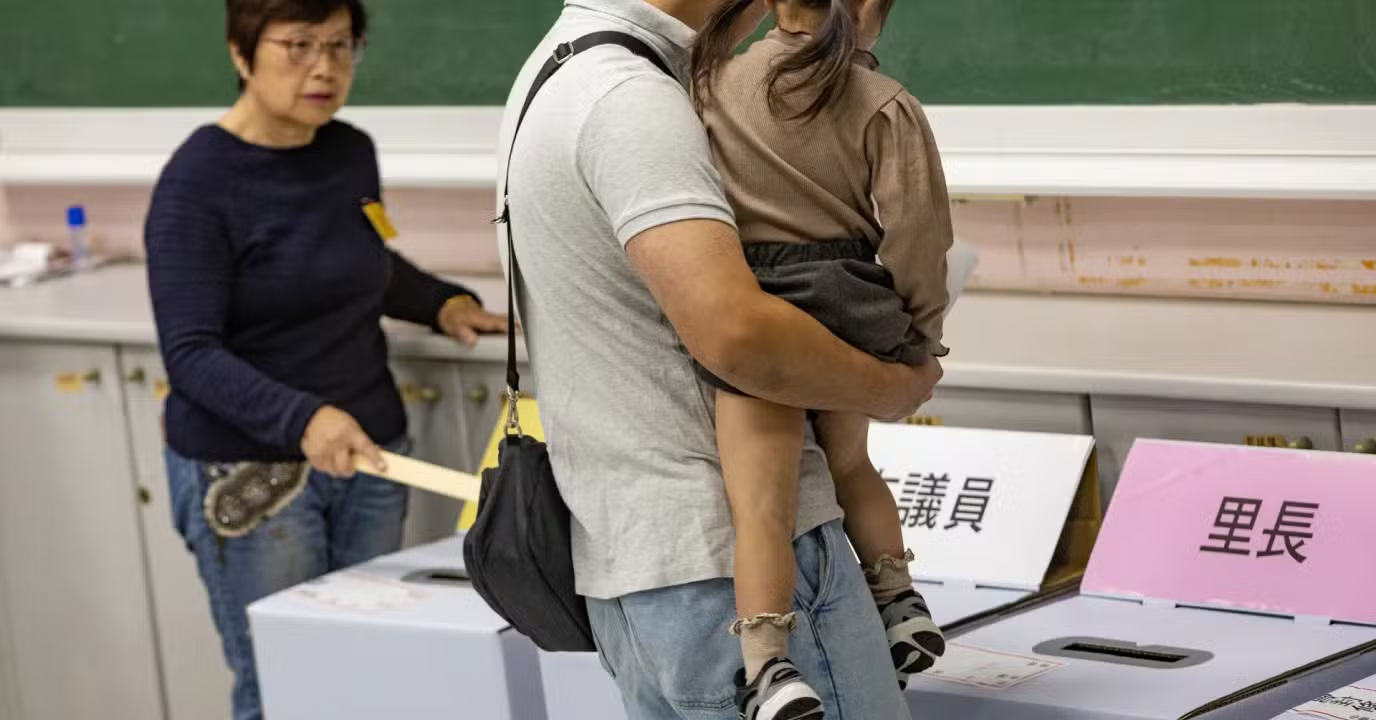
Polls opened at 8am and closed at 4pm on election day, with voters casting ballots at schools, temples and community centres in the nine-in-one elections. Shen cancelled his final rally over traffic concerns and held an online event instead, drawing more than 500,000 viewers on YouTube, while President William Lai Ching-te urged voters at a New Taipei City rally to back the Democratic Progressive Party's candidates there.
Taiwan holds local elections on Saturday 28 November 2026, choosing mayors, council members and other local leaders across 22 districts in a vote held every four years.
The vote takes place against a background of intense military pressure from Beijing, and Taiwanese officials have raised the alarm over thousands of incidents of suspected misinformation or election interference.
Hundreds of China-linked AI-generated videos have spread disinformation about Taiwanese politicians disliked by Beijing.
The Democratic Progressive Party selected Puma Shen, a national legislator Beijing declared a 'diehard separatist' in 2024, as its challenger for Taipei mayor, the first candidate under Beijing sanctions to run for the capital's mayoralty.
Most races are a tight competition between Democratic Progressive Party and Kuomintang candidates, with the Taipei mayoral contest among the most contentious votes.
The Democratic Progressive Party's Su Chiao-hui is proving a strong challenger to the incumbent Kuomintang in the neighbouring New Taipei City race.
Zhu Fenglian, a spokesperson for China's Taiwan affairs office, called the interference allegations completely fabricated and said they stir up anti-China sentiment to win votes.
Wei-Ting Yen, a political scientist at Academia Sinica, said the outcome will have huge implications for cross-strait relations, and that if the Kuomintang loses some of its traditional strongholds Beijing may need to reconsider what is the most effective strategy for influencing Taiwanese people.
Puma Shen said in an interview that even if he does not win, the Taipei mayoral race is 'a slap to China' because it proves 'democracy works here in Taiwan'.
Huang Bo-kai, a 23-year-old law student, said his top concern is cross-strait relations and how United States-China relations are evolving, adding that Taiwan could very well be the next target of China.
Lev Nachman, a political scientist at National Taiwan University, said the national leaders of both main parties have been notably absent from the mayoral races, reflecting how far the campaigns focus on local issues.
William Yang, a senior analyst at the International Crisis Group, said livelihood issues, including stagnant wages, high housing prices, affordability and a more even distribution of Taiwan's AI-fuelled economic boom, will really determine how Taiwanese voters vote.
It was forecast that the local elections would shape the fortunes of the ruling Democratic Progressive Party as it navigates an increasingly precarious set of relationships on the global stage.
Polls gave Puma Shen a slight lead in the Taipei mayoral race, which would have been unthinkable a few months earlier, after a rapid rise driven by social media and positioning on China.
Nearly 11,000 local officials are at stake in the 28 November 2026 vote, which the two big parties treat as ground-gaining ahead of the presidential election.
It was forecast that Taipei could this time be taken by the party that governs Taiwan.
Chiang Wan-an said he aims to consolidate Kuomintang power locally ahead of the 2028 presidential election.
Polls opened at 8am and closed at 4pm local time on Saturday 28 November 2026, with voters casting ballots at schools, temples and community centres in the nine-in-one elections.
Puma Shen cancelled his final rally over traffic concerns and held an online event instead, which drew more than 500,000 viewers on YouTube.
President William Lai Ching-te urged voters at a rally in neighbouring New Taipei City to back the Democratic Progressive Party's candidates there.
Chiang Wan-an told supporters the Taipei race was 'very close'.
Austin Wang, a political scientist at the University of Nevada, said Puma Shen's victory in the Kuomintang's heartland could be seen as 'quite shameful' in Beijing.
Taiwan's Mainland Affairs Council warned that Beijing is trying to influence the outcome of the local elections through 'cognitive warfare' and 'transnational repression'.
Results of the elections were expected early in the evening of 28 November 2026.

