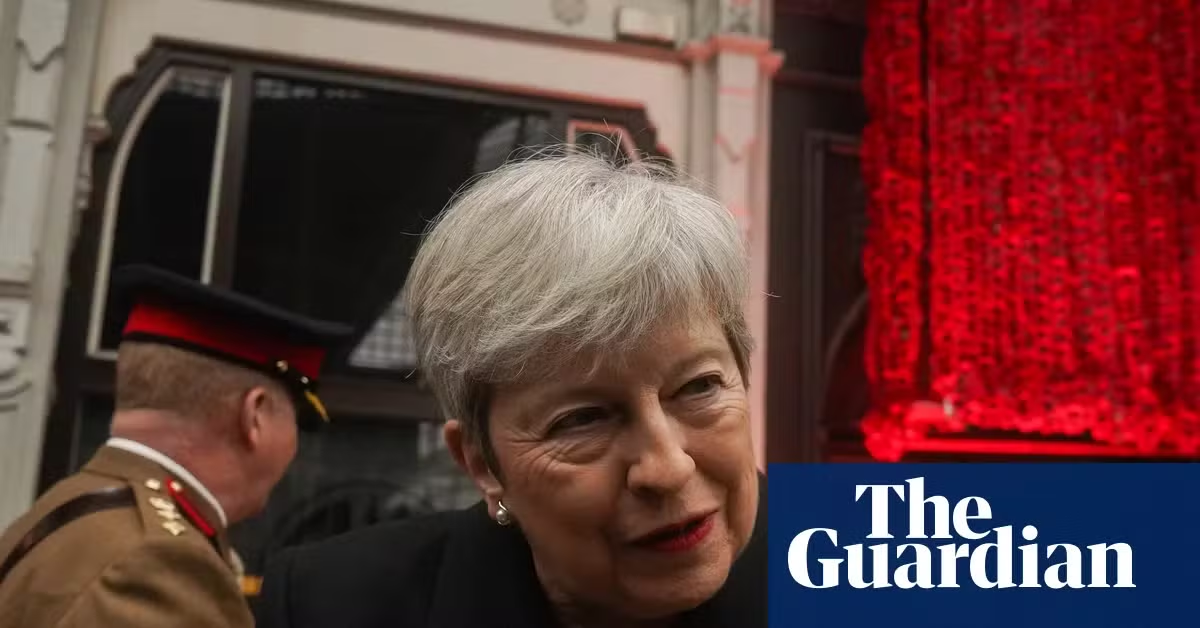
Theresa May tells Andy Burnham to accept Brexit and move on as EU debate returns
Theresa May ‘aghast’ at Andy Burnham’s talk about rejoining EU
theguardian.com· 4h
Theresa May fires Brexit warning at Andy Burnham as PM pledges closer EU ties
mirror.co.uk· 5h
Theresa May 'aghast' at Burnham's EU plans and says 'Brexit is done'
bbc.com· 7h
UK should only rejoin EU if it innovates on technology, Blair warns
Burnham ‘determined to take UK back into EU’ after landmark deal with Brussels
independent.co.uk· 26h
Kann Großbritanniens Premier Burnham sein Land wirklich in die EU zurückbringen?
spiegel.de· 31h
After Brexit, Britain’s Government Floats ‘Breturn’
wsj.com· 47h
Ed Davey on EU deal, free movement and why 'most Britons don't know who you are'
youtube.com· 2d
UK would be twice as rich inside EU than in Swiss-style deal, study finds
Live Q&A: Can Burnham Reset the UK’s Relationship with Europe?
bloomberg.com· 2d
Au Royaume-Uni, Andy Burnham ravive le débat sur le Brexit, plus de cinq ans après sa mise en œuvre effective
lemonde.fr· 2d
Could Britain rejoin the EU? There's growing speculation it may try to
abc.net.au· 2d
The Brexit debate is back - and there are nerves about what happens next
Burnham faces the hard reality of Brexit
ft.com· 3d
Andy Burnham gives perfect response to Boris Johnson weighing in on Brexit debate
thelondoneconomic.com· 4d
David Lammy urges Andy Burnham take UK back into the EU
David Lammy urges Andy Burnham to campaign on rejoining EU at next election
Lammy says Labour should fight election with rejoin EU vow and 'expose' Farage
David Lammy joins calls for UK to rejoin EU
thetimes.com· 4d
Andy Burnham delays taking stock of UK’s relationship with EU
Burnham says Brexit has dramatically diminished Britain’s global standing
UK seeks closer ties with EU after Brexit fail
aljazeera.com· 5d
Boris Johnson Warns Andy Burnham He 'Will Impale Himself and His Party' if He Prioritises Brexit
ibtimes.co.uk· 5d
Andy Burnham set to argue that Brexit has failed in key speech
Andy Burnham Says Brexit Hasn't Worked: UK Prime Minister Calls for a New Deal With Europe
blogspot.com· 6d
Andy Burnham to say Brexit ‘has not worked’ and he will sign new deal with EU
UK has lost more than it gained from Brexit, Burnham expected to say
Andy Burnham says UK has ‘lost more than we gained’ through Brexit
Andy Burnham hits back at David Cameron over criticism of his EU plans
David Cameron explains why Andy Burnham should forget about rejoining EU
He triggered Brexit. Now Lord Cameron warns Burnham against rejoining EU
Labour’s Brexit red lines ready for ‘dignified retirement’, says their co-author
Don’t do the Norway model, Norway tells Britain
politico.eu· 12d
Lisa Nandy wary of ‘circular arguments’ about rejoining EU
UK culture secretary Lisa Nandy questions whether rejoining EU is a ‘choice we have’
Andy Burnham wants to get closer to the EU - but he shouldn’t expect a smooth ride
UK cannot 'cherry pick' EU single market deal, says Barnier
Closer ties with EU would boost UK economic growth, Bank of England governor says
Rachel Reeves says Britain's future is a return to the EU
gbnews.com· 21d
'No confusion at all' on Government's stance on Brexit, Burnham insists at PMQs | LBC
lbc.co.uk· 25d
Prime Minister Andy Burnham was accused at Prime Minister's Questions on 28 October of confusion over whether he wants a referendum on rejoining the European Union. He denied it, saying Labour's red lines would hold for this Parliament. Former chancellor Rachel Reeves said Brexit left Britain 'poorer, weaker and less secure' and backed rejoining, and the EU's former chief Brexit negotiator Michel Barnier ruled out any 'single market à la carte'. Burnham suggested returning to the bloc is his long-term ambition.
Cabinet ministers privately warned the row would only help Nigel Farage's Reform UK, and former prime ministers David Cameron and Theresa May cautioned against reopening the Brexit debate, May telling Burnham to accept it and move on. Burnham rejected that. At the Lord Mayor's Banquet on 17 November he compared Brexit to 'The Emperor's New Clothes', citing damage of 4 to 8 per cent of GDP. He then delayed a planned statement on closer ties, saying there was 'no rush'.
A YouGov poll found 53 per cent support rejoining, and a study projected rejoining would add £112 billion a year. At a Brussels summit on 21 November the UK and EU agreed a package: a youth scheme for 18 to 31 year olds, an end to most food checks from March 2028, and exemption of £6.5 billion from EU carbon taxes. Talks stalled over EU students' tuition fees.
At the summit he said he wanted to 'brainstorm' options for the future relationship but did not indicate he would discuss rejoining.
Kemi Badenoch accused Prime Minister Andy Burnham of creating confusion over his position on rejoining the European Union at Prime Minister's Questions and asked directly whether he wanted a referendum on rejoining.
Burnham said there is 'no confusion at all' over his position on rejoining the EU and that the Government has a collectively agreed position, which he set out that day.
Burnham said Labour's manifesto red lines, including on freedom of movement, will stay firmly in place for the whole of this Parliament.
Burnham said the Government is not proposing any changes in this Parliament and will lead a discussion about making the UK's arrangement with the EU better in a way people can support.
Burnham called the deal negotiated by the Conservatives 'bad for growth and bad for control of immigration' and said he would not defend it.
Former chancellor Rachel Reeves set out an argument for a closer relationship with, and ultimately reunification with, the European Union.
Reeves said Brexit has made Britain 'poorer, weaker and less secure' and insisted she has always backed rejoining the EU, even in Government.
Reeves welcomed Andy Burnham's leadership in facing up to a debate about Britain's future relationship with Europe.
Reeves said that ahead of the UK-EU summit on November 20 Britain should at a minimum seek confirmation of the youth mobility scheme and progress towards entering the SAFE defence partnership.
Bank of England Governor Andrew Bailey said the UK economy would benefit from closer economic ties and more open trade with the European Union.
Jonathan Portes said Bailey's assessment was correct and that the real choice is between some version of the status quo and rejoining the EU.
Stephen Millard of the National Institute of Economic and Social Research said any move to reduce trade frictions with the UK's nearest and largest trading partner must be good for productivity and growth.
Joe Meighan of European Movement UK said Bailey's recognition that more open trade would boost growth should give the Government confidence to pursue a closer relationship with Europe.
Michel Barnier, the EU's former chief Brexit negotiator, said the UK cannot cherry-pick which elements of the EU single market it subscribes to and that there is no 'single market à la carte'.
Barnier said EU members would insist the UK readopt all four freedoms, including the free movement of people, to gain access to the single market.
Barnier said the door is open to the UK rejoining the EU but that a new British rebate would be off the table because leaving created a new situation.
Nigel Farage said: 'It is the same old Barnier - arrogant, out of touch and a bully. He vindicates our decision to leave every time he opens his mouth.'
Andy Burnham suggested that returning to the EU is his long-term ambition, opening the possibility of going back into the bloc one day.
Burnham's willingness to contemplate returning to the EU was reported to rest on a belief that public attitudes have shifted, and going back in has long been his own conviction.
Kemi Badenoch criticised Burnham for 'unpicking the deal this country signed with the EU a decade after the referendum' and said 'he has already revealed his entire negotiating hand'.
Reform UK deputy leader Richard Tice accused Burnham of 'trying to sneak us back into Brussels via the back door' and said Reform UK would 'never let this betrayal go unchallenged'.
The Czech prime minister said he would like to see the UK go back into the EU, answering: 'Yes, of course - we need more money.'
Culture Secretary Lisa Nandy questioned whether rejoining the European Union is a 'choice we have'.
Lisa Nandy and other cabinet ministers privately warned that Burnham's plan for an 'honest conversation' with the public about Brexit could reopen a row that would only benefit Nigel Farage's Reform UK.
Senior government figures said Burnham wanted a mandate in Labour's next election manifesto to start negotiations with the EU, with any subsequent referendum solely confirmatory.
Business Secretary Jonathan Reynolds and Home Secretary Shabana Mahmood were reported to be cautious about pushing for the UK to fully rejoin the EU.
Nandy said she does not know whether going back into the EU is a choice the UK has, and said an 'honest conversation' is needed after a decade in which Britons have been badly let down.
Nandy said nobody wants to repeat 'circular arguments' about in or out, and urged Burnham to still pursue closer ties with the EU to fulfil the promises made at the time of the referendum.
A senior government figure said David Cameron made a mistake in 2016 by asking people to vote on an undefined plan.
Norwegian Prime Minister Jonas Gahr Støre warned Burnham not to emulate Norway's EU relationship, saying the two economies are so different that Britain has to find its own solution.
Støre said Norway has had to sign 100 additional agreements with Brussels on climate, students, security and other matters, and that he told British friends after Brexit not to take the Norwegian version if they left because there was too much Brussels.
Chris Ward, co-author of Labour's 2024 manifesto red lines on the EU, said it is time to give the pledges a 'dignified retirement' because they no longer speak to the world as it is in 2026.
Ward said the main reason for abandoning the red lines is that the UK could no longer rely on the Americans, a geopolitical shift he called unthinkable in 2016 but unavoidable now.
Ward called for a public debate on whether the UK should formally rejoin the EU or seek an associate membership like Canada's, and said supporters of rejoining should make a different argument than the old economic one.
Ward forecast that the reset deal would get over the line at the UK-EU summit and demonstrate real benefits within the red lines, including a youth mobility scheme and the return of Erasmus+.
Ward said the drive to renew the UK's relationship with the EU may prove the defining political moment of the autumn.
Former prime minister David Cameron advised Burnham against starting a 'decade-long debate' over whether the UK should rejoin the European Union.
Burnham insisted voters would be 'the boss' of changes to the UK's relationship with the European Union.
Cameron said he was 'desperately disappointed' by the 2016 leave vote, but warned that 'flirting with rejoining' could hamper efforts to get a better deal because EU countries might feel there is no point.
Cameron said the UK's economic problems are overspending, over-borrowing, over-taxing and over-regulation, and have nothing to do with Brexit.
Cameron said that instead of launching an argument about rejoining, the UK should focus on being Europe's best friend, best neighbour and best partner.
Cameron said starting a conversation about rejoining would be a 'very long and painful' argument that no one knows where it would end up.
Burnham rejected David Cameron's criticism, saying Brexit contributed to Britain's low growth and that Treasury evidence shows a good working arrangement with the EU on emissions trading and agri-food could add growth.
Burnham said no one is talking about rejoining the EU and that he believes a 'win-win' deal could be done that would be 'more like the Brexit that people thought they were voting for in 2016'.
Burnham met European Commission president Ursula von der Leyen in Dublin on 12 November at the European Political Community summit, where he said requests for the deals under discussion were coming from the European side.
Burnham said Brexit has caused 'more harm than good' to Britain.
Burnham said Cameron's intervention feels like it is more about unity in the Conservative Party than about fighting for British interests.
Burnham said he is due to sign agreements with EU leaders that could raise UK GDP by 0.4 per cent, covering food and farming, emissions trading and a youth mobility scheme.
Burnham addressed the Welsh Labour conference in Llandudno and said he is open to rejoining the single market, the customs union, or 'going all the way' by rejoining the EU.
Burnham said agreements he hopes to secure at a 20 November Brussels summit with Ursula von der Leyen and António Costa could raise UK GDP by 0.4 per cent, about £17 billion.
Burnham reiterated his commitment to Labour's manifesto red lines, which rule out returning to the customs union, the single market, or free movement.
Burnham said the UK has 'lost more than we gained' since leaving the EU, and accused the Conservatives of giving Britain a harsher and harder Brexit than people expected and of having 'burned all our bridges' with the EU.
Burnham said a new deal with the EU will 'get food prices down' and put more money in the pockets of British exporters.
Burnham said he would work towards a new food and farming deal to help Welsh businesses, including Welsh farmers and exporters of Welsh shellfish and Welsh lamb.
Burnham was reported to be preparing a speech at the Lord Mayor's Banquet, ahead of the UK-EU summit in Brussels, in which he would say Brexit 'has not worked' and the UK has lost more than it has gained.
Burnham was expected to compare the UK's Brexit deal to the 'emperor's new clothes', saying 'the emperor has nothing on', and to argue that a needlessly hard Brexit created barriers for businesses and that the promise to 'take back control' was not delivered.
Burnham was expected to say any deal must pass the 'Makerfield test' of providing tangible improvements to everyday lives, and to restate there will be no return to the single market, the customs union, or freedom of movement.
EU relations minister Hamish Falconer said the UK could have a 'voice in the room' under a new deal with the EU but no vote on EU food policies.
Falconer said there could well be an 'exit clause' in case a future government reversed the closer alignment, explaining that the EU was 'worried' about a future Reform or Conservative government undoing the agreement.
The proposed exit clause reflects EU concerns about the possible cost of rebuilding facilities for border food safety checks put in place after Brexit.
Boris Johnson said Britain would 'absolutely' vote for Brexit again if Burnham forced another vote, warned that Burnham 'will impale himself and his party' on the issue, and said it is 'madness to escalate the Brexit issue as your political priority'.
Johnson said Burnham needs to move off the Brexit issue because the reality is that people are not fools.
Burnham was expected to say at the Lord Mayor's Banquet that the UK was left with a needlessly hard Brexit that created barriers for businesses and damaged its economic potential.
Boris Johnson said he could return to front-line politics if another referendum or snap election were held on the Brexit issue.
Burnham delivered a speech at the annual Lord Mayor's Banquet at the Guildhall in London in which he compared the outcome of Brexit to the fairy tale 'The Emperor's New Clothes'.
Burnham said trade with EU countries has dropped sharply and estimates of the economic damage from Brexit range from 4 to 8 per cent of UK GDP.
Burnham said Brexit was the first domino to fall in a global move towards isolationism and protectionism, that it is what the country's enemies wanted, and that Russia wanted disunity within NATO and a weaker Europe.
Burnham's spokesperson Tom Wells said no assumptions are being made and the British public will be the boss of any outcome.
Burnham said the pro-Brexit campaign's promise to 'take back control' of borders, laws and the economy was not delivered, and that the hard Brexit the country was given is not good enough for Britain.
Burnham said the UK needs to reset its relationship with the EU to combat growing global isolationism.
Burnham said the summit could deliver real improvements in everyday life in parts of the country that have felt neglected for too long, and that he would open a discussion with EU partners on Britain's long-term relationship soon after it.
Supporters of Brexit founded two campaign groups in the days before the speech, aimed at keeping Britain out of the EU should Burnham seek to rejoin.
Downing Street sources suggested Burnham should 'press the brakes' on reversing Brexit, saying he wants to 'frame the debate' rather than push automatically to an end point, and admitted he made that harder by setting out his personal preference to rejoin.
Burnham signalled that Labour could drop its red lines on Europe in its next manifesto.
Sandro Gozi, chair of the EU-UK parliamentary delegation, said the UK will remain a rule-taker, without a seat in the room to shape European legislation, until it joins the single market, and might get a consultative role like Switzerland's.
Gozi said Burnham is right to try to fully exploit the potential of the current situation but that there are limits, and forecast that the food and drink deal will show the UK that the status quo's constraints can be overcome only by dropping the red lines.
Burnham warned that discussions with the EU about long-term options will take time, and said he will present the options and his assessment of them to inform decisions in the next parliament.
Burnham delayed a planned statement setting out options for a closer relationship with the EU, saying there is 'no rush' to decide on the UK's longer-term relationship and that he will 'take stock' after the Brussels summit.
Downing Street said Burnham is now likely to focus on the details of the deal secured at the summit, delaying his bigger plans to around the same time as his 10-year plan for the country.
Burnham denied he is 'stepping back' from his commitments on EU ties or 'jumping the gun' about where the relationship would end up.
Burnham said in a Sky News interview that he will not set out the full options for a closer EU relationship until December, alongside his 10-year plan.
Former foreign secretary David Lammy joined calls for the UK to rejoin the EU.
Lammy urged Burnham to give voters a clear choice about establishing a closer relationship with the EU.
David Lammy said he pushed Keir Starmer towards the end of his premiership to rip up Labour's red Brexit lines, and suspects Starmer felt he could not get it past cabinet members who would not have been keen.
Lammy said Labour should fight the next general election on a commitment to rejoin the EU, and that putting rejoin on the ballot paper would expose Nigel Farage as a defender of 'a failed low-growth orthodoxy'.
Lammy wrote that Burnham's Labour conference speech in Liverpool 'blew the door wide open' on joining the EU, and that forming the next government would give Labour the mandate to begin formal negotiations.
Lammy wrote that once a deal on rejoining is agreed it should be put to the people against the status quo, with the public deciding between two clearly defined choices.
Lammy blamed Brexit for costing Britain influence.
Burnham launched an attack on former Conservative prime minister Boris Johnson, who alongside David Cameron had cautioned him against returning to the EU.
Burnham said he does not agree that reopening the Brexit topic has become a toxic debate, and denied changing the timeframe he laid out in September.
Burnham repeated his pledge to stick to the 2024 Labour manifesto's red lines, which rule out returning to the customs union, single market or free movement, before a general election, and said the British public will be in charge of whatever comes next.
Lammy argued only full EU membership could deliver economic growth alongside a British voice on single market rules, saying rejoining the single market from outside is 'not a runner' and the customs union alone would not deliver enough growth.
Lammy said the UK could rejoin while staying outside the passport-free Schengen travel zone and without adopting the euro, though the British budget rebate could become less generous, with a 'different formula' for financial contributions up for negotiation.
Lammy said Burnham's status as a former mayor from the north of England makes him 'uniquely placed' to convince the public of the need to reverse the decision to leave the EU.
Boris Johnson said in an interview that Burnham is 'wasting his premiership' on the EU issue, and answered 'Absolutely' when asked whether Britons would vote to stay out of the EU in another referendum.
Burnham told Sky News that Johnson is not an authority on these matters, that he will not listen to him, and that Johnson left Britain with a bad Brexit deal that cost the country more than it gained, having burnt bridges and created a lot of bad feeling.
Former business secretary Peter Kyle and former Welsh secretary Jo Stevens joined Rachel Reeves and David Lammy among former Starmer cabinet ministers publicly calling to revisit EU membership.
The government said Burnham will lay out the options for Britain's long-term relationship with the EU around the time he presents his 10-year plan, right before Parliament's Christmas break.
Labour's 2024 manifesto red lines would not preclude Burnham initiating negotiations now on an arrangement that breaks them, which would take effect after the next general election.
Downing Street said EU-UK talks are going down to the wire ahead of the summit.
Some Labour MPs warned the reopened Brexit debate is 'toxic' and could drown out the rest of Burnham's agenda, while others worried he could disappoint pro-EU voters if he does not go far enough.
One Labour MP said: 'If this just looks like politicians wanting to rejoin because they never got over leaving then it's dead on arrival.'
A veteran of the Leave campaign said of the returning debate: 'It is like déjà vu with knobs on.'
Another Labour MP said it does not really matter where the prime minister is heading, because just being seen to talk about Europe is a big change from before.
A YouGov poll for Best for Britain of more than 4,000 people found 53 per cent of people in the UK support rejoining the EU, with 32 per cent opposed and 15 per cent unsure.
EU officials and diplomats remain open to talks with Britain but are treating any re-entry bid as distant and unrealistic, and many are sceptical the UK could accept new terms for rejoining.
Previously negotiated carve-outs, including that the UK would not need to use the euro, could be off the table under a new deal.
Burnham is expected to use the next UK general election, scheduled for 2029, to gauge support for closer ties with Europe.
EU foreign policy chief Kaja Kallas said all the EU's friends are welcome to join, but that the British people would ultimately have to make the decision for their country.
Jill Rutter of the Institute for Government said the easiest options for the UK would be to stay out of the bloc or rejoin completely, arguing the customs union gives up independent trade policy for little gain and the single market requires a big contribution and freedom of movement.
Kemi Badenoch said rejoining the European Union would not solve all the UK's problems.
A European diplomat posted in London credited Burnham with a form of 'audacity' for reopening the Brexit debate, saying: 'For now, our job is mainly to try to understand what the United Kingdom exactly wants.'
The UK and EU were reported to be split over the timeline of the post-Brexit deal ahead of the summit in Brussels.
A study led by Professor Jun Du of Manchester University's Productivity Institute projected that rejoining the EU in full would boost the UK economy by £112 billion a year, up to 3.7 per cent of GDP at 2025 prices.
The study projected a Swiss-style single market deal would raise UK GDP by 1.79 per cent, worth £54 billion, and a customs union agreement by 1.26 per cent, worth £38 billion a year.
The study assumed Burnham unveils his plans at the next general election, due by 2029, and said that if the UK moved closer to the EU by 2035, 80 per cent of the boost would arrive within 15 years, with full benefits not felt until 2050.
Liberal Democrat leader Ed Davey said Britain needs to embrace the single market, including free movement of labour, in the interests of the economy, dealing with the cost of living, and cutting people's taxes.
Davey said immigration went up and got totally out of control after Brexit, and that free movement would grow the economy and help stop the small boats crossing the channel because leaving the EU ended the Dublin Convention, which had let Britain return people who arrived from another EU country.
Davey said rejoining Europe is not the immediate goal because the British people must first be persuaded of the benefits of greater European cooperation, though the Liberal Democrats' long-term aim of getting back to the heart of Europe stands.
Davey said Burnham is absolutely right to talk about the harms of Brexit but disappointing in not seeming really ambitious on Europe, and that the Liberal Democrats do not expect him to go anywhere near far enough at the summit.
Davey welcomed Burnham moving onto Liberal Democrat territory, saying the party is winning the argument if other parties join them.
Six years after the UK's departure from the EU, Burnham's government floated the term 'Breturn' for the prime minister's push to consider a major U-turn and rejoin the trade bloc to bolster the British economy.
A European psychodrama was forecast to return as Burnham kick-starts the debate on rejoining the European Union.
At a Brussels summit with Ursula von der Leyen and António Costa, the UK and EU agreed a landmark package of deals and opened a year of negotiations over the UK's relationship with the EU.
A youth experience scheme will let UK and EU citizens aged 18 to 31 live and work in each other's jurisdictions for up to three years, allowing around 100,000 young Europeans to live and work temporarily in the UK each year, with first travel by January 2030.
A sanitary and phytosanitary agreement will end most post-Brexit checks and restrictions on food and agricultural products from March 1, 2028.
An emissions trading systems agreement, applied from the start of 2028, will exempt £6.5 billion of British exports, including steel and aluminium, from EU carbon border taxes.
Agreement stalled over tuition fees for EU students, with a six-month deadline set after the UK resisted charging EU students the same £9,970 rate as British students, a cut from fees of up to £38,000 a year that could cost around £500 million annually.
Doubts were raised in Brussels about whether the rest of the deal would be implemented unless the UK gives in to the EU's demands on tuition fees.
Senior allies said Burnham is determined to take the UK back into the EU, saying he deeply believes it and thinks most of the British public want it.
The government said the deals agreed at the Brussels summit will add 0.5 per cent to GDP, a £17 billion boost, in 2040.
Foreign secretary Ed Miliband said 'all the options will be on the table' during the negotiations, including the possibility of rejoining, and that the world had changed 'massively' since the 2016 referendum.
Miliband said it was 'absolutely clear' the agreements would apply, with the dates set out for 2028 and legislation being introduced in Parliament, and that von der Leyen was clear there are three agreements and a separate issue on tuition.
Cabinet minister Dame Angela Eagle said the Treasury and the Department for Education would work with universities during the negotiations on fees.
Former prime minister Tony Blair said Britain should only rejoin the EU if it reforms and allows more innovation on technology, saying Brexit was a real mistake but Europe may be moving in the wrong direction on technology innovation.
Blair said he was painted as saying Britain should just go back and rejoin, but his position is heavily conditioned, and Britain has to be prepared to walk away from the negotiation and make its own economy and technology sector strong.
At the Brussels summit, Burnham said he wanted to 'brainstorm' options for the future relationship between Britain and the EU, but did not indicate he would discuss the prospect of the UK rejoining.
Former prime minister Theresa May said she is 'aghast' that Burnham could be considering rejoining the EU, telling him: 'Brexit is done. Just accept Brexit and move on.'
May said the EU exit negotiations took hours of work across the whole of government, including the prime minister's, cabinet ministers' and officials' time, and that is one reason she looks 'slightly aghast' at Burnham talking about further negotiations to go into the EU.
May claimed Burnham 'wants to pat people on the head' by suggesting people got the 2016 vote wrong and should have another go, and urged him to 'just get on with' the challenges of the day rather than reopen the question.

