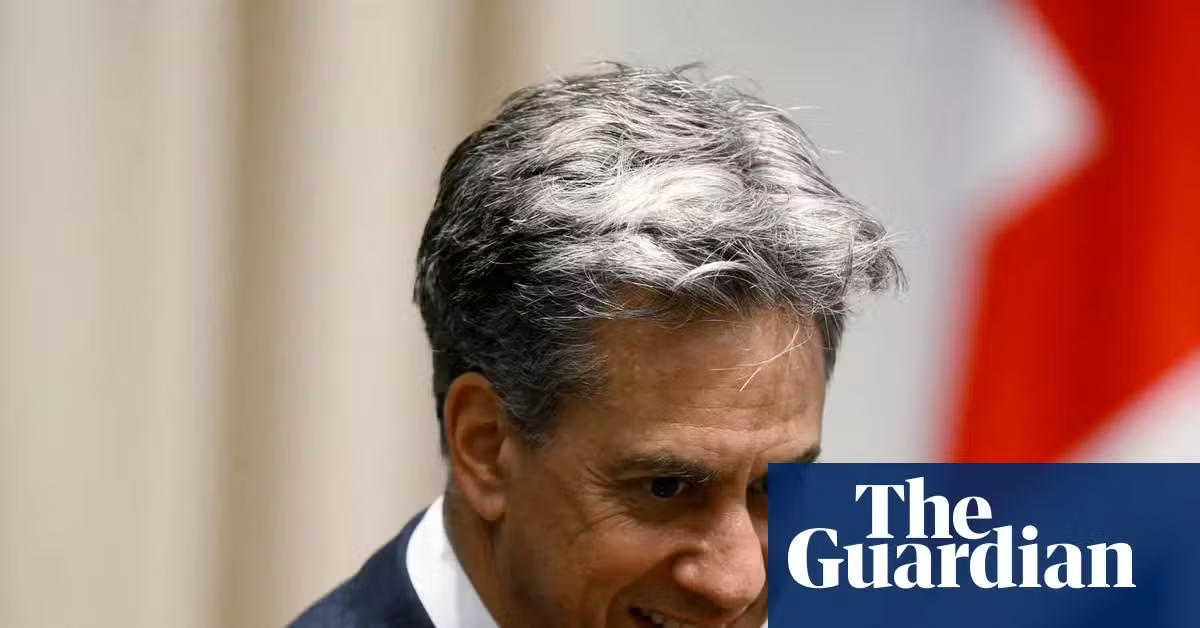
Ed Miliband says closer EU ties will give UK a say on Brussels decisions
Closer EU ties will give UK say on Brussels decisions, says Ed Miliband
theguardian.com· 1h
UK and EU Seal Post-Brexit Reset Deal, Opening a New Chapter in Relations
blogspot.com· 6h
EU deal: 'Move on!' Former PMs pile in with advice for Andy Burnham, but will he listen?
bbc.com· 7h
After lengthy negotiations, the UK and the EU move closer together
lemonde.fr· 25h
Rejoining EU ‘on the table’ as UK strikes deals on trade and young people
Ed Miliband: EU deal not dependent on tuition fees agreement
U.K. and EU strike deals on trade and travel, pledging to rebuild ties after Brexit
nbcnews.com· 40h
(S+) Andy Burnham und die EU: In Brüssel wird wieder die britische Nationalhymne gespielt
spiegel.de· 43h
Au terme de longues négociations, le Royaume-Uni et l’Union européenne font un pas l’un vers l’autre
Burnham seals trade and youth mobility deals in biggest step towards EU since Brexit
10 years after divisive Brexit referendum, UK weighs a ‘Breturn’ to the EU
aljazeera.com· 45h
Andy Burnham's first taste of EU deal-making unlikely to be his last
EU-UK summit live: Burnham hails ‘win-win’ Brexit reset worth £17bn to UK economy
independent.co.uk· 45h
What is the EU-UK youth experience scheme and when will it start?
What the Brussels summit could mean for the UK-EU Brexit deal
Un accord conclu entre le Royaume-Uni et l’Union européenne, cinq ans après la mise en œuvre du Brexit
Key takeaways from UK-EU summit: Idea of Britain rejoining still on table
abc.net.au· 47h
UK says new deal will ‘rebuild bridges’ with EU: What’s in it?
LIVE: EU and UK leaders speak after Brussels summit
youtube.com· 2d
UK and EU agree on 'landmark' deal to ease trade and youth mobility, talks to continue on tuition fees
Ed Davey on EU deal, free movement and why 'most Britons don't know who you are'
Fallout over tuition fees may snag Burnham’s EU deal, say insiders
Four thoughts on the UK-EU summit
substack.com· 2d
Großbritannien-EU-Gipfel: Brüssel und London einigen sich offenbar grundsätzlich auf Wiederannäherung
EU and UK seal reset deal
UK and EU Tighten Relationship as Global Order Shifts
bloomberg.com· 2d
Live Q&A: Can Burnham Reset the UK’s Relationship with Europe?
The U.K. and EU hold a rare summit to strengthen ties
npr.org· 2d
UK-EU summit live: PM set to sign reset deal after ‘down to the wire’ talks
thetimes.com· 2d
Andy Burnham heads to Brussels as UK and EU close in on Brexit reset deal – live
UK-EU summit live: Andy Burnham to sign EU ‘reset’ deal in Brussels
ft.com· 2d
Le Royaume-Uni et l'UE comptent s'entendre sur un rapprochement lors d'un sommet à Bruxelles
france24.com· 2d
EU and Britain to agree steps towards relations reset
What impact has Brexit had on the UK and EU economies?
UK-EU summit live: Burnham's deal at risk unless UK cuts European student fees, EU officials say
EU-UK talks: New Brexit deal 'won't solve' all issues, but is a 'step in the right direction'
UK and EU agree deals on trade and youth movement, pledging to rebuild ties after Brexit
apnews.com· 2d
Easing Back From Brexit: What to Expect at U.K. Summit With E.U.
nytimes.com· 2d
Burnham’s EU reset hit by last-minute tensions with France
UK-EU reset talks will go ‘down to the wire’ as crunch summit approaches
EU-UK talks going down to the wire, says No 10
Entre le Royaume-Uni et l’Union européenne, des retrouvailles complexes
Prime Minister’s EU talks will drag the UK ‘backwards’, Kemi Badenoch says | ITV News
itv.com· 3d
Andy Burnham is in danger of over-selling his big Brussels summit. What happens if he under-delivers? | Joël Reland
Brejoin? Is Andy Burnham going to reverse Brexit? – podcast
EU ‘to close door’ to talks on long-term UK ties until Burnham has decided on Brexit
The EU that Burnham is eyeing up is very different to the one Britain left
bbc.co.uk· 4d
"A 'Farage fee'... we'd rip it up" | Richard Tice on UK-EU deal and Farage leadership
Burnham delays plans to set out options for UK’s long-term ties with EU
Andy Burnham to say Brexit ‘has not worked’ and he will sign new deal with EU
UK on brink of EU deal to bring down price of weekly shop, says Andy Burnham
mirror.co.uk· 6d
Tories ‘burned all our bridges’ in Brexit aftermath, Burnham says ahead of EU summit | LBC
lbc.co.uk· 8d
Andy Burnham says 'win-win' deal can be agreed between UK and EU
‘Win-win’ deal with EU could be done, Andy Burnham says
Five European leaders call for closer EU-UK ties ahead of Brussels summit
Andy Burnham to unveil EU trade deals worth billions of pounds
Britain and the EU agreed a post-Brexit reset at a Brussels summit on 20 November, sealing deals on food trade, carbon emissions and youth mobility after months of negotiation. Three agreements were close weeks ahead of the summit: an agricultural pact freeing trade in products such as Scottish salmon, linking the UK to the EU's emissions trading scheme, and a youth visa scheme for under-30s. Prime minister Andy Burnham said the agreement would boost the UK economy by £17bn, an increase of 0.4%. Leaders of Germany, Belgium, the Netherlands, Luxembourg and Denmark wrote to Ursula von der Leyen and António Costa calling for closer ties with Britain ahead of the summit.
The talks went down to the wire. The EU said its food and drink deal and emissions trading agreement might not enter into force without a deal on European students paying domestic tuition rates in Britain, and business groups and retailers including the British Chambers of Commerce, Tesco and the CBI backed the deal while the Conservatives vowed to oppose anything agreed. Hours before the summit, the two sides were still arguing over how much say Britain would have in new EU food rules, and negotiations only concluded in late-night talks.
In a joint statement the two sides confirmed deals that will scrap checks on trade in plant and animal products, link their emissions trading schemes, and let 100,000 young adults from each side live and work in the other's countries for up to three years, though the youth scheme may not start until January 2030. The tuition fees dispute was deferred to a separate agreement within six months, which von der Leyen called a 'different sheet of paper'. Britain will have no voting rights when the EU writes new food standards laws, with France leading that resistance, and no actual signing took place as a legal process must now run in each country, with final approvals still needed in both parliaments.
At the summit Burnham broke the long political silence on Britain rejoining the EU, saying it was one possible outcome, far from imminent and needing both voters' backing and the unanimous support of a mistrustful EU. Opposition quickly organised: a new 'Stay Out' campaign group was launched chaired by former Vote Leave figure Oliver Lewis, which put the cost of rejoining at £39.3bn a year, and former Leave figures including Boris Johnson and Michael Gove re-emerged against any return. Polling analysed by Sir John Curtice showed an average of 62 per cent favour rejoining once undecided respondents are excluded, though some surveys put support at about 35 per cent when closer ties were offered as an alternative. Chancellor John Healey and Culture Secretary Lisa Nandy had been explicit about their opposition to Burnham's enthusiasm for the EU.
The day after the summit, Ed Miliband said the agreements on food exports, energy and youth mobility would definitely become law regardless of any tuition fees deal, with legislation coming in 2028, and that there would be no cost to the UK taxpayer and no new contributions to the EU budget. He also said rejoining could be on the table in informal discussions between Burnham and European leaders ahead of the 10-year plan he will announce before Christmas. On 22 November Miliband said closer links with the EU will mean the UK having a say on decisions made by Brussels, though any timetable for closer integration, including possible talks about rejoining, remained unclear.
Prime minister Andy Burnham was preparing to announce billions of pounds of trade deals with the EU at a Brussels summit with Ursula von der Leyen and António Costa on 20 November.
Three deals were close to agreement: an agricultural pact freeing trade in products such as Scottish salmon, UK access to the EU's emissions trading scheme, and a youth visa scheme for people under 30.
Under the agricultural deal, travellers would receive pet passports for taking animals into the EU and certificates for transporting live animals would end, while some UK products banned under EU law would be allowed for a transition period.
Parts of the agreement would not take effect until 2028.
Burnham said the agreement would boost the UK economy by £17bn, an increase of 0.4%.
The UK government believed the agricultural deal alone would be worth over £5bn to the UK economy by 2040.
Both sides had agreed each EU member state should get its own quota under the youth visa scheme, and the UK was negotiating an emergency brake to restrict travel if a member state refused its quota.
The two sides had begun talks on a joint statement on future cooperation, including a draft seeking an agreement on lower fees for European students at UK universities within six months.
The UK was willing to spend hundreds of millions of pounds compensating universities for any financial loss if the EU granted Britain access to its Made in Europe scheme.
The EU's draft joint statement described the two sides as 'trusted partners', language the UK believed would allow it to participate in the Made in Europe scheme.
European countries were pushing Britain to sign up to higher tariffs on Chinese electric vehicles, a move UK ministers and businesses were resisting.
The European draft text said the UK was likely to pay a financial contribution to the EU's cohesion budget, though this had not been signed off by the UK.
The EU's cross-border carbon tax was due to come into force in January.
Andy Burnham told the Economist: 'A deal could add up to 0.4% to GDP. Now that is a number that you cannot ignore.'
Andy Burnham told ITV: 'Public opinion has changed nationally. But I want to be really clear on this issue. I will not run ahead of public opinion. The public need to be the boss when it comes to whatever happens with Brexit.'
Downing Street said the prime minister's announcement would take place 'around the time of the summit'.
The leaders of Germany, Belgium, the Netherlands, Luxembourg and Denmark, Friedrich Merz, Rob Jetten, Bart De Wever, Luc Frieden and Mette Frederiksen, wrote to Ursula von der Leyen and António Costa calling for closer ties with Britain ahead of the Brussels summit.
The five leaders urged the EU and the UK to speed up work on Britain's return to the EU's internal electricity market, saying it would benefit both sides.
The five leaders' letter stated: 'We call on you and the UK to agree during the summit on a path towards the conclusion of these negotiations.'
The letter described the UK as a 'close partner in the energy transition' and said its integration into the EU's internal electricity market was 'necessary to unlock the full potential of the North Sea area and transform it into the largest clean energy hub in the world'.
A Brussels diplomat said: 'The UK would not simply be paying into EU cohesion funds. The UK would be investing in access to a more integrated, secure and competitive European energy market.'
The Brussels diplomat said: 'This will lead to more efficient electricity trading, resulting in lower costs for UK consumers.'
Andy Burnham met fellow leaders at the European Political Community summit in Dublin ahead of the EU-UK summit the following week.
The EU said its food and drink deal and emissions trading agreement might not enter into force without a deal under which European students would pay domestic tuition rates in Britain.
Tuition fees for European students remained a stumbling block, and Burnham called the summit agreements a package deal without saying whether he accepted the link to tuition fees.
Ministry of Justice officials were trying to water down an EU ultimatum to halt the deportation of foreign national offenders.
The UK was believed to be pushing for access to the EU's Eurodac asylum fingerprint database and the Schengen Information System, which it lost through Brexit.
Officials at the summit were to discuss the next round of the reset, expected to focus on a joint migration pact, law enforcement and borders, visas for touring artists, and mutual recognition of qualifications.
Burnham was expected to make the EU reset the centrepiece of his white-tie speech at the lord mayor's banquet on Monday night.
Andy Burnham said a 'win-win' deal with the EU could be done that would be 'more like the Brexit that people thought they were voting for in 2016'.
Andy Burnham said the deal was not done and there would be 'some long nights ahead in the next seven days'.
Andy Burnham said he would fight hard for the summit's benefits for Britain and do anything he could to address the cost of living crisis.
The UK and EU agreed a draft deal on removing post-Brexit checks from food and agriculture exports, and draft texts on emissions trading and a youth travel and work scheme were circulated to EU nations.
The UK government claimed the agreement would eventually bring the UK economy £5.1bn worth of annual benefits.
Andy Burnham said the deal could bring lower prices for British consumers, lower costs for British businesses and more growth in the UK economy.
Andy Burnham said he would fight over the days to come to make sure the deal gets over the line.
Andy Burnham ruled out major changes to the UK's relationship with the EU before the next general election, honouring Labour's manifesto pledges of no return to the single market, the customs union or freedom of movement.
Andy Burnham said the Conservatives 'burned all our bridges' with the EU in the aftermath of the Brexit vote and gave Britain a harsher and harder Brexit than people thought they were getting in 2016.
Andy Burnham said Britain has 'lost more than we gained' in the decade since the referendum, and that he does not believe the Brexit deal the Conservatives got has been good enough for Britain.
Andy Burnham said the Conservatives were standing out against the deal and saying no to change.
Andy Burnham said he would lead on the issue and try to get the best deal he could for Wales, Welsh farmers, and exporters of Welsh shellfish and Welsh lamb.
The Conservatives vowed to oppose any deals reached at the UK-EU summit on 20 November.
Writing in a newspaper article, Andy Burnham said: 'Any deal I seek to agree in Brussels must first pass what I call the Makerfield test: will it make life better for people in the parts of Britain that have felt forgotten?'
Andy Burnham asked of the Conservatives: 'How can they turn their backs on lower food prices when families are struggling so much?'
M&S Food boss Alex Freudmann said: 'A deal means fresher food and fuller shelves for our customers, lifting the pressure on the price of the weekly shop.'
Alex Freudmann said: 'The sooner this agreement is signed, the better. 20 November is the moment finally to get the deal done.'
Ireland's Europe minister Thomas Byrne said Ireland would be very strong supporters of closer integration between the EU and the UK, while being conscious it was an internal matter for the UK.
Pat McFadden said the summit was really important and being taken very seriously by the prime minister, for security, cost, business and consumer reasons and because of a lack of cooperation on immigration.
A possible 'exit clause' was being considered in the deal in case a future government reversed the closer alignment, amid EU concerns about the cost of rebuilding border food safety checks put in place after Brexit.
EU relations minister Hamish Falconer said the UK could have a 'voice in the room' under a new deal with the EU but no vote on EU food policies, and that there could well be an 'exit clause' because the EU was 'worried' about a future Reform or Conservative government undoing the agreement.
Boris Johnson told the Telegraph it was madness to escalate the Brexit issue as a political priority and that Andy Burnham would impale himself and his party on it and would not win.
Boris Johnson said Andy Burnham needs to move off the Brexit issue because the reality is that people are not fools.
Boris Johnson said Britain would 'absolutely' vote for Brexit again if Andy Burnham forced another vote on the issue.
Andy Burnham delayed plans to set out options for the UK's long-term ties with the EU.
Business groups and retailers including the British Chambers of Commerce, Tesco, M&S, Asda, the CBI and the British Retail Consortium backed the UK-EU deal.
It was reported that once the UK-EU deal was signed, the UK would have to pay a multi-million pound fee if a future government pulled out of it, and that withdrawal clauses of that kind are standard in international treaties and work both ways.
Richard Tice said a Reform government would reverse the UK-EU reset deal because it will be bad for Britain, and that its concessions are frankly not worth it.
Richard Tice said the UK-EU reset deal is a slippery slope towards coming as close as possible to rejoining the EU.
Richard Tice said a Reform government would refuse to pay the multi-million pound exit fee and would simply rip the deal up, saying no clause in an international treaty can bind a future government.
Richard Tice said a Reform government would have a friendly, constructive trading relationship with the EU as near neighbours.
The UK rejoining the EU's electricity market and trying again to join an EU-backed defence loan scheme were under immediate discussion ahead of the summit.
It was reported that Burnham may in time propose rejoining the EU's customs union or single market, and could eventually table a new referendum on rejoining, though none of the bigger moves would come before the next general election.
Reform UK described the government's proposals as 'opening the door to uncontrolled immigration'.
The Conservatives charged the government with 'dragging us into the European Union via the back door'.
Conservative deputy leader Alex Burghart vowed that, if elected, his party would 'rip up' the UK-EU agreements.
EU foreign policy chief Kaja Kallas described the UK-EU process as 'small steps… to make both sides stronger' and warned that Europe has a lot of trauma from Britain leaving the EU, so things will not be easy.
Georgina Wright identified a window of opportunity before France's election for the UK to get 'creative' in its reset proposals, saying the time to act was at hand.
EU diplomats said the bloc would shut the door to discussions about the UK's longer-term relationship until the government decided whether it wanted to proceed with reversing Brexit.
European capitals warned they had reached the end of the line for piecemeal reset summits, with senior EU diplomats saying the annual approach would quickly 'reach its limits' and that more mini deals did not make sense.
A joint statement after the summit was expected to signal further discussions on the UK's entry to the EU's energy single markets, irregular migration and a closer defence and security relationship.
The EU planned a 'pause for reflection' after the Friday summit.
The government was considering holding a year-long 'national conversation' in 2027, including town halls and citizens assemblies, before deciding which route to pursue before the next election.
Burnham was not expected to set out the full range of options for the future relationship, from the status quo to customs union, single market or full rejoin, until his 10-year plan in December.
One EU diplomat said: 'Clarity is what we need more than anything from the UK. Don't come back until you know what you want. Work out what your options really are and then come to negotiate.'
Another EU diplomat said: 'The prime minister needs to bring the public with him. We can't have another negotiation based on just half the country. We'll only put the effort in if we know it's not going to change down the line.'
Another EU diplomat said: 'It is like a buffet: you can choose to nibble on one or two dishes to start, but at a certain point you have to go for the whole of the buffet.'
British carmakers would not count as European under the EU's Made in Europe programme, and resolving this had been made a UK priority.
Joël Reland of UK in a Changing Europe said the draft agreements may be finalised but the deals were far from done in a practical sense, being contingent on tuition fees and on legislation and systems likely to be in place in 2028.
Joël Reland said the EU was set to make any UK inclusion in the Made in Europe programme conditional on alignment with certain trade policies, in particular restrictions on Chinese goods, likely meaning higher tariffs or import controls on Chinese electric vehicles.
Joël Reland recommended Andy Burnham think several steps ahead and adopt a more sombre tone rather than celebrating billions being added to the UK economy.
Joël Reland recommended Burnham say: 'These gains are welcome and hard-fought, but they prove the limitation of our current approach – expending a lot of effort for minimal economic gain.'
Joël Reland said the UK-EU summit may one day be seen as the start of the UK's long march back towards the EU.
The cap on the youth mobility scheme was reported to be expected between 80,000 and 100,000 visas, with the language of the deal still under negotiation.
Kemi Badenoch warned the prime minister's talks with Brussels would take the UK 'backwards' on control of Britain's money, laws and borders, and said closer ties would not provide a significant enough boost to growth and would risk Britain's sovereignty.
Writing in the Daily Mail, Kemi Badenoch said: 'There is a world of difference between practical co-operation with our neighbours and giving up the freedoms Britain voted for in 2016.'
Kemi Badenoch wrote: 'The three central purposes of Brexit were control over our money, over our laws and over our borders.'
Kemi Badenoch wrote that Andy Burnham did not lead Labour into the last general election, that Keir Starmer did on a promise not to reopen the relationship with the EU, and that Burnham stabbed him in the back pursuing his own divisive agenda.
Kemi Badenoch said Andy Burnham does not have a mandate to deepen Britain's ties with the EU, writing: 'Britain cannot afford a decade of false hope from Labour.'
David Lammy said Labour should campaign to return to the EU.
Downing Street said negotiations were 'going down to the wire' ahead of the summit, and that if a deal was secured the government would introduce legislation to Parliament the following week.
The UK's request to limit numbers and the EU's request that EU students pay the same tuition fees as domestic students remained sticking points in the talks.
The prime minister's spokesman said Brexit has done 'more harm than good'.
The prime minister's spokesman said: 'The choice over the coming days is clear: stand with Boris Johnson and Kemi Badenoch defending a broken status quo, or with Andy Burnham delivering change, cutting costs for business, helping with the costs of the weekly shop and creating opportunities for young people.'
With less than 24 hours to the summit, the two sides still had to resolve how much say Britain would have in new EU food rules, and EU ambassadors were to meet at 5pm and continue until agreement was reached that night.
Under the food and drink proposal the UK would dynamically align with EU sanitary and phytosanitary standards, have a 'voice' but not be in the room when laws are drafted, and the deal was expected to come into force on 1 March 2028.
The UK was pushing for a formal role in EU committees implementing and setting food rules, an issue that remained unresolved after a meeting of EU ambassadors, with one diplomat saying the Commission had proposed an 'extremely restrictive consultation mechanism'.
The draft proposal gave the UK two options on tuition fees: significantly reduced undergraduate fees or equal treatment with nationals.
The UK and EU were believed to be close to summit language pointing towards UK inclusion in the Made in Europe policy, though nothing could be formalised until the EU passed its own legislation.
Burnham's spokesperson said there was a UK-EU consensus that there would be no further incremental reset summits until a full negotiation on a longer-term relationship begins, and that discussions on options would start after the summit.
An EU diplomat said: 'We are fighting hard on this and think we will get there.'
No 10 said: 'We were obviously elected on a manifesto that promised to reset the relationship and seek to deepen ties with our European friends.'
Burnham's effort to reset relations with the EU was hit by last-minute tensions with France.
Freedom of movement was not being discussed at the summit.
Britain and the EU confirmed in a joint statement after the Brussels summit that they had agreed deals on trade, carbon emissions and youth movement, pledging to rebuild ties with an 'ambitious and dynamic' post-Brexit relationship.
The agreements will scrap checks on trade in plant and animal products, link the UK's and EU's emissions trading schemes, and let 100,000 young adults from each side live and work in the other's countries for up to three years.
The UK and EU gave themselves six months to reach an agreement on the level of student fees for EU students in the UK and British students in the EU.
Burnham said the deals could add 0.5% to Britain's economy, having previously put the figure at 0.4%.
An EU official said the package was contingent on the two sides reaching agreement on university tuition fees within six months, while talks continued on Britain's desire for access to the EU's Made in Europe manufacturing rules.
To get the deals, the UK must accept some EU rules and standards that it has no role in setting.
Ursula von der Leyen said ahead of the summit she wanted it to be 'a summit of ambition and concrete results', with more opportunities for young people, easier agrifood trade, and stronger cooperation on economic security.
António Costa said ahead of the meeting: 'Our security and prosperity are closely intertwined, making a strong partnership between us essential.'
A British government spokesperson said: 'The deal is done.'
Nigel Farage told the BBC that 'the great Brexit debate has just started again' and said it is 'perfectly clear' that the debate very soon becomes one about whether Britain rejoins the EU or stays out.
Andy Burnham pitched the package as a way of 'cutting costs, keeping prices down in the supermarkets and creating opportunities for young people', describing the summit as a step toward undoing a decade of damage caused by the divorce with the EU.
Under the food deal the whole UK will realign with EU rules on agri-food products, meaning goods sent from Great Britain to Northern Ireland will no longer need to be checked at ports and sea-border controls on food should effectively end from 2028.
Border control posts at Northern Ireland ports should become largely redundant and 'Not for EU' labels on Great Britain food products sold in Northern Ireland will no longer be needed, though pre-Brexit checks on livestock would continue.
A deal on electricity, which could cut costs for Northern Ireland consumers, was not part of the agreement.
Northern Ireland Agriculture Minister Andrew Muir said the deal will 'make a real positive difference for consumers, businesses and farmers' in Northern Ireland.
Andrew Muir said: 'Whilst this will not fix everything, it's a massive step in the right direction.'
Agreements finalised late the night before the summit included a youth mobility deal under which up to 100,000 young people would flow in each direction every year, and an agricultural deal reducing regulation for exporters while committing Britain to following European rules.
The EU decided the tuition fees issue was 'parallel' rather than separate to the agreements on youth mobility, food exports and emissions trading, and gave Britain six months to agree to equal tuition fees or negotiate an alternative.
Cabinet ministers including John Healey, Ed Miliband, Louise Haigh, Angela Eagle, Anneliese Midgley and Hamish Falconer attended the summit in Brussels alongside EU negotiators.
Business Secretary Jonathan Reynolds said Britain will have influence over the European rules it agrees to follow on food and farming even without a vote, because British experts will be in the room as the EU discusses its regulations, amounting to 'having a say'.
Jonathan Reynolds said the expected youth mobility scheme is not 'freedom of movement in any sense', is time limited, and that participants could look for a job but would not get access to social security or student loans.
Jonathan Reynolds said the agreement being sought is 'entirely consistent within the red lines that were in the Labour manifesto' and improves the 'very hard Brexit the Conservative party chose to give the country', though he could not promise any specific food product would be cheaper.
Kemi Badenoch, in a post on X, accused Andy Burnham of 'flip-flopping' on the EU and of wanting to distract the country with talk of rejoining.
Kemi Badenoch said she wants to see easier trading with the EU but 'not trade at any cost'.
In a statement, the Liberal Democrats said Britain is stronger and more secure with closer ties to Europe, both economically and on security, and that the prime minister must deliver at the summit.
Reform UK said in a post on X that Andy Burnham is opening the door to more foreign workers instead of tackling youth unemployment in Britain and is taking Britain backwards.
Nigel Farage said Andy Burnham has no 'democratic mandate to do any of this' and that the deal is a slippery slope imperiling what Brexit should really look like.
Andy Burnham called the youth mobility scheme a 'good day for young people in Britain', saying young people were the 'biggest losers' after Brexit and Covid, and said he was really confident it is a good deal for Britain.
Downing Street said the deal will 'cut costs, keep prices down and open up opportunities for young people'.
An emissions linking agreement with the EU was estimated to add £3.8bn a year to the UK economy, alongside up to £5.1bn a year from a food and drink trade deal.
The UK had originally wanted only 50,000 people in the youth mobility agreement, a figure the EU considered too low.
London had agreed only to apply 'significantly reduced' fees for EU students at British universities, while the EU pushed for home fees, often about one third of the international price.
Nigel Farage accused Andy Burnham of a Brexit 'betrayal'.
Nigel Farage said: 'We don't need to be in political union of any kind at all to do business and have good relations with our neighbours.'
The summit had initially been scheduled for July but was postponed after the resignation of Burnham's predecessor as prime minister, Keir Starmer.
The EU issued a late-night compromise text to all member states after a hours-long meeting of ambassadors in Brussels on the evening of 19 November, and by the morning of 20 November no one had broken silence on it, leaving it adopted for signing by the UK.
The UK and EU provisionally agreed to allow a capped 100,000 EU citizens under 31 to come to the UK every year under a youth mobility scheme giving those aged 18 to 31 the right to live, work, travel and study on both sides of the Channel for up to three years.
A supplementary agreement was reached to settle tuition fees within six months, and the arrangement allows the UK to hold up the youth mobility deal if the EU does not give it what it needs in the Made in Europe legislation.
The UK will have no voting rights when the EU writes new food standards laws and will instead be consulted at key stages, with France leading the resistance to giving the UK voting rights.
To secure the food and drink agreement the UK will align with EU standards, meaning the government must abandon its planned ban on foie gras imports, with the deal not expected to take effect until 2028.
The emissions trading agreement will restore a link severed by Brexit, exempting EU and UK businesses from each other's charges on high-carbon imports such as steel, cement and electricity.
The youth mobility scheme may not be up and running until 2030.
Andy Burnham will be welcomed with a rendition of God Save the King and the Ode to Joy at the summit's opening ceremony in Brussels.
Andy Burnham broke a long political code of silence on the option of Britain rejoining the EU, saying it was just one possible outcome, far from imminent, and would need the backing of British voters and the unanimous support of a mistrustful EU.
Andy Burnham said: 'The Brexit we were given has not worked. We have lost more than we gained.'
Andy Burnham said all options should be on the table for future relations with the EU, including rejoining the now-27-nation bloc.
Downing Street said negotiations had concluded and a reset deal was sealed, with both sides agreeing timelines for implementing a youth mobility scheme, a sanitary and phytosanitary agreement, and a link between their emissions trading systems, with a legal process to follow in each country.
Andy Burnham told Ursula von der Leyen and Antonio Costa at the start of the talks: 'This is a good day for Britain. This is a good day for Europe, and people across Europe and across the United Kingdom will get real benefit.'
Nigel Farage called Andy Burnham naive and wrote that the EU used the moment to 'strong-arm the British prime minister', adding: 'It's the same old game, and he's fallen for it out of sheer inexperience.'
The EU had originally called for the youth mobility scheme to be uncapped, and the UK responded with a cap of around 50,000 before apparently accepting a compromise cap of 100,000 people coming to the UK each year, with quotas worked out on a country-by-country basis.
Some countries, including Germany, indicated they were prepared to accept unlimited numbers under the youth mobility scheme.
The EU's tuition fees demand was deferred to a supplementary agreement the following year on exact levels.
A new 'Stay Out' campaign group opposed to returning to the European Union was launched, chaired by former Vote Leave figure Oliver Lewis.
Chancellor John Healey and Culture Secretary Lisa Nandy were among cabinet members who had been explicit about their opposition to Burnham's enthusiasm for the EU.
Ian Dunt said it is telling how ineffective the pro-Brexit arguments are, because people do not mind young Europeans coming to the UK and like the idea of British young people having a few years in Europe.
Ian Dunt said the pro-Brexit figures are right to think so and right to be worried, and suspects their main aim is now to prevent the debate being reopened by putting enough fear into wary cabinet members.
Ian Dunt called youth mobility the most palatable possible introduction to a bigger conversation, saying it seeds the arguments that come later about why older Britons should not also live and work in Europe.
Ian Dunt argued the sanitary and phytosanitary agreement is a mini version of the entire Brexit debate: whether to prioritise cooperation and mutual advantage or a zero-sum assessment of national sovereignty.
Ian Dunt expects the fee outcome to be another compromise, above the levels applying to UK citizens and below those applying to the rest of the world.
EU sources said the three deals would not enter into force unless the UK reached a settlement over tuition fee rates for European students, which UK officials disputed, saying the issues were completely separate.
UK officials said new food and agriculture arrangements would come into force in March 2028 regardless of an agreement on tuition fees.
UK officials said the UK had won sign-up to the potential idea of inclusion in the EU's yet-to-be-finalised Made in Europe policy, which one official called 'a big win'.
The UK suggested in 11th-hour talks over tuition fees that it could go as low as £12,000 for EU students, more than £2,000 above the charge for UK students, while the EU continued to seek equal treatment.
The EU agreed to defer agreement on tuition fees by six months.
No 10 said less than an hour after Burnham arrived at the summit venue: 'The deal is done – negotiations have concluded'.
Andy Burnham told business leaders: 'It just makes sense to get closer', describing the summit as 'a big day and hopefully a positive day'.
In a statement, the EU Council and Commission said: 'The Council and Commission consider that this agreement is to provide for equal treatment with nationals as regards tuition fees for all students. The Council and Commission acknowledge that these four agreements form a package of the 2026 EU-UK summit.'
An EU official said: 'I think our position has been clear. We think this is an issue that needs to be addressed'.
Speaking on LBC radio, Nigel Farage said Andy Burnham is 'rejoining a chunk of the European Union's single market', which would make the UK a rule taker, and that 'It is wholly unnecessary, and he's being led by the nose by the European bureaucrats'.
Ed Davey said Britain needs to embrace the single market, including free movement of labour, in the interests of the economy, dealing with the cost of living, and cutting people's taxes.
Ed Davey said immigration went up and got totally out of control after Brexit and was worse than when Britain was in the EU, and that free movement would grow the economy and crucially help stop the small boats crossing the channel.
Ed Davey said small boats crossings got really bad after Britain left the EU because it came out of the Dublin Convention, which enabled Britain to return people who came from another EU country.
Ed Davey said rejoining Europe is not the immediate goal because the British people must first be persuaded of the benefits of greater European cooperation, but the Liberal Democrats' long-term aim of getting back to the heart of Europe stands.
Ed Davey said the Liberal Democrats do not expect the prime minister to go anywhere near far enough at the EU summit, and that it is disappointing he does not seem to be really ambitious on Europe.
Ursula von der Leyen called the agreement a 'turning point' in relations.
Andy Burnham hailed a 'landmark' agreement, telling the gathering: 'This is a good day for Britain. This is a good day for Europe.'
No actual signing was expected on 20 November, with no document being inked, as a legal process would now take place in each respective country.
Ursula von der Leyen said there was an 'intensive' debate at the meeting on how much the world has changed since Brexit, noting the COVID pandemic 'was not even over when Russia started the war in Ukraine' and that the two sides had 'stuck together from day one'.
Von der Leyen said the EU is totally open to doing the necessary brainstorming for the wider picture beyond incremental improvements of the relationship.
Andy Burnham said the deal would 'rebuild the bridges that were broken all those years ago' and hailed the agreements as 'a good deal for Britain'.
The agreements still require final approvals in the UK and EU parliaments.
Andy Burnham became the first leader since the Brexit vote to reopen debate about a possible return to the EU, making clear that rejoining one day is not off the table.
Andy Burnham said at a news conference: 'People can see the status quo is not working. It's not good enough for Britain.'
Andy Burnham described the past 10 years since the Brexit referendum as 'a decade of drift' and said he will seek 'informal brainstorming' with European colleagues in the next year about what the right long-term relationship could look like.
António Costa told Andy Burnham at the news conference that he is 'always welcome' in the European Union.
Nigel Farage said on LBC that the deal agreed in Brussels is 'not a reset, it's a reverse', and said on GB News that Burnham had 'no mandate whatsoever' to align Britain more closely with the EU.
The EU and UK agreed to advance together on fighting irregular immigration and to soon hold a 'structured dialogue' covering nearly all migration issues, including returns to third countries of people refused asylum.
Andy Burnham announced the agreement, calling it a 'historic agreement' celebrating a relaunch of relations ten years after the Brexit referendum.
Ursula von der Leyen called the summit's results 'excellent', saying the summit marks a 'turning point' in relations with London, and added: 'Old friends are giving new breath to their friendship'.
António Costa said: 'The European Union and the United Kingdom are stronger when we work together'.
Andy Burnham said 'the world of today is different from that of 2016' and that faced with the state of the world, those who share the same vision must work together.
A UK government spokesperson said: 'Discussions will continue in certain areas'.
A diplomat in Brussels summed the negotiations up as 'hell'.
The youth experience scheme is due to launch no later than January 2030, with 100,000 places a year for each side allocated among EU member nations according to each country's population.
UK participants will initially apply to travel to one EU country but can later switch, staying in up to three countries over three years and spending 12 months in one before switching.
Visas issued under the scheme will initially be valid for two years with an option to extend for one more year, and participants will be unable to access benefits or bring dependants, and must pay an application fee and prove they can support themselves.
Andy Burnham said at a joint press conference that the opportunities 'open horizons, and they create friendships that will last a lifetime' and that it is 'a very emotional moment because these are the young people that will shape our future'.
In the House of Commons, Reform UK's Suella Braverman asked why the government is proposing to 'open the doors to hundreds of thousands of young Europeans who will come here and work in our shops and restaurants' and whether that is not 'a total and utter betrayal of young people in this country'.
Andy Burnham said at a press conference that the agreement is 'a win-win' and 'is in tune with public opinion in the UK', calling it 'a deal for young people'.
Andy Burnham said the next 12 months will be spent 'brainstorming' ideas with the EU for the future relationship, saying: 'Incremental steps… only take us so far.'
Naomi Smith, chief executive of Best for Britain, called the deal 'one small step in our economic fortunes but one giant leap for young people's opportunities'.
Northern Ireland secretary Sir Chris Bryant said the deal will be 'completely transformational' for businesses in Northern Ireland, virtually all getting rid of the paperwork on flowers and finally allowing seeds and plants to be sent from Great Britain to Northern Ireland.
Oliver Lewis, chairman of the Stay Out campaign, called the deal 'a humiliating spectacle' for the prime minister, saying Burnham has been 'played like a fiddle' by Brussels and that it will only end with British taxpayers subsidising cheaper fees for EU students.
Alex Burghart, deputy leader of the Conservative Party, criticised the deal as 'reopening divisions of the past', saying because Burnham is a bad negotiator British taxpayers will pay into the EU, energy prices will increase, farmers will follow EU rules, and hundreds of thousands more migrants will come to Britain.
Tina McKenzie, national chair of the Federation of Small Businesses, said the new deal could end border headaches for small firms, but the government must now deliver the legislation and clear guidance needed so small businesses can benefit from reductions in border checks, delays and costs.
The settled position appeared to be that negotiations on student fees would continue over the six months after the summit but on a separate track, which Ursula von der Leyen described as a 'different sheet of paper'.
Andy Burnham said the government had got as far as it could go with incremental deals with the EU, at least this side of a general election.
Ursula von der Leyen made clear the EU was embracing the brainstorming process on the future relationship.
Polling analysed by Sir John Curtice showed an average of 62 per cent favour rejoining the EU against 38 per cent for staying out once undecided respondents are excluded, though some surveys put support for rejoining at about 35 per cent when closer ties were offered as an alternative.
The campaign group Stay Out put the annual cost of rejoining the EU at 39.3 billion pounds, equivalent to 750 million pounds a week.
Former Leave campaign figures including Boris Johnson and Michael Gove re-emerged to marshal opposition against any return or realignment, reviving loosely sourced claims about the cost of rejoining.
Sir John Curtice said the UK public are certainly in a different place on the EU than they were in 2016, and that around half of those supporting rejoining say they strongly support it, suggesting a deeper commitment to that option.
The UK hailed a joint decision to create a 'partnership for economic resilience' and a 'common prosperity and economic security space', an answer to shared concerns about artificially cheap Chinese goods, as addressing its concerns over the EU's Made in Europe plans.
Under the deals, British experts will be invited to relevant EU meetings, including on potential animal health emergencies, but Britain will have no voting rights, with France instrumental in shaping the exclusion.
Andy Burnham declared a 'new world' of cooperation between the UK and the EU, saying the deals, initiated by Keir Starmer, would add 0.5% to British GDP, a £17bn boost to the British economy.
The final deal emerged after late-night talks went to the wire, with the summit opening in a choreographed ceremony in the Europa European Council building where a quintet played the British and EU anthems.
Andy Burnham challenged his opponents, notably Nigel Farage, to justify rejecting a deal that would boost growth and lead to cheaper food and electricity, asking: 'Why would anybody turn their back on that?'
Andy Burnham rejected suggestions the expert access was a fig leaf, saying it would be 'quite a moment' to have British experts back in EU meeting rooms.
António Costa described the UK as 'our closest neighbour, a reliable ally and a natural partner'.
Ursula von der Leyen said it was up to the UK to decide where the journey was going, adding: 'We welcome this brainstorming, so count on us.'
German Social Democrat MEP Bernd Lange called on both sides to resolve the tuition fees issue, saying: 'We can't open the door to young people and then price them out of walking through it.'
An EU diplomat said: 'The UK has a tendency to make even small questions so difficult', adding that while a British prime minister talks about a change of approach, British negotiators act the same way they always had.
Andy Burnham called the deal a 'historic moment', saying the two sides are 'rebuilding the bridges that were broken all of those years ago' and 'building a much more constructive relationship with our nearest neighbors and our largest market.'
Alex Freudmann, managing director of food at Marks and Spencer, called the announcement 'a major step forward'.
Nigel Farage told reporters in Brussels that Andy Burnham had taken 'the first step, incrementally, to take us back into membership of the European Union.'
Ed Miliband said the UK-EU deal would come into force regardless of whether the two sides negotiated a separate tuition fees agreement, and that the agreements on food exports, energy and youth mobility would definitely become law, with legislation introduced in Parliament and changes coming in 2028.
Miliband said there would be no cost to the UK taxpayer for anything agreed at the summit, with no new contributions to the EU budget.
Ed Miliband said Ursula von der Leyen made clear at the press conference that there are the three agreements and a separate issue, which is tuition, and she was 'confident' a solution on fees would be found, with Andy Burnham adding 'me too'.
Kemi Badenoch said the deal is 'not fair', arguing UK farmers would have to follow rules set in Brussels and young people from the EU would compete with young Britons struggling to get jobs at home.
Kemi Badenoch claimed Andy Burnham 'plucked' the £17bn figure out of thin air, saying the only modelling she has seen of the agreement's economic boost puts the figure at 0.0%.
Nigel Farage said Friday marked a 'betrayal of the British people' and a good day for the EU to try and humiliate the UK.
Professor Duncan Ivison, vice chancellor of the University of Manchester, said allowing EU students to pay domestic fees would take an estimated £500m out of the higher education sector, and it is not clear universities could increase places for EU students even if they came.
Ed Davey said there needs to be more than 'tweaks' to the UK's relationship with the EU, and that the youth mobility scheme is a big step forward but nowhere near enough, with the UK needing a whole new deal that actually works for Britain, and fast.
Dame Angela Eagle said the Treasury and the Department for Education will work with universities to find a solution during negotiations, and that the government wants win-win deals.
Ed Miliband said the UK rejoining the EU could be on the table in informal discussions between Andy Burnham and European leaders in Brussels.
Andy Burnham will use the announcement of his 10-year plan before Christmas to explore how the UK could get closer to the EU after the next election, with informal discussions before next year's UK-EU summit.
Ed Miliband said all the options will be on the table and the UK will look at the benefits and the costs of all the different options.
Ed Miliband said he accepts the result of the 2016 vote but that the world has changed massively, as has Europe, and that it is not about this parliament, with the government respecting the red lines in this parliament.
Angela Eagle said the deal is good for farmers, will open up new markets, is a win-win for the UK and will dissolve a lot of the friction and costs at the border for UK agriculture and food.
The UK side felt positive that it had not backed down on the tuition fees issue, and the feeling in government was that the summit showed the EU will allow the UK to pick and choose where to cooperate and is willing to listen to what Burnham wants to do next.
Theresa May warned that doing deals with the European Union is simply a long, hard slog.
The Liberal Democrats, SNP, Greens and Plaid Cymru argued the EU deal does not go far enough.
The Conservatives complained the EU deal is not fair, for example that British farmers will have to follow EU rules to make life easier for those who trade with the bloc.
Reform said the EU deal is a betrayal of the 2016 vote.
Ed Miliband said closer links with the EU will mean the UK having a say on decisions made by Brussels.
Any timetable for closer integration, including possible talks about the UK rejoining the EU, remained unclear after the Brussels summit.
Ed Miliband refused to say whether he now supports discussions on potentially rejoining the EU.
Ed Miliband said the UK is essentially a rule taker, with businesses selling into the European market having to abide by EU rules while filling in a whole bunch of forms, calling the current situation 'the worst of all worlds' and saying there is a clear case to integrate more closely into EU markets.
Ed Miliband said he was not in favour of Brexit but accepted the result, and that the world has changed massively since 2016, so the UK cannot stand still and must lay out the options for its future relationship with the European Union.