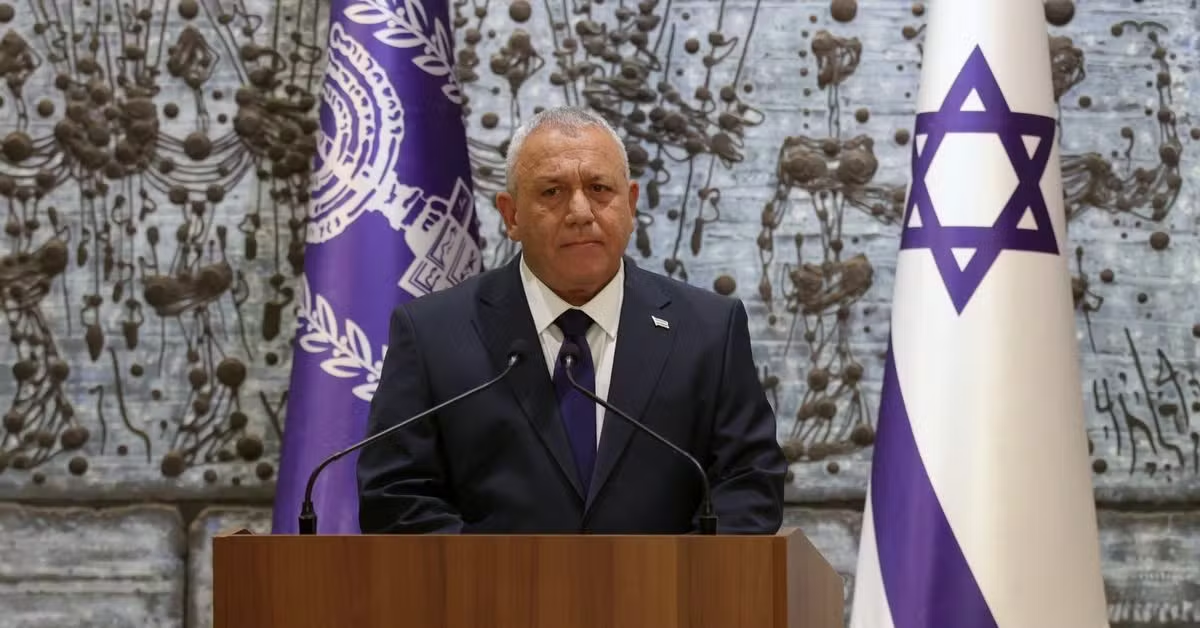
Eisenkot and Likud coalition talks stall over Ben-Gvir and the premiership
Israel: Gadi Eisenkot und Netanyahus Partei verhandeln erneut ohne Ergebnis
spiegel.de· 4d
Israël : les partis d'Eisenkot et de Netanyahu achèvent leurs discussions sans parvenir à un accord
france24.com· 4d
Netanyahu’s Likud, Eisenkot’s Yashar end coalition talks without deal
aljazeera.com· 4d
Israël: pas d'avancée entre les partis d'Eisenkot et de Netanyahu pour la formation d'un gouvernement
rfi.fr· 4d
Israël : les partis de Gadi Eisenkot et de Benyamin Nétanyahou concluent de nouvelles négociations de coalition sans accord
lemonde.fr· 4d
Gadi Eisenkot invites Netanyahu's Likud party for coalition talks
euronews.com· 5d
Eisenkot invites Netanyahu's party to Israeli coalition talks
abc.net.au· 5d
Israël : Gadi Eisenkot invite le parti de Benjamin Netanyahu à des négociations de coalition
Israël : Gadi Eisenkot invite le parti de Benyamin Nétanyahou à des négociations de coalition
Netanyahu may fall, but his far-right legacy in Israel is going nowhere
Speculation grew on 14 November that Prime Minister Benjamin Netanyahu might seek a unity government with former chief of staff Gadi Eisenkot, as the opposition worked to unseat him. Far-right leaders Bezalel Smotrich and Itamar Ben-Gvir publicly opposed a government led by Eisenkot.
Eisenkot's party Yashar! announced on Saturday 21 November that it had invited Netanyahu's Likud to coalition talks, after representatives of the two parties had already met on Sunday 15 November. Eisenkot is open to forming a government with Likud members but has ruled out a coalition led by Netanyahu. His bloc holds 48 of the 61 Knesset seats needed, and is divided between an alliance with the ultra-Orthodox, a pact with the Arab parties, or a national unity government with Netanyahu.
On Friday 20 November, Eisenkot said he does not want the negotiations to drag on and is ready to present a minority government to a vote in the Knesset.
On Sunday 22 November, negotiating teams from Likud and Yashar! met for four hours in Herzliya near Tel Aviv and ended the session without agreement, announcing only that they will hold another meeting without saying when. The talks stalled on whether Ben-Gvir's far-right party would join the coalition, which Netanyahu considers indispensable and the opposition finds unacceptable, and on the premiership, with Likud refusing any rotation and demanding Netanyahu remain in office for the full four-year term. Likud set conditions for joining a unity government, including an end to personal attacks on Netanyahu, exclusion of the Arab parties, rejection of a Palestinian state, continued Israeli control over territories in Syria, Lebanon and the Gaza Strip, and a compromise on ultra-Orthodox conscription.
Eisenkot would prefer to form a national unity government led by himself, without sharing power with Netanyahu, bringing in Likud and some parties of the outgoing coalition while excluding Ben-Gvir's party.
Speculation grows that Prime Minister Benjamin Netanyahu may seek a unity government with former chief of staff Gadi Eisenkot as the opposition works to unseat him.
Far-right leaders Bezalel Smotrich and Itamar Ben-Gvir publicly oppose a government led by Gadi Eisenkot.
Itamar Ben-Gvir claimed Benjamin Netanyahu now has a choice of selecting himself to 'save Israel' or former chief of staff Gadi Eisenkot.
Bezalel Smotrich warned his ultra-Orthodox allies against negotiating with Gadi Eisenkot, saying Eisenkot will 'dump them' once he uses their votes to oust Benjamin Netanyahu.
On Saturday 21 November, Gadi Eisenkot's party Yashar! announced it had invited Benjamin Netanyahu's Likud party to coalition talks, to begin the next day.
Representatives of Yashar! and Likud had already met on Sunday 15 November.
Gadi Eisenkot is open to forming a government with Likud members but has ruled out a coalition led by Benjamin Netanyahu.
Eisenkot's bloc, holding 48 of the 61 Knesset seats needed, is divided between an alliance with the ultra-Orthodox, a pact with the Arab parties, or a national unity government with Netanyahu.
On Friday 20 November, Eisenkot said he does not want the negotiations to drag on and is ready to present a minority government to a vote in the Knesset.
Yashar! said the talks reflect 'a real commitment to forming the widest possible government' and that Eisenkot will 'neglect no avenue' to obtain the breakthrough needed to form a government.
Naftali Bennett said his party would refuse to ally with Benjamin Netanyahu 'or his bloc, whatever the circumstances', and that he will make sure Netanyahu is not the next prime minister.
Naftali Bennett said he is determined to establish a reform government led by Gadi Eisenkot.
Benjamin Netanyahu strongly attacks the Arab parties, which hold 19 seats and oppose his remaining in office.
Naftali Bennett called for a 'Zionist unity government headed by Eisenkot' and said he is 'committed to ensuring that Netanyahu will not be the next prime minister of the State of Israel'.
On Sunday 22 November, negotiating teams from Likud and Yashar! met for four hours in Herzliya near Tel Aviv and ended the session without agreement on a coalition.
Likud and Yashar! announced only that they will hold another meeting, without saying when.
Likud set conditions for joining a national unity government: an end to personal attacks on Netanyahu and his government, a coalition of all parties supporting Israel as the nation-state of the Jewish people without the Arab parties, rejection of a Palestinian state, continued Israeli control over territories in Syria, Lebanon and the Gaza Strip, and a compromise on ultra-Orthodox conscription.
In a joint communiqué, Likud and Yashar! stated that 'the positions of the two parties on a series of substantive questions were presented and were the subject of in-depth discussions'.
The Herzliya talks stalled on whether Itamar Ben-Gvir's far-right party would join the coalition, which Netanyahu considers indispensable and the opposition finds unacceptable.
The talks also stalled on the premiership, with Likud refusing any rotation and demanding Netanyahu remain in office for the full four-year term.
Benjamin Netanyahu posted on social media rejecting any coalition supported by Arab deputies.
Yair Lapid responded to Netanyahu's post by denouncing his hypocrisy.
Yair Golan denounced the negotiations as a 'stab in the back of voters'.
Gadi Eisenkot would prefer to form a national unity government led by himself, without sharing power with Netanyahu, bringing in Likud and some parties of the outgoing coalition while excluding Itamar Ben-Gvir's far-right party.
Avigdor Liberman, an ally of Eisenkot, said he opposes a minority government supported by the Arab parties and instead advocates an alliance with the ultra-Orthodox parties.