DeSantis deploys Guard personnel as more rain floods Florida's Atlantic coast
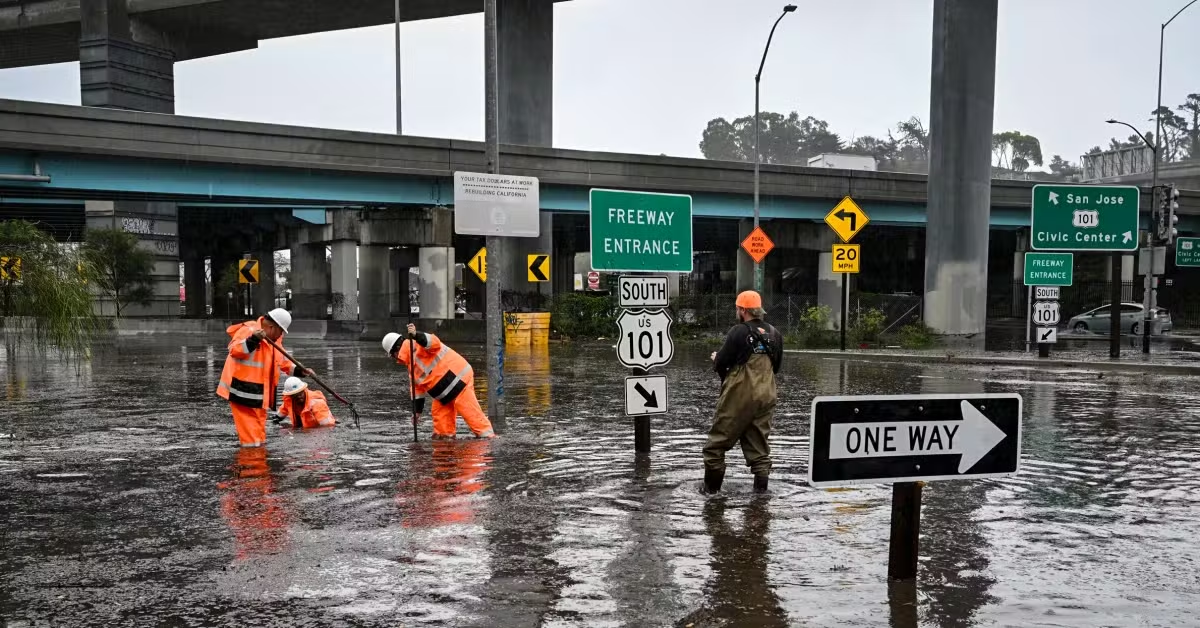
El Niño strikes again, breaking rain records in San Francisco and along Florida’s Atlantic coast
nbcnews.com· 2d
In Florida, More Rain Threatens Flooded Areas and Roads
nytimes.com· 2d
A MAGA blowhard doomed his state to a perfect storm of 'rain-bombs' and torrential floods
rawstory.com· 2d
Extreme flooding sets records in Florida, with more rain to come
washingtonpost.com· 2d
Photos, videos show devastating South Florida flooding that closed schools, forced evacuations
cbsnews.com· 2d
Rainfall supercharged by El Niño floods roads in south Florida
Rainfall supercharged by El Niño causes road flooding, collapsed synagogue roof in south Florida
apnews.com· 3d
More than a foot of overnight rain in South Florida causes widespread flooding
Intense flooding slams Florida from a developing storm that could snarl early Thanksgiving travel on the East Coast | CNN
cnn.com· 3d
Intense Rain, Floods Slam Both South Florida And San Francisco
huffpost.com· 5d
A strong El Niño drove days of record-breaking rain and severe flooding across south and central Florida in mid-November 2026, submerging streets, homes and highways.
Broward County was hit hardest, with about 15 inches of rain in 24 hours, and no injuries or deaths have been reported.
Residents were rescued by boat, schools closed, and Broward County, Fort Lauderdale and Hollywood declared states of emergency.
Gov. Ron DeSantis deployed hundreds of Guard members and state officers, and about 11 million Floridians were under a flood watch.
Meteorologists link the storms to El Niño, this season's second biggest on record for August through October, expected to last through May 2027.
Forecasters expect 4 to 8 more inches of rain on Florida's Atlantic coast and warn the storm could disrupt Thanksgiving travel.
Record-breaking rainfall collapsed the roof of the historic Temple Sinai in Hollywood, Florida, causing extensive damage to the synagogue.
More than a foot of rain, more than three Novembers' worth, fell within hours in the Hollywood, Florida, area, with some places getting more than 5 inches per hour.
Hollywood police said first responders performed water rescues throughout Tuesday night into Wednesday morning, 18 November 2026, and answered 64 flood-related calls.
Broward County and the city of Fort Lauderdale declared states of emergency on 18 November 2026.
Fort Lauderdale deployed its full fleet of vacuum trucks, a team of emergency contractors and 11 portable pumps to help drain excess water.
The deluge closed all Broward County Public Schools and several Keiser University campuses on 18 November 2026.
More than 6 inches of rain fell from Miami to Homestead, Florida, on 18 November 2026.
Historic rainfall and severe flooding inundated Florida's Space Coast earlier in November 2026, leaving the region soggy and vulnerable to the new round of rain.
Forecasters said the storm would linger off the southeast coast before pushing north and is likely to disrupt travel during the busy pre-Thanksgiving weekend.
The National Hurricane Center said there was a medium chance the system could eventually transition into a fully tropical or hybrid storm.
Flash flooding was reported in northeastern Miami-Dade County after an intense overnight storm.
Heavy rain supercharged by El Niño flooded South Florida early on 18 November 2026, and the city of Hollywood declared a state of emergency.
The National Weather Service reported preliminary figures of 15.3 inches of rain in a 24-hour period ending 18 November 2026 in parts of Broward County, Florida.
High water and stalled vehicles closed portions of the Florida Turnpike and Interstate 95 in Hollywood, Florida.
The city of Hollywood, Florida, received more than 300 calls for service overnight into 18 November 2026.
Heavy rain damaged the roof and flooded hallways at a Hollywood, Florida, hospital, with no injuries reported.
Officials announced that schools in Broward and Miami-Dade counties, Florida, would close on 19 November 2026.
Hollywood, Florida, Mayor Josh Levy urged motorists to stay off roads and avoid unnecessary travel, and said the rainfall was a historically significant event in the city.
Alejandra Garcia, a meteorologist with the National Weather Service in Miami, said El Niño has disrupted Florida's typical October-to-May dry season and is helping bring low pressure systems down toward the southeastern United States, causing the heavy precipitation.
The Florida Division of Emergency Management warned in an advisory that "potentially catastrophic" amounts of rainfall could cause flash flooding, life-threatening rip tides and minor beach erosion.
Fort Lauderdale recorded 5.72 inches of rain in a downpour ending early on 18 November 2026, breaking its daily record of 1.8 inches set in 1959.
Officials in Palm Bay, Florida, announced a mix of mandatory and voluntary evacuations for different neighborhoods and offered to transport residents by boat.
Florida Fish and Wildlife Conservation Commission officers rescued more than 70 residents and 20 to 30 pets from a flooded Hollywood, Florida, apartment complex on 18 November 2026.
Floodwaters breached classrooms inside schools in Hollywood, Florida, and the nearby town of Davie, and a synagogue roof collapsed in Broward County.
Fort Lauderdale Fire Rescue said in a social media post that its high water teams were out assisting folks who needed help in the flooding.
Officials and local residents said a number of families "lost everything" in the flooding.
The National Weather Service warned of life-threatening flash flooding in central Brevard County as bands of heavy rain kept moving ashore on 19 November 2026.
Emergency crews used boats to evacuate residents in Palm Bay, Florida, on 19 November 2026.
Record rainfall combined with king tides to cause massive flooding along Florida's Atlantic coast.
King tides and strong northeast winds brought significant flooding to Northeast Florida, with impacts a National Weather Service forecaster said resembled those of a tropical storm.
Meteorologist John Morales wrote that the flooding was driven by a super-strong El Niño that was clearly a product of climate change, and that rising sea levels keep making such flooding worse and more expensive.
The columnist recommended that from now on the flooding and its causes be called the DeSantis Effect.
Jennifer Jurado, chief resilience officer for Broward County, said the county scrambled to prepare before the flooding hit and has created a 20 million dollar grant program to help municipal governments add flood infrastructure.
Treasure Coast citrus growers described the flooding as the worst event the local industry has ever seen.
Heavy rain pounded South and Central Florida for a third day on 19 November 2026, prompting water rescues, evacuations and school closures.
Broward County said crews operated pumps to drain inundated streets and carried out other flood response activities.
A flood watch was in effect for all of Southeast Florida through Friday morning.
The slow-moving storms that drenched South Florida began on Tuesday, 17 November 2026.
The National Weather Service said an additional one to two inches of rain was expected and that while totals would not be as high, it would not take much to exacerbate areas that are already saturated.
Gov. Ron DeSantis deployed hundreds of National and State Guard personnel, highway patrollers and wildlife officers to respond to the flooding.
More than a foot of rain fell on Florida's Atlantic coast in the 48 hours before 19 November 2026, hitting areas flooded two weeks earlier.
About 11 million Floridians were under a flood watch on the morning of 19 November 2026.
The flash flood risk for Florida's saturated Space Coast rose to its highest category on 19 November 2026.
Officials in Melbourne, Florida, opened an emergency shelter at a community center in response to the flooding.
Daytona Beach recorded nearly 5.8 inches of rain on 18 November 2026, breaking its previous daily rainfall record by more than 5 inches.
The National Oceanic and Atmospheric Administration expects the El Niño pattern to persist through May 2027.
Forecasters expect 4 to 8 more inches of rain along Florida's Atlantic coast by 21 November 2026, with 12 to 15 inches possible in localized areas, and say more flooding is likely.
Melissa Watson, a National Weather Service meteorologist in Melbourne, Florida, said quite a few rainfall records were broken in the state and that the rainwater is not seeping into the earth because the soils are completely saturated.

