Astronomers report first observation of a giant star swallowing its companion
Astronomers watched a star spiral to its death inside a giant companion
arstechnica.com· 28h
Dans la galaxie d’Andromède, une étoile géante engloutit sa compagne durant une fusion stellaire inédite
lemonde.fr· 33h
Astronomers just witnessed a dying star gobble up its neighbor in real time
scientificamerican.com· 2d
First observation of a giant star swallowing its neighbour
nature.com
Intra-stellar: a star inside a giant star
Astronomers led by Viraj Karambelkar report the first direct observation of a giant star engulfing its smaller companion, in the Andromeda galaxy about 2.5 million light-years from Earth.
The giant, about seven times the Sun's mass, spent years swallowing a companion of roughly 0.7 solar masses before the pair ended in a luminous red nova in late 2025.
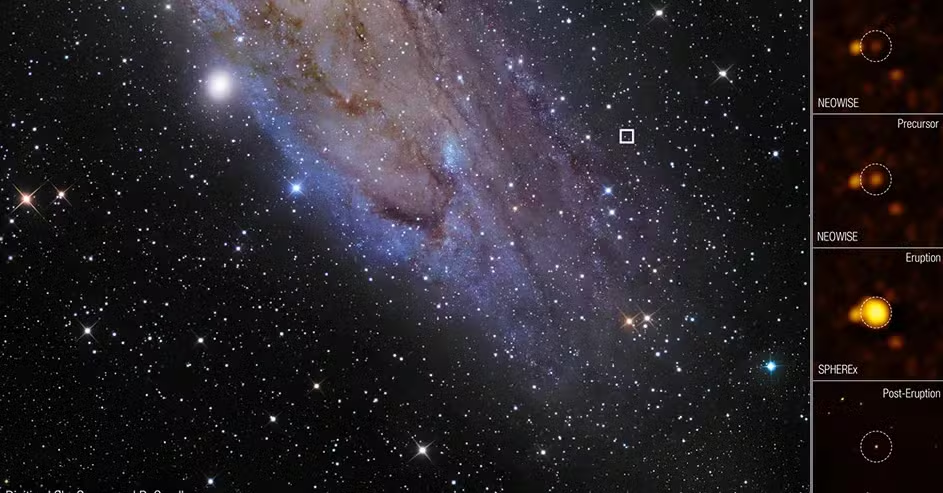
The system, AT 2025abao, was tracked from 2018 by telescopes including WINTER, NEOWISE, SPHEREx and James Webb, brightening at its peak like 1.5 million Suns.
The event confirms common envelope evolution, a long-held theory in which a swelling giant star engulfs its companion and the two share a single envelope of gas.
Researchers say the merger may have left a rejuvenated star nicknamed Bao, though dust still hides the remnant, and the team will keep watching for years.
The study was published in Nature on 18 November 2026, and newer telescopes are expected to detect such events in about 100 galaxies.
A study by Karambelkar and colleagues published in Nature on 18 November 2026 reported the first observation of a giant star swallowing its neighbour.
Scientists reported witnessing in real time a dying star colliding with its smaller companion in the Andromeda galaxy, 2.5 million light-years from Earth, in a collision that may have left a single rejuvenated remnant.
In 2023, Viraj Karambelkar and colleagues began observing Andromeda with the WINTER telescope at Palomar Observatory and NASA's NEOWISE space telescope, spotting the system while searching for stars changing in brightness.
Viraj Karambelkar, a NASA Hubble Fellow at Columbia University, said the discovery, described in a Nature paper, confirms ideas that had previously existed only in theory.
Researchers say the merger in the Andromeda galaxy may have produced a rejuvenated star nicknamed Bao, a name inspired by the system's designation AT2025abao and the Chinese steamed buns.
At the end of 2025 the smaller star finally merged with the core of its companion, ending seven years of gradual inward spiraling.
Viraj Karambelkar said this is the first time a giant star engulfing its companion has been observed in the process, calling the merger a 'unification event'.
Kishalay De, an astrophysics professor at Columbia University and co-author of the study, said previous stellar mergers involved two relatively small compact stars whose merger was almost inevitable once they came into contact.
Karambelkar argues that gas escaping freely toward the poles but blocked around the equator explains the hourglass-shaped nebulae seen around dying stars, confirming a long-held idea about binary interactions.
In the final plunge the companion released about a hundred times more energy than during the slow spiral, most of it flinging a tenth of the envelope outward at about ten times escape speed.
In October 2025 the star brightened roughly 100-fold in 25 days, shining like 1.5 million Suns at its peak, after the companion fell deep inside the envelope and crashed into the core.
NASA's SPHEREx space telescope observed the star in July 2025, finding the giant swollen to about 860 times the Sun's width and wrapped in fresh dust.
In April 2025 the team published a paper suggesting the system AT 2025abao was undergoing an engulfment in progress, but kept watching to rule out a single unstable star.
Between 2018 and early 2025 the giant brightened two- to three-fold in visible light while its temperature stayed nearly constant, as friction from the sinking companion heated the envelope.
Astronomers detected the star's first brightening in 2018; until then it had barely changed.
Modeling of the quiet years showed a giant about 350 times wider than the Sun, outshining its unseen companion by a factor of about 18,000, with the companion estimated at 0.7 solar masses.
The team reconstructed the system's history using observations from about a dozen telescopes and surveys, going back to photographic sky plates from 1989.
Karambelkar said his team's minds were blown by the eruption.
Karambelkar said the team wants to monitor the system for several years, possibly even decades, to watch the dust clear and learn whether the stars merged or the binary survived.
Karambelkar forecast that the Vera Rubin Observatory and the Nancy Grace Roman Space Telescope should spot such events in about 100 Milky Way-like galaxies, possibly several per year.

