House to vote on permitting bill week of November 30 as Democrats push for amendments
US Senate ‘permitting bill’ threatens clean water protections to speed up energy projects
theguardian.com· 16h
The House will vote on the permitting bill next week. Democrats want amendments.
politico.com· 2d
Climate scientists urge US lawmakers to vote no on sweeping permitting bill
The outlook for the bipartisan reform bill darkens
semafor.com· 2d
Climate scientists come out against BAAJA — and Sheldon Whitehouse
heated.world· 2d
Nevada senators divided on permitting reform bill
ktnv.com· 3d
Are House Democrats Ready to Fight Permitting Reform Bill Backed by Big Oil and Trump? | Common Dreams
commondreams.org· 3d
Trump hates wind power. A bill he supports may help it get built
newsnationnow.com· 4d
IN CASE YOU MISSED IT: The BAAJA Hides a Massive Permitting Overhaul Inside a Survivors Bill
substack.com· 4d
'Bullshit': The Very Wonky Bill That Sparked A Brawl Among Democrats
huffpost.com· 6d
It’s a Bill on Energy Permits, but Trump’s Pet Projects Are Part of the Debate
nytimes.com· 6d
Rep. Stansbury: BAAJA Has Passed the Senate. Now What?
youtube.com· 6d
15 Democrats Join GOP to Pass Big Oil-Backed Permitting Bill in the Senate
truthout.org· 6d
Scalise backs Senate-passed permitting bill
These 14 Democratic senators voted to loosen environmental laws to speed up energy build-out
thehill.com· 6d
US Senate passes bill to speed up energy project approvals
aljazeera.com· 6d
Senate passes bipartisan energy bill amid environmental concerns
npr.org· 7d
Despite Strong Tribal Opposition, U.S. Senate Approves BAAJA in Late-Night Vote
nativenewsonline.net· 7d
15 Senate Democrats Help Republicans Pass 'Giant Giveaway to Big Tech and Polluters' | Common Dreams
FAFO for Dems now?
Senate OKs bill to speed energy projects, make data centers pay their way
usatoday.com· 7d
Senate passes BAAJA permitting reform bill backed by AI, energy sectors
cnbc.com· 7d
Senate passes BAAJA permitting reform bill backed by AI, energy sectors
Senate votes to weaken environmental laws to speed up energy projects
washingtonpost.com· 7d
Senate passes landmark permitting deal
Senate passes bipartisan permitting reform bill designed to boost energy projects
cbsnews.com· 7d
Senate passes sweeping bill simplifying permitting rules to build in America
nbcnews.com· 7d
Senate Passes Major Permitting Bill to Speed Up Energy Projects
Senate backs bill to speed up permitting reviews, force data centers to pay for energy costs
apnews.com· 7d
How the Bipartisan Permitting Bill Could Drive Up Natural Gas Exports - Inside Climate News
insideclimatenews.org· 7d
Senate Passes Permitting Reform Bill with Support of 14 Democrats, Including Leader Chuck Schumer
democracynow.org
Data Center Impact Hotly Contested in Federal Permitting Fight - Inside Climate News
Why the Heck Is Kyrsten Sinema at the Senate Right Now?
newrepublic.com· 7d
Senate standoff threatens permitting deal’s bipartisan support
BAAJA passes another procedural vote
Senate Permitting Bill Authors Seek Data Center Exemption
bloomberg.com· 8d
What Congress’ bill to speed up energy projects would mean for you
grist.org· 9d
Fast-Tracked BAAJA Puts Tribal Sovereignty, Lands at Risk
21 Dem Senators Join GOP to Move Forward Bill to Speed Up Data Center Permits
We can do better. We should not pass this permitting bill. Join me live on the Senate floor.
Senate takes big step toward passing permitting reform package
Many liberals hate this bill to overhaul permitting. Democrats may help pass it anyway.
Congress’s Permitting Bill Is a ‘Massive Giveaway’ to the AI Data Center Industry, Critics Warn
time.com· 17d
Urgent: The Bipartisan Effort to Quietly Erode Environmental and Tribal Protections - Natural Causes | iHeart
iheart.com
Senate votes to advance bipartisan permitting reform bill
ACLU warns permitting bill could give way to ICE detention centers
Jeffries opposes Senate permitting deal, demands more House input
A new bill could change how the US builds energy infrastructure
technologyreview.com· 22d
The Bipartisan American Affordability and Jobs Act, a 417-page bill to overhaul federal energy permitting written by Senators Shelley Moore Capito, Mike Lee, Sheldon Whitehouse and Martin Heinrich, passed the Senate 62 to 33 on November 18, with 15 Democrats joining all but six Republicans. The technology-neutral bill narrows which projects need federal permits, sets approval deadlines, would let the federal government override states blocking interstate power lines, and would make data centers pay the full cost of grid upgrades they trigger, an estimated $55 billion over ten years. The White House backed the bill, and Donald Trump urged the Senate to pass it in a post on Truth Social.
Opposition built as the bill moved. House Minority Leader Hakeem Jeffries came out against it over changes to environmental laws and tribal sovereignty, hundreds of organizations including the Sierra Club urged Congress not to pass it as written, and 17 Democratic state attorneys general asked for revisions. On November 24, more than 100 climate scientists signed an open letter urging the House to vote no, saying the bill would prolong the fossil fuel era. Senator Jeff Merkley objected to proceeding without a vote on an amendment to ban data centers on public lands, and the objections blocked all amendments, so negotiated tribal language that Senator Lisa Murkowski had spent weeks working out never made it in, though she voted yes anyway. Because the Senate replaced the entire text of H.R. 2347, a survivors' tax bill whose official title it still carries, the House must vote again, and the bill dies if not signed before the new year.
The House, returning from Thanksgiving recess on November 30, plans a simple-majority vote on the bill that week under a floor rule. House Majority Leader Steve Scalise endorsed the package, while progressives including Alexandria Ocasio-Cortez and Rashida Tlaib oppose it as written, and Representative Sean Casten is circulating a letter asking Speaker Mike Johnson to allow an open amendment process. Capstone DC vice president Charlotte Jenkins pegs the bill's chance of passage during the lame duck session at 30 percent.
The Bipartisan American Affordability and Jobs Act, a 417-page bipartisan bill to overhaul federal energy permitting, was scheduled for a Senate vote on November 9, before the next Congress takes control.
The bill narrows which projects need federal permits, sets deadlines for approvals, and contains specific provisions on transmission planning and mining.
The bill has four Senate sponsors, two Republicans and two Democrats, and is largely technology neutral, opening doors for both fossil fuel and renewable projects.
The White House backed the bill.
The White House's Council of Economic Advisors found the bill would reduce review times and deliver economic benefits such as boosting GDP.
The American Clean Power Association, which largely supports the bill, found it could unlock 350 gigawatts of new clean energy for the grid.
The Rhodium Group found the bill would cut economy-wide emissions by 4 percent in the best case and leave them about the same in the worst case, with annual energy bill savings of $78 per household and 200 gigawatts of new clean energy by 2040.
Resources for the Future found the bill could cut power-sector emissions 6 percent by 2041 and save more than $350 billion in system costs by midcentury.
The Natural Resources Defense Council said the bill's transmission provisions could have substantial benefits for the grid but that narrowing environmental reviews could damage public and private lands, and some environmental groups oppose the bill or parts of it.
Kevin Kircher, an energy modeler at Purdue, said the bill trades growth of the clean electricity industry for growth of the fossil fuel industry, and his modeling found energy-sector emissions would have been higher in 2025 under the bill.
House Minority Leader Hakeem Jeffries came out in opposition to the Senate permitting bill on November 5, 2026, raising concerns about proposed changes to bedrock environmental laws and protections for tribal sovereignty.
A spokesperson for Jeffries said he supports the need for permitting reform but that the Senate bill falls short in several areas, including its National Environmental Policy Act reforms and its failure to adequately protect tribal sovereignty.
The spokesperson said, "We must once again support the clean energy economy and combat the climate crisis with the fierce urgency of now," and that Jeffries will not rubber-stamp legislation that emerges from the Senate without more constructive involvement with the House Democratic Caucus.
The American Civil Liberties Union circulated a memo on Capitol Hill warning that the Senate permitting bill would amend the National Environmental Policy Act so that projects including immigration detention centers could be built without government review.
The ACLU's memo argued the bill would allow ICE to move ahead with 'massive, irreversible projects' with 'no meaningful legal recourse' and said the irony is glaring that a bill sold as making America more affordable would hand ICE a faster, cheaper path to expanding detention facilities.
A spokesperson for Senator Sheldon Whitehouse rejected the argument, saying there is no plausible reading of the bill's National Environmental Policy Act provisions that would exclude detention centers housing federal detainees from review.
Senators Shelley Moore Capito, Mike Lee, Sheldon Whitehouse and Martin Heinrich announced their deal on permitting reform at a press conference at the U.S. Capitol on September 30, 2026.
The Senate voted 73-25 on the night of November 9, 2026 to proceed to consideration of the permitting reform bill, S. 5653, with nearly all Republicans and more than a dozen Democrats in favor.
Senator Catherine Cortez Masto voted to proceed but said through a spokesperson she would not support final passage unless the bill is amended to remove the language relevant to tribal nations.
Senator Martin Heinrich said voters sent a very clear Election Day message that they expect Congress to lower costs, and that Congress does not have to wait for the new Congress to start.
Senator Jeff Merkley said the bill has never had a public hearing, not in the House and not in the Senate.
Senator Brian Schatz said in a statement that the bill is a bipartisan compromise and that deals like this are tough.
Senator Sheldon Whitehouse said he hopes the amendment process will address remaining concerns and told those still disappointed to be positive because Democrats will control the House and Senate for two years.
Water Protector Legal Collective lawyer Natalie Segovia said the bill would curtail four cornerstone laws, the National Environmental Policy Act, the National Historic Preservation Act, the Clean Water Act and the Endangered Species Act, and would strip the right to challenge permits that violate them in court.
Segovia said Title III would redefine sacred sites in ways that could leave places including Mauna Kea and Chaco Canyon unprotected and would let the Interior Department take over tribal historic preservation offices that miss deadlines.
Segovia said the bill would extend nationwide permits from five to ten years without review and eliminate injunctive relief for most cases, and that tribes across the nation call the bill an affront to tribal sovereignty.
Segovia urged people to call their senators before the new Congress is inaugurated in January 2027, and Natural Causes host James said the bill simply has to be defeated.
Donald Trump urged the Senate to pass the Bipartisan American Affordability and Jobs Act in a post on Truth Social in November 2026.
The bill would force data centers to pay the full cost of the grid upgrades they trigger, an estimated $55 billion in transmission charges over ten years, about $35 billion more than under current policy.
Hundreds of local and national organizations, including the Sierra Club and the Natural Resources Defense Council, signed letters urging Congress not to pass the bill as written.
Donald Trump wrote on Truth Social, "China will take any Data Center that we don't want."
Allie Rosenbluth of Oil Change International called the bill a massive giveaway to the data center industry that creates a backdoor for fossil fuels to enter the grid and goes against the spirit of midterm voters who backed candidates opposing data centers.
Holly Bender of the Sierra Club said the data center industry is driving a historic and alarming investment in gas, and that the bill would make it easier and faster to build gas pipelines while making it harder for communities to have a say.
A coalition of tribal leaders wrote that the bill would 'gut the ability of Tribal Nations and the American public to identify and protect historic and cultural places threatened by federally connected projects,' including data centers.
Senator Sheldon Whitehouse said, "The day of data center freeloading ends when this bill passes."
Meg Slattery of Earthjustice said the data center industry's ravenous demand could soak up new power and that the bill's other provisions would fast-track the worst version of that story.
Michele Jawando of the Omidyar Network said trying to ram the bill through a lame duck Congress before a hundred new House members arrive is never a good look for the industry.
The Senate voted 70-27 on November 16, 2026 to end debate on a managers' substitute amendment sponsored by Senator Shelley Moore Capito that strengthens provisions on data centers and tribal sovereignty, setting up a final Senate vote before the Thanksgiving recess.
Senator Catherine Cortez Masto called for striking the section of the bill affecting the National Historic Preservation Act.
House Energy and Commerce Committee Chair Brett Guthrie called for changes to the bill to address grid reliability.
The bill faces House opposition from Representatives Jared Huffman, Adelita Grijalva, Summer Lee, Melanie Stansbury and Rashida Tlaib.
Industry groups including the Data Center Coalition, the American Petroleum Institute and the National Mining Association support the legislation, as do labor unions including the AFL-CIO and the International Brotherhood of Electrical Workers.
Representative Adelita Grijalva said Congress should not be rushing to pass a bill that gives President Trump even more unilateral authority to bypass the nation's laws.
Representative Jared Huffman said the bill would constrain National Environmental Policy Act reviews, radically alter transmission approvals, and let companies sue the government for damages if they can show they were discriminated against based on fuel type.
President Trump vowed, "I will not approve wind turbines. Wind turbines are a major loser," told reporters "We're behind it 100 percent," and said he may help Speaker Mike Johnson whip House Republicans, saying, "We may see."
Senator Sheldon Whitehouse said the bill's prospects in the House "seem pretty good" and that "There aren't many bills that pass around here without some criticism."
Senator Martin Heinrich said the bill would lower energy costs, strengthen tribal consultation and create more good-paying jobs, and said the substitute amendment incorporated feedback from tribes.
Senator Jeff Merkley said the bill accelerates the extraction and burning of fossil fuels and would make it easier to build more data centers powered by behind-the-meter natural gas plants.
Senator Edward Markey delivered a Senate floor speech urging colleagues to vote no on the permitting bill.
Markey said the bill would eliminate the ability to vacate permits under the National Environmental Policy Act and the National Historic Preservation Act, so a project that violates those laws would still go forward.
Markey said 17 data centers are proposed for construction on more than 17,000 acres of public land across six western states, and that proposed gas plants to power data centers doubled to 189,000 megawatts in a year.
Markey said even the bill's supporters' own models show only modest or nonexistent benefits, with electricity savings of about $4 to $6 a month by 2040, a potential 1.4 percent increase in clean energy, and Rhodium modeling finding emissions could even rise 1 percent.
Markey said the bill would write many of President Trump's executive actions into law so no future president could restore community power, and he urged the Senate not to pass the bill.
Markey said eight state environmental departments, including Massachusetts, have stated the bill significantly undermines state authority and cripples their ability to protect clean water.
Twenty-one members of the Senate Democratic caucus, including Chuck Schumer, Sheldon Whitehouse, Richard Blumenthal, John Fetterman, Kirsten Gillibrand and Martin Heinrich, voted on November 16 to end debate on the permitting bill.
Senator Catherine Cortez Masto voted against the November 16 cloture motion after previously voting to advance the bill.
Elizabeth Bast, executive director of Oil Change International, said the senators who voted to advance the bill betrayed voters who turned out to demand Congress rein in data center development, stop corruption, and bring down electricity costs.
The Bipartisan American Affordability and Jobs Act passed the Senate by a vote of 62 to 33, with 15 Democrats joining all but six Republicans.
The bill would give the federal government greater authority to override states that block interstate power lines and would bar states from using the Clean Water Act to block power lines or pipelines unless they directly discharge into the water.
The bill still needs to pass the House and receive the president's signature, and it will die if not signed before the new year.
Green New Deal sponsors Ed Markey and Mazie Hirono opposed the bill, as did climate movement figures Al Gore and Genevieve Guenther, while climate scientist Zeke Hausfather and utility watchdog David Pomerantz supported it.
Many opponents said they support permitting reform but believe Democrats should wait until January, when they will have majorities in both chambers, to negotiate stronger protections.
The bill's authors proposed a five-paragraph amendment that would exempt data centers primarily providing internet or cable access, telecommunications or other communications services from the requirement to pay for power-grid upgrades.
The Senate advanced the Bipartisan American Affordability and Jobs Act 65-31 in a procedural cloture vote on November 18, 2026, overcoming the chamber's 60-vote threshold.
Senators Josh Hawley and Mike Rounds were the only Republicans to vote against the bill, with Rounds citing disagreement with its provisions on power lines and Hawley opposing after voting to advance debate earlier in the week.
Senators Jeff Merkley and Ron Wyden withheld consent on November 18 for a time agreement needed to proceed to 19 amendment votes on the permitting bill, threatening all amendment votes and some Democrats' support for final passage.
Ron Wyden pushed for a vote on his amendment to ban data centers from public lands, while Jeff Merkley sought votes on additional amendments he introduced beyond two already cleared for consideration.
Ron Wyden wrote on X, 'Republicans are blocking a simple vote on my amendment to ban data centers on public lands,' adding that 'Republicans are too afraid to stand up to Trump even though Americans overwhelmingly voted to rein in data centers.'
Jeff Merkley told reporters the bill never had a chance for stakeholders to weigh in or a committee vote, and said it has to have a robust amendment process on the floor at a minimum.
Senator Brian Schatz said he has been a yes on the bill but will not be a yes unless his amendment expanding historic preservation funding gets in.
A senior GOP aide said the onus was on Wyden and Merkley to allow their colleagues to vote on changes, and that the Senate would move to final passage on November 19 if they maintained their holds.
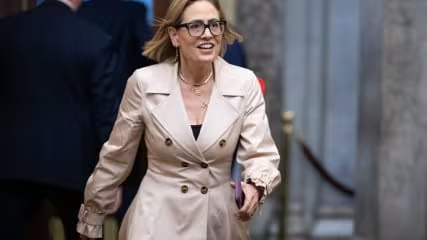
Former Arizona senator Kyrsten Sinema returned to Capitol Hill to urge her former colleagues to support the permitting bill; she co-chairs the AI Infrastructure Coalition, a group of tech companies advocating for data centers.
A spokesperson for the AI Infrastructure Coalition said Sinema was 'not doing any work on behalf of us.'
A spokesperson for Sinema said she stepped in at the request of former colleagues, is not helping on behalf of any person, and has no client or compensation.
Dylan Hedtler-Gaudette of the Project on Government Oversight said that while Sinema may just be passionate about permitting reform, he suspects she probably has a vested interest in the bill for a client or someone else.
Senators Sheldon Whitehouse and Martin Heinrich posted a video on X on the night of November 18 defending the bill after Democratic support eroded and left its backers six votes from losing the 60 needed for passage.
Republican leaders blocked a floor vote on Ron Wyden's amendment to ban data centers on federal land, stalling progress on the bill for most of November 19.
New peer-reviewed research from Harvard researchers found the 400 largest US data centers emit 25.7 million metric tons of carbon dioxide a year, two to three times previous estimates.
The bill would have the Federal Energy Regulatory Commission write new rules ensuring all data centers, new and old, are charged for grid upgrades they require and for their use of the existing grid.
Senator Sheldon Whitehouse said in the video, "I don't know that there are two Senators who care more about protecting the environment than we do," and that the bill 'produces gigaton-scale carbon emissions reduction.'
Senator Martin Heinrich maintains the bill does nothing to make it easier to site data centers, on or off federal land.
Senator Ron Wyden wrote on X that the bill achieves "Mike Lee's fever dream of giving away your public lands to tech giants."
Retired federal judge David Tatel wrote that the bill would reduce the National Environmental Policy Act to 'a mere husk.'
Michele Nellenbach of the Data Center Coalition said data centers can play a critical role in advancing affordability, create well-paying jobs, generate substantial tax revenue, and deliver significant economic investment to local communities.
Meg Slattery of Earthjustice said the bill does not address on-site generation and that the models of its emissions impacts do not account for behind-the-meter generation.
Senator Alan Armstrong of Oklahoma, a former chief executive of Williams Cos., cited the bill's potential to spur data center development as a selling point.
Senator Sheldon Whitehouse told doubters to 'Grab the bird in the hand,' saying if there are things to improve there is the next Congress.
The bill moved to the House of Representatives, where a vote is expected in the week beginning November 30, 2026.
Food & Water Watch said Chuck Schumer's vote to advance the 'terrible pro-polluter, pro-data center' bill over a majority of his own caucus is all the reason needed to demand he step down as leader of the Senate Democrats.
Senator Jeff Merkley said the bill strikes down tools states have when they decide they do not want a data center because it threatens key clean air or clean water issues.
Rhodium Group modeling projects the bill could increase natural gas exports an additional 8 to 15 percent, with a buildout of new gas pipelines mostly oriented to exports.
The bill would make it harder for states and tribes to modify or reject certain pipeline permits, restrict legal challenges, and make it much harder for a future administration to pause approving new gas exports.
The bill would allow companies to sue the government if agencies modified or revoked permits, requiring the agency to show by clear and convincing evidence that its action was warranted, with penalties that could reach 100 percent of reasonably expected construction or operating costs.
Ben King of the Rhodium Group said the biggest winner among fossil fuels would be LNG, with new pipelines oriented to exports.
Mariam Al-Shamma of the Bipartisan Policy Center said a lack of new interstate pipelines has been one of the few constraints on LNG growth, and that the project uncertainty the bill targets is real.
Jeremy Symons of the Center for Energy & Environmental Analysis called the bill's project certainty provisions the worst he has seen in 20 years of following environmental legislation, 'a blank check to industry.'
An analysis by Public Citizen argued the bill could erect significant hurdles to a future administration modifying LNG permits that current law allows.
The bill's four main champions, Senators Shelley Moore Capito, Mike Lee, Martin Heinrich and Sheldon Whitehouse, released a detailed set of amendments designed to bolster support for the legislation.
President Trump called the Senate bill 'a BIG WIN for U.S. ENERGY INDEPENDENCE and DOMINANCE' and wrote that it will ensure the United States can build pipelines, mines and power plants more quickly, 'lowering Energy Costs for American Families.'
Senator Maria Cantwell said the bill has been rushed, its impacts are not fully considered, and it would undermine tribal nations and weaken protections for the nation's bodies of water, land and wildlife.
Oneida Nation Vice Chairman Jameson Wilson said the bill threatens the tribe's ability to protect its sacred spaces, ancestors, traditional ceremonies and culture, and that any effort to accelerate development must strengthen, not erode, tribal sovereignty.
Former Energy Secretary Jennifer Granholm said the sponsors' recent changes strengthen protections for tribal consultation and restore important state authority over water quality, and urged lawmakers to take the opportunity.
Environmental Integrity Project executive director Jen Duggan said the 'backroom deal' will pave the way for more fossil fuel projects while sacrificing public health and environmental protections, calling it a gift to some of the biggest polluters in America.
Senator John Barrasso said it takes too long and costs too much to build in America and that projects remain frozen for years in the 'regulatory penalty box.'
Senator Sheldon Whitehouse called the bill 'the floor, not the ceiling, of our climate and environmental aspirations.'
Senator Jeff Merkley said getting more renewable electrons where they are needed does not tackle climate change if more fossil fuel burning is promoted at the same time.
The bill would exempt certain projects, such as expansions of pipelines or power lines along existing routes, from National Environmental Policy Act reviews.
The bill includes provisions aimed at preventing presidents from rescinding permits for already approved developments or blocking projects they do not like.
The bill would push utilities to plan more long-distance power lines and give the federal government greater authority to site transmission across state lines.
Senator Ruben Gallego said he was frustrated the bill could have been much better and that a political calculation by some colleagues aimed to prevent any improvements so it 'would fail in the House.'
Senator Jeff Merkley called the bill's speedy march to passage 'an outrageous abuse of democracy.'
Senator Sheldon Whitehouse said in the month before publication that 'the American people spoke loud and clear that they wanted results on affordability' and that the bill is 'something we can grab now, and that will pay dividends soon in lower energy rates.'
Senator John Barrasso forecast the bill would get the votes in the House and be signed by President Trump.
Senator Shelley Moore Capito said critical investments in the nation's infrastructure, energy production and economy have for too long been forced to sit on the sidelines due to endless red tape, duplicative reviews and regulatory uncertainty.
Senator Sheldon Whitehouse said Democrats are focused on lowering energy costs, reducing emissions, and stopping data centers' free ride, and that Americans will start to get some relief quickly if the bill passes.
Senate Majority Leader John Thune said the clearest path to making the bill law is for the House to take up the Senate measure and pass it, though he could not predict what would happen if the House changed it and sent it back.
House Majority Leader Steve Scalise said the House wants to see a bill pass both chambers, that the details matter, and that a permitting bill still has a great chance of reaching President Trump's desk.
The Bipartisan Policy Center said the bill would require new data centers of 20 megawatts or more to pay the full incremental cost of the infrastructure built to serve them.
Senator John Barrasso lauded the bill's streamlining of environmental and judicial reviews and limits on lawsuits as common-sense reforms.
Senator Jeff Merkley said ahead of the vote, 'Embedded in this bill is a fundamental question about the direction we go regarding our responsibilities to this planet,' and forecast the bill would 'open another floodgate for carbon that we won't ever be able to reverse.'
Representative Jared Huffman argued in a social media post that the Trump administration could use the bill to approve fossil fuel projects while continuing to slow-walk renewable energy projects.
Senate Majority Leader John Thune said, 'The best way to get anything done around here is for them to pick up the bill and pass it,' noting the bill has been through the full legislating process.
Senator Jeff Merkley objected on the Senate floor on the night of November 19 to proceeding to amendment votes unless the Senate took a vote on an amendment to ban data centers on public lands.
House Speaker Mike Johnson said on November 18 he would try to pass the permitting bill under suspension, a fast-track procedure requiring a two-thirds majority and barring floor amendments, and if that fails, under a standard rules procedure requiring a simple majority.
Speaker Mike Johnson said there is a lot of interest on the Republican side to get permitting reform done and that it is bipartisan.
Representative Debbie Dingell said the bill puts her in a difficult place because she has a 100 percent labor voting record but her husband wrote the National Environmental Policy Act and the clean water and endangered species laws, and there are things that need protecting.
Hakeem Jeffries has said Congress certainly needs to get permitting reform done but has not backed away from his position that the legislation falls short and needs changes to its National Environmental Policy Act and tribal provisions.
The Rhodium Group estimated the bill would allow an additional 17 to 249 gigawatts of clean energy to be built by 2040 and reduce greenhouse gases by 5 to 148 million metric tons annually in 2040.
Senator Martin Heinrich said in a statement that no big bipartisan bill will be perfect for everyone but that there is a real opportunity to make electricity more affordable for families, and that working people cannot afford to wait another few years.
The American Petroleum Institute called the bill 'a major breakthrough on historic permitting reforms' that would deliver more affordable energy for consumers, cut costly delays, and build much-needed critical infrastructure.
The American Clean Power Association called the bill a clean energy bill that will modernize America's energy systems and lower consumer prices.
Senator Ron Wyden told reporters he will not sit around and let data centers scar the nation's treasures.
Representative Scott Peters said the bill lowers bills, cuts pollution and protects ratepayers, and urged Congress to pass it before the end of the current Congress.
Representative Jared Huffman urged Democrats to say no to the bill, saying people should not believe the lie that it is the last, best and only chance for permitting reform and that 'We can produce a better deal.'
Senator Ruben Gallego told reporters the legislation will make the biggest difference for the next 100 years, especially in bringing down carbon emissions once President Trump is gone.
Seventeen Democratic state attorneys general wrote a letter seeking revisions to the bill to protect laws they say it could weaken, such as the National Environmental Policy Act and the Clean Water Act.
Senate Majority Leader John Thune said the bill cuts through decades of red tape and is estimated to save the average household hundreds of dollars each year.
Senator Jeff Merkley said the bill would 'put the pedal to the floor' on data center development while running roughshod over the sovereignty of Native American tribes.
Senator Sheldon Whitehouse called the bill a big step forward in the fight against climate change, citing 1.5 gigatons of emissions it would lower through 2040, the same as taking nearly 35 million gas-powered cars off the road.
Oil Change International called the bill a 'fossil fuel giveaway.'
Mark Ruffalo said Senate Democrats were on the verge of handing Trump Republicans and the fossil fuel industry a major legislative win by passing a bill that would fast-track AI data centers, pipelines, mines, power plants and ICE camps, calling it the most severe and devastating rollback of environmental laws in American history.
Naomi Klein said in a video that the bill is a major giveaway to data centers, big tech and the fossil fuels that power it, and that Senate Democrats were using their remaining lame-duck power to push through the opposite of what voters had just overwhelmingly voted for.
The host said the bill would gut foundational environmental protections, including the Clean Water Act, the National Environmental Policy Act and tribal review, and take away states' authority over projects like fracked-gas pipelines, ICE camps and data centers.
The host claimed Chuck Schumer has a conflict of interest because his daughter works for OpenAI, and claimed Sheldon Whitehouse owns millions of dollars in AI stock and is personally enriching himself off the bill.
Senator Andy Kim of New Jersey, who had supported advancing the bill in earlier procedural votes, switched his vote to no on final passage.
Senator Andy Kim said he voted earlier in the process to allow a debate and amendment process that could improve the bill, but that the improvements which would rein in the worst impulses of the Trump administration were not made and the potential consequences for New Jersey are unacceptable.
Erich Pica, president of Friends of the Earth US, said senators who voted for the bill should be ashamed, calling it a giant giveaway to Big Tech and polluters and a reckless attack on clean air, clean water, wildlife, public lands, oceans, and communities.
David Watkins of the Union of Concerned Scientists said the bill identified the wrong problems and arrived at the wrong solutions, and that the House should reject it and negotiate a better bill in the new Congress in January.
Senator Jeff Merkley called the bill's passage without a Senate hearing 'pretty damn outrageous and offensive.'
Protesters demonstrated against the bill at the U.S. Capitol in the week of the Senate's vote.
The House, on Thanksgiving recess after the Senate's vote, is scheduled to return on Monday, November 30, 2026.
Senator Alex Padilla said he voted no because the bill threatens tribal sovereignty, could allow the destruction of ancestral lands, sacred places and cultural resources without adequate legal recourse, and relies on assurances from President Trump, who weeks earlier said he would not approve any wind projects.
The National Congress of American Indians has repeatedly called for the withdrawal of the bill's Division B, Title III, arguing it fails to adequately protect tribal sovereignty and the government-to-government relationship between the United States and Tribal Nations.
Senator Shelley Moore Capito said the Senate's passage of permitting reform finally became reality and is a major step toward addressing the affordability concerns of the American people.
Senator Jeff Merkley wrote on X that the bill is 'a bad deal' that opens the gates to a flood of natural gas for data centers while leaving expanded transmission of renewable energy subject to Trump's obstruction.
Senator Mike Lee said, "We are going to make it easier to build in America again and make life more affordable for American families."
The bill extends how long water quality permits last before they must be renewed, adds hurdles to the Environmental Protection Agency's ability to set water quality criteria, and changes the Endangered Species Act's definition of 'best available science.'
Senator Angus King said his vote was not an easy choice but that on balance the bill is a lot better than the status quo and unlocks an enormous amount of renewable energy unable to reach the market because of a lack of transmission.
Senator Martin Heinrich said the bill would get more affordable energy onto the grid faster, make data centers pay their fair share of electricity and grid costs, and create more than 100,000 good-paying American jobs while maintaining important environmental protections and strengthening tribal consultation.
House Majority Leader Steve Scalise endorsed the Senate-passed permitting package on November 20, calling it more important now than ever to send the bill to President Trump's desk.
Representative Brian Fitzpatrick said the House Problem Solvers Caucus is reviewing the Senate legislation with an eye toward possibly endorsing it.
Steve Scalise wrote in a social media post that the Senate took important action by passing permitting reform, that the legislation will cut red tape, create jobs and lower costs for families, and that "Now is the time to finish the job."
Brian Fitzpatrick said the caucus must flag any member, district, tribal or environmental issues before deciding whether to endorse the bill.
Representative Melanie Stansbury called the bill a bad bill at a bad time that does bad things, and said it is opposed by every major environmental organization, by tribes and tribal leaders, by civil rights groups including the NAACP and the ACLU, by every member of New Mexico's House delegation, by the state's attorney general, and by the environmental caucuses in the state legislature.
Stansbury said changes made to the bill stripped out some of its transmission benefits and that the next few days will be critical as it comes to the House.
Stansbury urged viewers to call their members of Congress, and said a better deal can be reached next Congress, when her side will hold majorities in both chambers, and that she will demand the bill's good provisions get done in the first 100 days of the next Congress.
Critics warned the bill could clear the way for President Trump's triumphal arch near Arlington National Cemetery and a new championship-level golf course in Washington, because its provisions would prevent judges from halting projects for violating the National Environmental Policy Act and the National Historic Preservation Act, even projects with nothing to do with energy.
Greg Werkheiser, founding partner of Cultural Heritage Partners, sent a letter to the top House Democrat laying out ten consequences of the bill he called terrible.
Werkheiser said in the letter that the bill would eliminate the public comment process for projects affecting historic sites, and told an interviewer that under the bill "if you want to put a Walmart literally right next door to Gettysburg Battlefield, you can do it."
Representative Jared Huffman said several pending lawsuits against President Trump's projects have court orders enjoining parts of them, and that the bill as written would wipe away the critical tools, including injunctive relief, used to stop what he called the president's vanity projects.
President Trump praised the bill, calling it "one of the biggest things that you'll see" and saying it would cause "tremendous amounts of new building."
Vice President JD Vance called the bill an amazing bipartisan piece of legislation that will allow the United States to build like never before, with more homes, more factories and more power plants.
Senator Lisa Murkowski spent weeks negotiating changes with the bill's authors to address tribal concerns, but because Jeff Merkley and Ron Wyden blocked all amendments, her negotiated language never made it into the bill, though she voted for it anyway.
Potential 2028 Democratic presidential contenders split on the bill, with Senators Jon Ossoff and Raphael Warnock voting against it and Senators Elissa Slotkin and Ruben Gallego backing it.
Senator Sheldon Whitehouse called the idea that the bill benefits data centers 'bullshit,' saying it is actually a pretty good limit on data centers and the first bill to take away their ability to freeload on the public.
Senator Lisa Murkowski said the day after the vote that senators had a bipartisan agreement that would have made the legislation better for tribes, that ninety-eight members agreed and two blocked it, and that she will continue working with tribes to advance the additional protections into law.
Senator Ruben Gallego accused Senator Jeff Merkley of attempted sabotage, writing that a Senate Democrat was objecting to a largely Democratic amendment that would have improved the bill significantly in the hopes it would die in the House.
Representative Alexandria Ocasio-Cortez said she believes a bill negotiated under a Republican trifecta is inferior to one negotiated between the president and a Democratic House and Senate, and does not buy the argument that this is Democrats' only chance.
Representative Ro Khanna said the bill's data center cost provisions are not good enough because data centers would still benefit like other enterprises from improved electrical and gas transmission.
In a November 8 statement, the National Congress of American Indians, the Native American Rights Fund and other tribal rights groups said tinkering with the bill's harmful provisions does not resolve their fundamental flaws or the cumulative impact on tribal cultural heritage.
Senate Amendment 6883 on November 10 struck all after the enacting clause of H.R. 2347 and inserted the bill's text, replacing everything in the survivors' tax bill while keeping the survivor tax section at the end as Division C.
The bill's official title still reads as a tax bill excluding damages received on account of sexual acts from gross income even though the survivor provisions are the last six of the bill's 488 pages, and the Senate never voted to change it.
From November 16 to November 18 the Senate cleared every 60-vote hurdle on the bill; senators filed 173 amendments, but the only ones offered on the floor came from Majority Leader John Thune, filling every open slot so no other senator could get a vote without his consent.
On November 18 the Senate voted 70-26 to waive a budget objection and 69-27 to adopt the bill's text, and 14 Democrats and Independent Angus King joined 50 Republicans to cut off debate.
Senators Jon Ossoff, Gary Peters and Jeanne Shaheen voted to adopt the text on November 18 but then voted against cutting off debate, while Senator Tina Smith voted no on all three November 18 votes and on final passage.
Right after final passage, Democratic senators tried to add a package of changes including data center protections, and objections blocked both.
Because the Senate replaced the whole text of H.R. 2347, the House must vote again; if it passes the bill as is it goes straight to President Trump, and if it changes anything, even the title, the bill returns to the Senate where any single senator can hold it up.
Senator Sheldon Whitehouse acknowledged on the Senate floor on November 20 'considerable dispute about this bill on our side of the aisle' and said Democrats' new majorities could fix problems later.
Lead sponsor Shelley Moore Capito asked the House on November 20 to act quickly and send the bill to President Trump's desk without delay.
The bill would require federal agencies to decide whether to approve a project within 45 days of an environmental review and issue other authorizations within 120 days.
The bill would let developers sue the government and recoup certain costs if there is a pattern of 'disparate treatment' against a specific type of energy source, and is expected to prevent the Trump administration from revoking existing wind farm permits, including offshore.
Gene Grace of the American Clean Power Association said agencies would be compelled to move between stages on timelines with judicial enforcement, though the administration could still deny a permit at a decision point with a required level of evidence.
Xan Fishman of the Bipartisan Policy Center said the bill's project certainty provisions mitigate risks for investors, lowering financing and construction costs and getting more projects going forward.
Representative Scott Peters said anyone concerned about Trump jerking around wind and solar should be more comfortable with the bill and Trump than without the legislation, calling President Trump a two-year problem against a 30- or 40-year transmission and infrastructure challenge.
Nat Keohane of the Center for Climate and Energy Solutions said the bill's purpose is to get politics out of permitting and that he has confidence the administration will follow through on its provisions.
White House spokesperson Taylor Rogers said President Trump is delivering on his American energy dominance agenda by fixing America's broken permitting system, and that the bill will cut red tape, lower energy costs and create high-paying jobs.
President Trump told reporters of the Senate's passage, "They had to get it through," reiterating that he supports the bill 100 percent.
In the House, corporate Democrats including Representatives Jared Golden, Nikki Budzinski, Scott Peters and George Whitesides argued permitting reform should happen now, while progressives including Alexandria Ocasio-Cortez, Adelita Grijalva, Ro Khanna, Summer Lee and Rashida Tlaib, along with Jared Huffman, Melanie Stansbury and Mike Levin, opposed the bill as written.
House Speaker-designate Hakeem Jeffries said he is undecided on the bill, stating that the legislation "falls short" and needs to be reworked before he can support it.
American Petroleum Institute president and CEO Mike Sommers said that if the United States is going to build more, produce more and pay less, that means passing the historic permitting bill the Senate passed.
Senator Sheldon Whitehouse, who urged House Democrats to support the bill, called it a strong, bipartisan whack against an industry run amok and said Democrats should not deny Americans the data center accountability they have demanded over ghost stories being told to deliberately mislead people.
Natural Resources Defense Council senior attorney John Walke said the bill enables Trump rollbacks and eliminates bedrock environmental safeguards, and that that is not accountability.
Representative Mike Levin said the bill would limit California's ability to protect its own water, weaken the science behind endangered species decisions, keep courts from halting projects when agencies skip required reviews, and make the Trump administration's fossil fuel approvals, offshore leases included, extremely hard for a future president or a judge to undo.
Levin said there is still time to get the bill right, and that if House and Senate leaders from both parties negotiate sufficient changes, he will be ready to vote yes.
Nevada's two Democratic senators split on the bill, with Catherine Cortez Masto voting no on final passage and Jacky Rosen voting yes.
Jacky Rosen tried to remove the sections of the bill reforming the National Historic Preservation Act but was unsuccessful.
Catherine Cortez Masto said in a statement she voted no because the bill contains harmful changes to the National Historic Preservation Act that undermine tribal sovereignty and fail to protect government-to-government tribal consultation, adding there is no reason to threaten tribal sovereignty to accomplish permitting reform.
Jacky Rosen said the bill would benefit Nevada's clean energy projects and bring jobs to the state, and that she fought to strengthen the bill but Senate Republicans refused to accept any changes, so she believed the opportunity to lower energy costs for Nevada families could not be squandered.
Patrick Donnelly of the Center for Biological Diversity said the bill would mean more development, data centers and polluting industry on public lands, with protections for clean air, water and wildlife stripped away across the board.
Representative Dina Titus said she is still considering the bill before taking a position.
More than 100 climate scientists and scholars signed an open letter on November 24 urging the House of Representatives to vote no on the bill, saying it would slow the transition to net zero by prolonging the fossil fuel era and locking in future emissions.
The scientists wrote in the open letter, "We understand the need for trade-offs and compromise when passing bipartisan legislation," but "as scientists we feel strongly that the costs of this bill to the climate are too high."
The signatories include Michael Mann, Michael Oppenheimer, Robert Brulle, Raymond T. Pierrehumbert, Jennifer Francis, Daniel Kammen and Robert Howarth, researchers whose work Whitehouse has cited in his 'Time to Wake Up' floor speeches.
The scientists said the Rhodium Group analysis is flawed because it leaves out how the bill's changes to environmental laws could increase pollution, and pointed instead to Kevin Kircher's modeling finding the bill would likely increase US greenhouse gas emissions and deaths from fossil fuel air pollution.
Senator Sheldon Whitehouse said he has great respect for the climate scientists and is sorry to disagree with them, pointing to gigaton-scale emissions reductions, freed-up clean power, $10 billion in annual consumer electricity savings, and the $35 billion whack at data centers.
Michael Mann said Whitehouse has long been one of his heroes and that nothing pains him more than to find him not only supporting the bill but one of its principal backers.
Robert Brulle said Whitehouse's support for the bill makes him question Whitehouse's leadership and commitment to dealing with climate change, and gave as his professional opinion that pushing the bill through a lame duck Congress without hearings was designed to conceal from the public what is really in it.
Michael Mann said the claim that the bill will accelerate the energy transition relies on the rosiest of scenarios and neglects the loopholes bad actors including the Trump administration have at their disposal.
Capstone DC vice president Charlotte Jenkins pegged the bill's chance of passage during the lame duck session at 30 percent.
A growing number of Republicans who nominally support the bill have already left Washington after losing reelection.
Representative Jared Huffman called the bill 'the most sweeping rollback of environmental laws' ever.
Charlotte Jenkins said Speaker Mike Johnson's strategy for pushing the bill through relies on a procedural maneuver that requires a two-thirds majority to succeed.
Republican strategist Liam Donovan wrote that the only hope is for the bill's supporters to 'go full bounty hunter' in dragging GOP representatives back to Washington to vote.
Michael Mann urged Democrats, who take control of Congress in January, to scrap the bill, put a sensible, popular data center bill on President Trump's desk, force him to veto it, and force Republicans to defend sustaining that veto.
Timmons Roberts of Brown University said the bill is 'very worrisome,' has felt very rushed, and carries grave potential for damage, adding that in some ways opponents feel held hostage because wanting more renewables also means accepting the lock-in of fossil fuels.
House Republican leaders plan to hold a vote on the bill the week of November 30, 2026, under a simple-majority threshold, with a rule adopted on the floor before the vote.
Representative Sean Casten of Illinois announced his opposition to the bill on November 23 and is circulating a letter asking Speaker Mike Johnson to allow an open amendment process.
Sean Casten said if the open amendment push fails, the need for permitting reform will not go away and Congress will take it up in the 120th Congress.
The bill's Senate negotiators, Mike Lee, Martin Heinrich, Shelley Moore Capito and Sheldon Whitehouse, have warned that changes to the bill's text in the House could complicate its prospects.
Shelley Moore Capito said after Senate passage that she would not shut the door on the bill undergoing changes but does not think that is the preferable route.