Senate passes permitting bill 62-33 as Murkowski pledges push for tribal changes
'Bullshit': The Very Wonky Bill That Sparked A Brawl Among Democrats
huffpost.com· 14h
It’s a Bill on Energy Permits, but Trump’s Pet Projects Are Part of the Debate
nytimes.com· 24h
Rep. Stansbury: BAAJA Has Passed the Senate. Now What?
youtube.com· 24h
15 Democrats Join GOP to Pass Big Oil-Backed Permitting Bill in the Senate
truthout.org· 32h
Scalise backs Senate-passed permitting bill
politico.com· 32h
These 14 Democratic senators voted to loosen environmental laws to speed up energy build-out
thehill.com· 32h
US Senate passes bill to speed up energy project approvals
aljazeera.com· 33h
Senate passes bipartisan energy bill amid environmental concerns
npr.org· 38h
Despite Strong Tribal Opposition, U.S. Senate Approves BAAJA in Late-Night Vote
nativenewsonline.net· 38h
15 Senate Democrats Help Republicans Pass 'Giant Giveaway to Big Tech and Polluters' | Common Dreams
commondreams.org· 39h
FAFO for Dems now?
Senate OKs bill to speed energy projects, make data centers pay their way
usatoday.com· 45h
Senate passes BAAJA permitting reform bill backed by AI, energy sectors
cnbc.com· 45h
Senate passes BAAJA permitting reform bill backed by AI, energy sectors
Senate votes to weaken environmental laws to speed up energy projects
washingtonpost.com· 45h
Senate passes landmark permitting deal
Senate passes bipartisan permitting reform bill designed to boost energy projects
cbsnews.com· 46h
Senate passes sweeping bill simplifying permitting rules to build in America
nbcnews.com· 46h
Senate Passes Major Permitting Bill to Speed Up Energy Projects
Senate backs bill to speed up permitting reviews, force data centers to pay for energy costs
apnews.com· 47h
Senate Passes Permitting Reform Bill with Support of 14 Democrats, Including Leader Chuck Schumer
democracynow.org
Senate standoff threatens permitting deal’s bipartisan support
BAAJA passes another procedural vote
Senate Permitting Bill Authors Seek Data Center Exemption
bloomberg.com· 3d
21 Dem Senators Join GOP to Move Forward Bill to Speed Up Data Center Permits
We can do better. We should not pass this permitting bill. Join me live on the Senate floor.
Senate takes big step toward passing permitting reform package
Many liberals hate this bill to overhaul permitting. Democrats may help pass it anyway.
Urgent: The Bipartisan Effort to Quietly Erode Environmental and Tribal Protections - Natural Causes | iHeart
iheart.com
Senate votes to advance bipartisan permitting reform bill
ACLU warns permitting bill could give way to ICE detention centers
Jeffries opposes Senate permitting deal, demands more House input
The Senate passed the Bipartisan American Affordability and Jobs Act, a bipartisan energy permitting bill, 62 to 33 on November 19, 2026, sending it to the House.
The bill shortens federal environmental reviews, limits lawsuits against energy projects, expands federal transmission authority, and requires large data centers to pay grid upgrade costs.
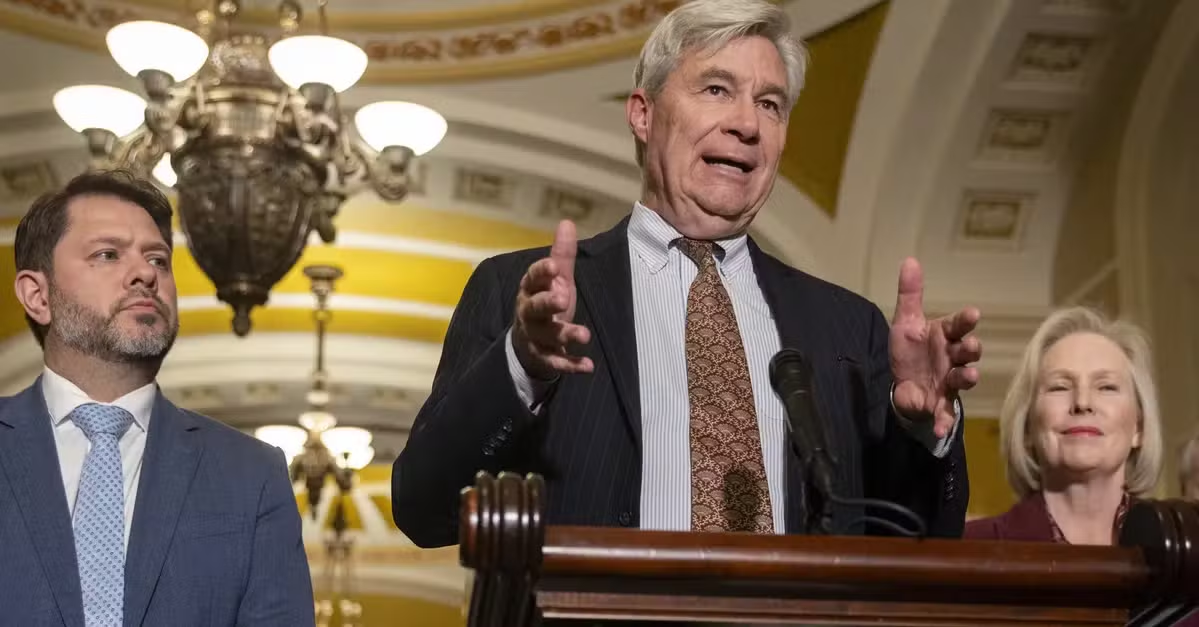
Sens. Shelley Moore Capito, Mike Lee, Sheldon Whitehouse, and Martin Heinrich negotiated the bill, which passed without ever receiving a Senate hearing.
Fifteen Democrats including Chuck Schumer backed it, while most Democrats, environmental groups, and tribal nations opposed it over weakened environmental and tribal protections.
The bill now faces an uncertain House vote, with Speaker Mike Johnson planning to try a fast-track procedure requiring two-thirds support before Democrats take both chambers in January.
A spokesperson for House Minority Leader Hakeem Jeffries said the Senate bill 'falls short in several areas' and that Jeffries 'will not rubber-stamp legislation that emerges from the Senate without more constructive involvement' with House Democrats.
The American Civil Liberties Union warned in a memo that the bill as written would allow ICE to move ahead with massive, irreversible detention projects with no meaningful legal recourse.
A spokesperson for Sen. Sheldon Whitehouse rejected the argument that the bill would make it easier to build ICE detention centers, saying no plausible reading of its National Environmental Policy Act provisions would exclude them from review.
The Senate voted 73 to 25 on November 9, 2026 to proceed to consideration of the bipartisan permitting reform bill, with nearly all Republicans and more than a dozen Democrats in favor.
Sen. Catherine Cortez Masto voted to proceed on November 9 but said she would not support final passage unless the bill's tribal nations provision was removed.
Sens. Shelley Moore Capito, Mike Lee, Sheldon Whitehouse, and Martin Heinrich announced their negotiated permitting reform deal at a press conference at the U.S. Capitol on September 30, 2026.
The Senate voted 70 to 27 on November 16, 2026 to end debate on a managers' amendment sponsored by Sen. Shelley Moore Capito that strengthened the bill's provisions on data centers and tribal sovereignty.
Rep. Adelita Grijalva said Congress should not be rushing to pass a bill that gives President Trump even more unilateral authority to bypass the nation's laws.
President Trump told reporters, 'We're behind it 100 percent,' while vowing, 'I will not approve wind turbines. Wind turbines are a major loser.'
Sen. Ed Markey delivered a Senate floor speech on November 17, 2026 urging the Senate to reject the permitting bill, arguing it strips communities, states, and tribes of the power to stop unwanted projects.
Sen. Ed Markey said in a Senate floor speech that the bill rolls out the red carpet for data center developers and puts them on a greased slide into towns across America, urging a no vote.
Sen. Catherine Cortez Masto of Nevada voted against the November 16 cloture motion after earlier voting to advance the bill, saying she would oppose final passage unless its changes to the National Historic Preservation Act were removed.
Elizabeth Bast, executive director of Oil Change International, said the senators who voted to advance the bill betrayed voters who turned out to demand Congress rein in data center development and bring down electricity costs.
The bill's authors proposed an amendment on November 18 that would exempt data centers primarily providing internet, cable, telecommunications, or other communications services from the bill's requirement to pay for power grid upgrades.
The Senate advanced the Bipartisan American Affordability and Jobs Act 65 to 31 in a procedural cloture vote on November 18, 2026.
On November 18, Sens. Jeff Merkley and Ron Wyden of Oregon withheld consent for a time agreement needed to proceed to 19 amendment votes on the permitting bill, threatening its final passage.
Food & Water Watch said Senator Chuck Schumer's vote with Republicans over a majority of his own caucus is reason enough to demand he step down as leader of the Senate Democrats.
Former Energy Secretary Jennifer Granholm said the bill sponsors' recent changes strengthen tribal consultation and restore state authority over water quality, and urged lawmakers to take the opportunity.
Oneida Nation Vice Chairman Jameson Wilson said the bill threatens the tribe's ability to protect its sacred spaces, ancestors, traditional ceremonies, and culture.
Sen. John Barrasso of Wyoming praised the bill's streamlining of environmental and judicial reviews and its limits on lawsuits as common-sense reforms.
During final passage on November 19, Sen. Jeff Merkley and Sen. Ron Wyden blocked all amendment votes, so the tribal protections Sen. Lisa Murkowski had negotiated with the bill's authors never came up, and the Senate moved straight to a final vote.
Sen. Josh Hawley of Missouri and Sen. Mike Rounds of South Dakota were the only Republicans to vote against the permitting bill, citing its expansion of federal authority over transmission.
Rep. Debbie Dingell said the bill puts her in a very difficult place because she has a 100 percent labor voting record but her husband wrote the National Environmental Policy Act and other laws that need protecting.
Rep. Scott Peters said the bill lowers bills, cuts pollution, and protects ratepayers, and that Congress should pass it before the end of the current Congress.
Rep. Jared Huffman urged Democrats to say no to the bill, saying, 'We can produce a better deal.'
Seventeen Democratic state attorneys general wrote a letter seeking revisions to the bill to protect laws they say it could weaken, including the National Environmental Policy Act and the Clean Water Act.
Sen. Jeff Merkley said the bill would 'put the pedal to the floor' on data center development while running roughshod over the sovereignty of Native American tribes.
Mark Ruffalo warned that Senate Democrats were on the verge of handing Trump Republicans and the fossil fuel industry a major legislative win that would be the most severe and devastating rollback of environmental laws in American history.
Naomi Klein said in a video that the bill is a major giveaway to data centers, big tech, and the fossil fuels that power them and that the only chance of stopping it is for people to flood the phones.
David Watkins of the Union of Concerned Scientists said the House should reject the bill and negotiate a better one in the new Congress in January.
Sen. Shelley Moore Capito said Senate passage of permitting reform finally became reality and is a major step toward addressing the affordability concerns of the American people.
Senate Majority Leader John Thune said the bill will cut through decades of red tape and save the average household hundreds of dollars each year.
Sen. Alex Padilla said he supports cutting red tape and getting more energy projects built but not at the expense of tribal sovereignty and California's environment.
President Trump called the bill 'a BIG WIN for U.S. ENERGY INDEPENDENCE and DOMINANCE' in a social media post urging its approval.
Sen. Mike Lee said, 'We are going to make it easier to build in America again and make life more affordable for American families.'
Jen Duggan, executive director of the Environmental Integrity Project, called the bill a backroom deal that will pave the way for more fossil fuel projects and a gift to some of the biggest polluters in America.
Sen. Maria Cantwell said after meeting with tribal leaders that the bill would undermine tribal nations' sovereignty and called for more time to consider and amend it.
Sen. Martin Heinrich said the bill will get more affordable energy onto the grid faster, make data centers pay their fair share of electricity and grid costs, and create more than 100,000 good-paying American jobs.
Sen. Angus King said his vote 'wasn't an easy choice' but that on balance the bill is a lot better than the status quo and unlocks renewable energy unable to reach the market.
Sen. Sheldon Whitehouse said 'Americans will quickly begin getting some relief on their energy bills if the House follows suit.'
House Speaker Mike Johnson said on November 18 that he would try to pass the permitting bill under a fast-track procedure requiring a two-thirds majority and, if that fails, under regular rules requiring a simple majority.
House Majority Leader Steve Scalise said the Senate took important action by passing permitting reform and wrote 'Now is the time to finish the job' in urging House passage.
The Senate passed the Bipartisan American Affordability and Jobs Act 62 to 33 on the night of November 19, 2026, with 15 Democrats and all but two Republicans in support, sending the bill to the House without it ever having received a Senate hearing.
Sen. Jeff Merkley called the bill's passage without a hearing 'pretty damn outrageous and offensive.'
Erich Pica, president of Friends of the Earth US, said senators who voted for the bill should be ashamed and called it a giant giveaway to Big Tech and polluters.
Sen. Andy Kim said he voted earlier to allow a debate and amendment process that could improve the bill, but the improvements were not made and the potential consequences for New Jersey are unacceptable.
The American Petroleum Institute applauded the Senate vote as 'a major breakthrough on historic permitting reforms' and praised lead sponsors including Sens. Sheldon Whitehouse and Mike Lee.
Rep. Melanie Stansbury called the bill a bad bill at a bad time and urged viewers to call their House members and oppose it in the critical days ahead.
President Donald Trump praised the bill's provisions on Friday, calling it 'one of the biggest things that you'll see' and saying it would cause 'tremendous amounts of new building.'
Vice President JD Vance called the bill 'an amazing bipartisan piece of legislation that will allow the United States to build like we've never built before.'
Rep. Jared Huffman said the bill as written wipes away critical tools, including injunctions under the National Environmental Policy Act and the National Historic Preservation Act, that have stopped President Trump's vanity projects.
The day after the Senate vote, Sen. Lisa Murkowski said in a statement that she supported the permitting bill and would keep working with tribes to advance the blocked negotiated protections into law as soon as possible.
Sen. Lisa Murkowski said in a statement the day after the vote that the bill is not perfect, that ninety-eight members agreed to changes better for Tribes and two blocked them, and that she is not giving up on the negotiated protections.
Sen. Sheldon Whitehouse called the idea that the bill benefits data centers 'bullshit' and said the bill is actually a pretty good limit on them.
Sen. Ruben Gallego accused Sen. Jeff Merkley of attempted sabotage, writing that a Senate Democrat was objecting to a largely Democratic amendment that would have improved the bill in the hopes that it dies in the House, adding the hashtag '#dirty'.
Rep. Alexandria Ocasio-Cortez said she really believes a bill negotiated under a Republican trifecta is inferior to one negotiated between the president and a Democratic Senate and House.
Rep. Ro Khanna said the bill's provisions forcing data centers to absorb costs are not good enough and that the bill would hurt people's water supply and cause noise and light pollution.